
You are sitting at home and suddenly the lights go off. You check the distribution board and see that one switch has tripped. You reset it, and everything works again. That small device protected your home from a serious electrical fault. That device is called an MCB.
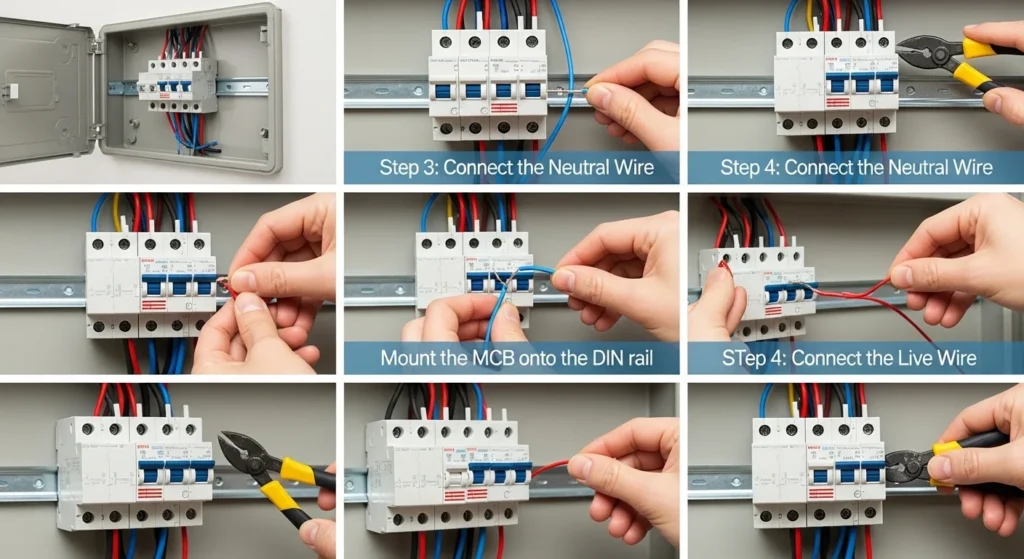
MCB Wiring in Home is one of the most important parts of any electrical installation. A properly wired MCB protects wiring, appliances, and even human life from short circuits and overloads. Poor wiring can cause fire, equipment damage, or electric shock.
In this complete guide, you will learn what MCB wiring in home means, its working principle, types, components, installation basics, advantages and disadvantages, applications, and troubleshooting. I will explain everything in simple language, just like a senior electrical engineer guiding a junior technician.
2. What is MCB Wiring in Home?
MCB Wiring in Home refers to the correct connection of a Miniature Circuit Breaker (MCB) in a residential electrical distribution board to protect electrical circuits.
An MCB is an automatic protective switch. It disconnects power when current exceeds safe limits.
Simple Explanation
Think of an MCB as a security guard. If too many people try to enter a room (overload) or if a fight breaks out (short circuit), the guard immediately closes the door. Similarly, the MCB cuts off electricity when current becomes dangerous.
Practical Example
If you connect too many heaters to one socket, the circuit current increases. The MCB detects this overload and trips. This prevents wire overheating and possible fire.
3. MCB Wiring in Home Working Principle
Understanding the MCB wiring in home working principle is very important for electrical students.
An MCB works on two main protection methods:
- Thermal protection (for overload)
- Magnetic protection (for short circuit)
Step-by-Step Working
- Normal Condition
- Current flows through the MCB.
- Internal contacts remain closed.
- Overload Condition
- Current increases slowly.
- A bimetallic strip inside the MCB heats up.
- The strip bends due to heat.
- It releases the trip mechanism.
- Circuit disconnects.
- Short Circuit Condition
- Current rises suddenly and sharply.
- Magnetic coil creates strong magnetic force.
- Instant tripping occurs.
- Power is disconnected immediately.
Easy Analogy
Thermal trip works like a metal spoon heating slowly in hot tea.
Magnetic trip works like a spring reacting instantly when pulled hard.
This dual protection makes MCB wiring in home very reliable.
4. Types / Classification of MCBs
MCBs are classified based on tripping characteristics and poles.
4.1 Based on Tripping Curve
Type B MCB
- Trips at 3–5 times rated current.
- Used in homes for lighting and socket circuits.
- Suitable for resistive loads.
Type C MCB
- Trips at 5–10 times rated current.
- Used for small motors and air conditioners.
- Common in residential and small commercial setups.
Type D MCB
- Trips at 10–20 times rated current.
- Used for heavy motors and transformers.
- Not common in normal homes.
4.2 Based on Number of Poles
Single Pole (SP)
- Protects phase only.
- Used in single-phase homes.
Double Pole (DP)
- Protects phase and neutral.
- Provides better safety.
Triple Pole (TP)
- Used in three-phase systems.
Four Pole (TPN)
- Used in three-phase with neutral.
5. Main Components of MCB
Understanding components helps in proper MCB wiring in home.
1. Toggle Switch
Manual ON/OFF control.
2. Bimetallic Strip
Provides overload protection.
3. Magnetic Coil
Provides short circuit protection.
4. Arc Chamber
Extinguishes electrical arc during tripping.
5. Contacts
Allow or stop current flow.
6. Terminal Connectors
Used to connect input and output wires.
Each part plays a critical role in protection and safe operation.
6. MCB Wiring in Home Advantages and Disadvantages
Advantages
- Automatic protection from overload
- Instant response to short circuit
- Reusable (no fuse replacement)
- Easy fault identification
- Compact size
- Improves electrical safety
- Reduces fire risk
Disadvantages / Limitations
- Higher cost than fuse
- Sensitive to improper wiring
- Wrong rating selection causes nuisance tripping
- Limited breaking capacity compared to MCCB
Despite limitations, MCB wiring in home remains the safest residential protection method.
7. Applications
MCB wiring in home applications are wide and essential.
In Homes
- Lighting circuits
- Socket circuits
- Air conditioners
- Water heaters
- Kitchen appliances
In Commercial Buildings
- Office lighting
- Small motor protection
- Distribution boards
In Modern Technology
- Solar distribution panels
- UPS systems
- Smart home systems
MCBs are standard protection devices in almost every modern building.
8. Comparison Section
Difference Between MCB and Fuse
| Feature | MCB | Fuse |
| Reusable | Yes | No |
| Operation | Automatic switch | Melting wire |
| Reset | Easy reset | Replace required |
| Cost | Higher | Lower |
| Safety | High | Moderate |
| Fault Response | Fast | Fast but destructive |
The difference between MCB and fuse clearly shows why MCB wiring in home is preferred today.
9. Selection Guide
Choosing the correct MCB is critical.
1. Check Load Current
Calculate total load in amperes.
2. Choose Correct Rating
Select slightly higher than operating current.
3. Select Correct Type
- Type B for home lighting
- Type C for motor loads
4. Check Breaking Capacity
Typical homes use 6kA or 10kA MCB.
5. Choose Pole Type
SP for basic circuits
DP for higher safety
Beginner Tip
Never oversize MCB. A higher rating reduces protection effectiveness.
10. Common Problems & Solutions (FAQs)
Q1: Why does my MCB trip frequently?
Possible causes:
- Overload
- Short circuit
- Loose wiring
- Faulty appliance
Solution:
Disconnect loads one by one and identify faulty equipment.
Q2: MCB not resetting?
- Internal damage
- Severe short circuit
- Burnt contacts
Solution:
Replace MCB.
Q3: Is neutral required in MCB wiring?
In SP MCB, neutral is separate.
In DP MCB, both phase and neutral are controlled.
Q4: Can I use higher amp MCB to stop tripping?
No.
This is dangerous and can cause fire.
11. Future Trends
Electrical protection is evolving.
Smart MCBs
- Remote monitoring
- Mobile app control
- Energy usage tracking
IoT Integration
Smart homes now use intelligent protection systems.
Arc Fault Protection
Advanced breakers detect arc faults before fire starts.
The future of MCB wiring in home includes digital monitoring and smarter protection systems.
12. Conclusion
MCB Wiring in Home is not just about connecting wires. It is about safety, protection, and reliability. A properly selected and correctly wired MCB protects people, wiring, and appliances from overload and short circuit faults.
We discussed the MCB working principle, types, components, applications, and the difference between MCB and fuse. We also covered selection tips and troubleshooting.
As an electrical student or technician, always focus on correct rating, proper wiring, and safety standards. Never compromise on protection devices. A small breaker can prevent a big disaster.
Keep learning, keep practicing, and always prioritize safety in every installation.