
Imagine entering a room on a very hot summer day. The temperature outside is above 40°C, and the room feels uncomfortable. When you turn on a traditional air conditioner, it starts cooling the room quickly. However, after some time, the compressor repeatedly turns ON and OFF to maintain the temperature. This frequent switching consumes more electricity and creates noticeable noise.
This is where the Inverter Air Conditioner becomes important. Modern inverter AC technology solves many problems found in conventional air conditioning systems. Instead of turning the compressor fully ON and OFF, it adjusts the compressor speed according to the cooling demand. This results in better comfort, improved energy efficiency, and lower electricity bills.
For electrical students, engineers, and technicians, understanding inverter AC technology is very valuable. It combines electrical drives, power electronics, and refrigeration systems in one device.
In this article, you will learn the Inverter air conditioner working principle, types, components, advantages, disadvantages, applications, and the difference between inverter AC and non-inverter AC. By the end, you will have a clear technical understanding of how inverter air conditioners work and why they are widely used today.
2. What is an Inverter Air Conditioner?
An Inverter Air Conditioner is a modern air conditioning system that uses variable-speed compressor technology to control cooling capacity.
In a traditional AC system, the compressor operates in only two states:
- Fully ON
- Completely OFF
However, an inverter AC changes the speed of the compressor motor according to the cooling requirement.
Simple Explanation
Instead of stopping and starting repeatedly, the compressor runs continuously but at different speeds. When the room is hot, it runs faster. When the room reaches the desired temperature, it slows down.
Practical Example
Think about driving a car:
- A normal AC is like a car that accelerates and stops repeatedly.
- An inverter AC is like a car that adjusts its speed smoothly depending on traffic.
Because of this smooth control, inverter air conditioners save energy and provide stable cooling.
3. Inverter Air Conditioner Working Principle
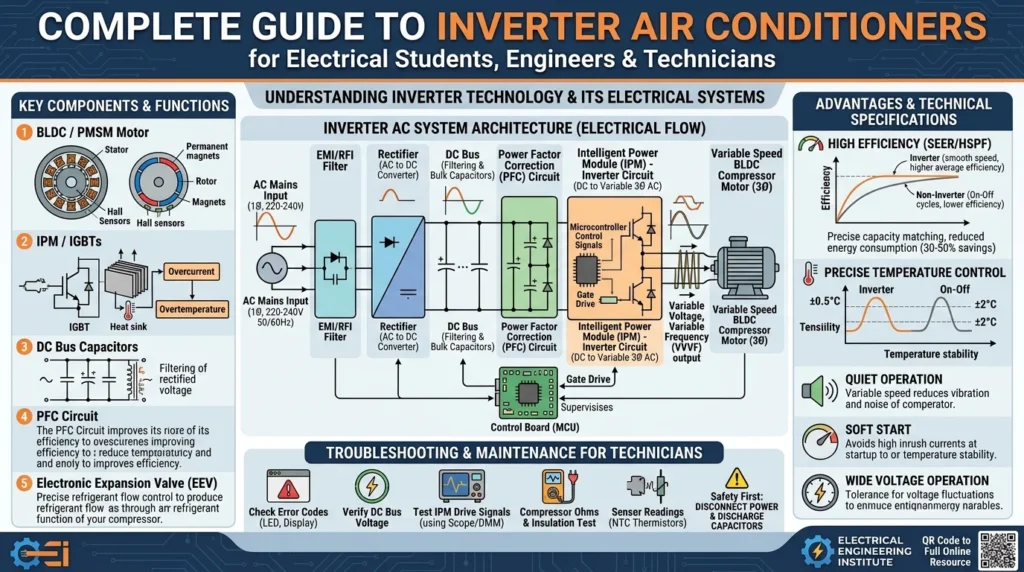
The Inverter air conditioner working principle is based on controlling the frequency of electrical power supplied to the compressor motor.
The compressor motor speed depends on the supply frequency. By adjusting this frequency, the inverter circuit controls compressor speed.
Step-by-Step Working
- Room Temperature Detection
- A temperature sensor measures the room temperature.
- The user sets the desired temperature using the remote control.
- Signal to Control Board
- The sensor sends information to the electronic control board.
- AC to DC Conversion
- Incoming AC power is converted into DC using a rectifier circuit.
- DC to Variable AC Conversion
- The inverter circuit converts DC into AC again.
- The output frequency is adjustable.
- Compressor Speed Control
- High frequency → High compressor speed
- Low frequency → Low compressor speed
- Cooling Adjustment
- When cooling demand is high, the compressor runs faster.
- When the desired temperature is reached, the compressor slows down.
Simple Analogy
Imagine a water pump filling a tank.
- A traditional system turns the pump fully ON or fully OFF.
- An inverter system adjusts the pump speed to maintain the water level smoothly.
This intelligent control is the key idea behind the Inverter air conditioner working principle.
4. Types / Classification of Inverter Air Conditioners
Inverter ACs can be classified based on design and installation type.
Split Inverter AC
This is the most common type used in homes.
Features
- Indoor unit mounted on the wall
- Outdoor unit containing compressor
- Quiet operation
- Energy efficient
Window Inverter AC
This type is installed in a window or wall opening.
Features
- Single compact unit
- Easier installation
- Suitable for small rooms
Cassette Inverter AC
Installed in the ceiling.
Features
- Air distribution in four directions
- Used in offices and commercial spaces
- Better air circulation
Ducted Inverter AC
Used for central air conditioning systems.
Features
- Air distributed through ducts
- Suitable for large buildings
- Uniform cooling in multiple rooms
5. Main Components of an Inverter Air Conditioner
Understanding components helps technicians diagnose faults and perform maintenance.
Compressor
The compressor circulates refrigerant through the system.
Function:
- Compresses low-pressure refrigerant gas
- Raises temperature and pressure
Inverter Control Board
This is the most important part of an inverter AC.
Function:
- Controls compressor speed
- Converts electrical power frequency
Indoor Unit
Contains:
- Evaporator coil
- Air filter
- Blower fan
Function:
- Absorbs heat from room air.
Outdoor Unit
Contains:
- Compressor
- Condenser coil
- Cooling fan
Function:
- Releases heat outside.
Expansion Valve
Function:
- Controls refrigerant flow
- Reduces refrigerant pressure
Temperature Sensors
Function:
- Detect indoor and outdoor temperature
- Send signals to the control system.
6. Advantages
The Inverter air conditioner advantages and disadvantages must be clearly understood. Let us start with advantages.
Key Advantages
- Lower electricity consumption
- Stable room temperature
- Quiet compressor operation
- Faster cooling
- Longer compressor life
- Reduced power fluctuations
- Better energy efficiency
- Environmentally friendly operation
Real-World Benefits
For homes, inverter ACs reduce monthly electricity bills.
For businesses, they improve cooling efficiency and reduce operational costs.
7. Disadvantages / Limitations
Despite many benefits, inverter ACs also have some limitations.
Common Disadvantages
- Higher initial cost
- Complex electronic circuitry
- Expensive repairs
- Requires skilled technicians
- Sensitive to voltage fluctuations
However, the energy savings over time often compensate for the higher purchase cost.
8. Applications
There are many Inverter air conditioner applications in modern environments.
Residential Applications
- Bedrooms
- Living rooms
- Apartments
- Villas
Commercial Applications
- Offices
- Shopping malls
- Restaurants
- Hotels
Industrial Applications
- Control rooms
- Data centers
- Laboratories
- Electronic manufacturing units
Modern Technology Uses
Inverter technology is also used in:
- Refrigerators
- Washing machines
- Heat pumps
9. Comparison Section
Understanding the difference between inverter AC and non-inverter AC is important for engineers and buyers.
| Feature | Inverter AC | Non-Inverter AC |
|---|---|---|
| Compressor Operation | Variable speed | Fixed speed |
| Energy Efficiency | High | Lower |
| Electricity Consumption | Low | High |
| Noise Level | Quiet | Noisy |
| Initial Cost | Higher | Lower |
| Temperature Control | Stable | Fluctuates |
| Compressor Life | Longer | Shorter |
This comparison clearly shows why inverter air conditioners are becoming the preferred choice.
10. Selection Guide
Choosing the correct inverter AC is important for efficient cooling.
Tips for Beginners
Room Size
Select AC capacity based on room size.
Example:
- Small room → 1 Ton
- Medium room → 1.5 Ton
- Large room → 2 Ton
Energy Rating
Choose higher star ratings for better efficiency.
Brand Reliability
Select brands known for durable compressors.
Installation Quality
Proper installation improves performance and life.
Voltage Protection
Use stabilizers in areas with unstable power supply.
11. Common Problems & Solutions
Why is my inverter AC not cooling properly?
Possible reasons:
- Dirty air filters
- Low refrigerant level
- Blocked condenser coil
Solution:
Clean filters and check refrigerant.
Why does the AC stop and start frequently?
Possible reasons:
- Sensor malfunction
- Electrical control problem
Solution:
Check temperature sensors and control board.
Why is electricity consumption high?
Possible reasons:
- Incorrect AC capacity
- Poor insulation
- Continuous high compressor speed
Solution:
Improve room insulation and select correct tonnage.
12. Future Trends
Air conditioning technology is evolving rapidly.
Smart Inverter AC
Modern ACs now connect to smartphones through Wi-Fi.
Users can control temperature remotely.
AI-Based Cooling
Artificial intelligence systems adjust cooling automatically according to room conditions.
Eco-Friendly Refrigerants
New refrigerants reduce environmental impact.
Solar Powered AC
Future systems may combine inverter technology with solar power for sustainable cooling.
These innovations will make air conditioning more efficient and environmentally friendly.
13. Conclusion
The Inverter Air Conditioner is one of the most important innovations in modern cooling technology. Unlike traditional systems, inverter ACs adjust compressor speed according to cooling demand. This intelligent operation improves energy efficiency, reduces electricity consumption, and provides stable indoor temperature.
Understanding the Inverter air conditioner working principle, components, and applications is very useful for electrical students, technicians, and engineers. These systems combine power electronics, motor control, and refrigeration engineering into a single efficient solution.
Although inverter air conditioners have a higher initial cost, their long-term benefits make them a smart investment. Lower electricity bills, quieter operation, and longer compressor life are strong advantages.
As technology advances, inverter AC systems will become even smarter, more efficient, and environmentally friendly. For anyone studying electrical or HVAC systems, learning about inverter air conditioning is an important step toward understanding modern energy-efficient technologies.