
Imagine you are installing heavy electrical panels or mounting cable trays on a concrete wall. You try to tighten a long screw using a normal screwdriver or drill, but the screw refuses to move further. It becomes very difficult to apply enough force manually. In such situations, professionals use a powerful tool known as an impact driver.
An impact driver is widely used in construction, electrical installation, mechanical work, and industrial maintenance. It is specially designed to drive screws and fasteners with high torque while requiring less physical effort from the user.
For electrical technicians and engineers, this tool is extremely useful when installing switchboards, cable brackets, electrical cabinets, and metal structures. Unlike ordinary drills, an impact driver delivers sudden bursts of rotational force that allow screws to penetrate tough materials like wood, metal, and concrete anchors.
In this article, you will learn everything about the impact driver, including its definition, impact driver working principle, types, components, impact driver applications, and impact driver advantages and disadvantages. You will also learn how to select the right impact driver and solve common problems when using this powerful tool.
What is an Impact Driver?
An impact driver is a power tool designed to drive screws, bolts, and fasteners by delivering high rotational torque combined with rapid impact force.
In simple terms, it is a tool that makes it easier to drive screws into hard materials. Instead of applying constant pressure like a normal drill, an impact driver produces quick bursts of force that help rotate the screw.
This feature allows the tool to drive long or large screws without slipping or damaging the screw head.
Practical Example
Suppose an electrical technician needs to install a large electrical panel on a metal frame. The mounting screws are long and require strong torque. Using a normal screwdriver would take a lot of effort and time.
With an impact driver, the technician can easily drive the screws into the frame quickly and securely. The impact mechanism automatically provides extra force whenever resistance increases.
Impact Driver Working Principle
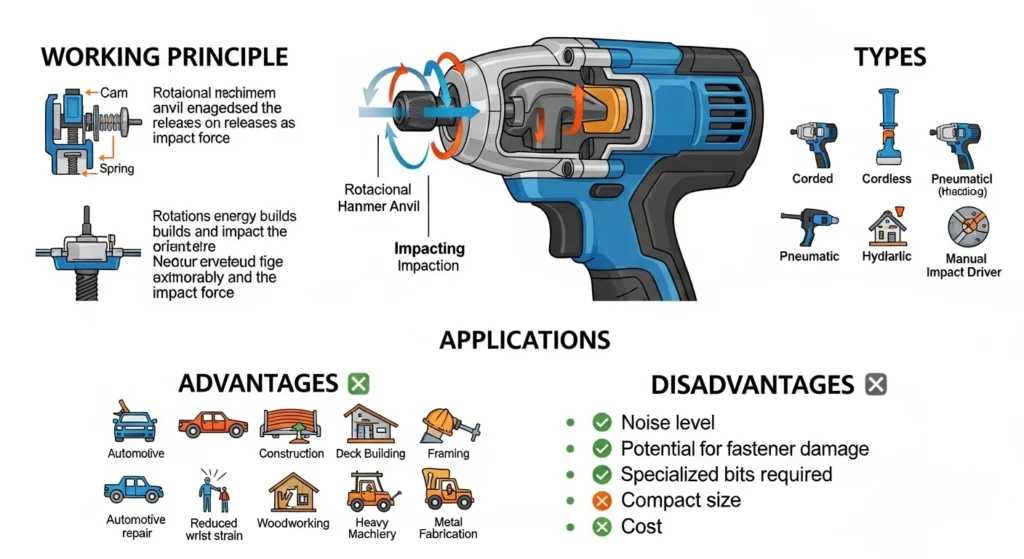
The impact driver working principle is based on combining rotational motion with sudden hammer-like impacts to generate high torque.
Instead of applying continuous force, the tool stores energy and releases it in quick bursts to rotate the fastener.
Step-by-Step Working Process
- Motor rotationWhen the trigger is pressed, the electric motor begins rotating the tool’s internal mechanism.
- Torque buildupThe rotating mechanism encounters resistance when driving a screw into a material.
- Impact activationWhen resistance increases, the internal hammer strikes the anvil inside the tool.
- Sudden torque burstThis impact produces a strong rotational force that turns the screw further.
- Repeated actionThe hammering process repeats many times per second until the screw is fully tightened.
Simple Analogy
Think of tightening a stuck bolt with a wrench while tapping it with a hammer. The hammer taps help loosen the bolt. An impact driver performs this process automatically and very quickly.
Types of Impact Drivers
Different types of impact drivers are available depending on power source and application.
Corded Impact Driver
Corded impact drivers operate using direct electrical power from a wall outlet.
They provide continuous power and are commonly used in workshops and industrial environments.
Cordless Impact Driver
Cordless impact drivers operate using rechargeable batteries.
They are portable and widely used in electrical installation, construction, and field work.
Pneumatic Impact Driver
Pneumatic impact drivers use compressed air as a power source.
They are commonly used in automotive workshops and industrial assembly lines.
Hydraulic Impact Driver
Hydraulic impact drivers use hydraulic pressure to produce impact force.
They are often used in heavy industrial applications where high torque is required.
Main Components of an Impact Driver
An impact driver contains several important mechanical and electrical components.
Electric Motor
The motor generates the rotational power required to drive screws and fasteners.
Hammer Mechanism
The hammer mechanism creates the impact force that increases torque during operation.
Anvil
The anvil transfers the impact force from the hammer to the screwdriver bit.
Chuck or Bit Holder
The chuck holds the screwdriver bit securely during operation.
Trigger Switch
The trigger controls the speed and operation of the tool.
Battery Pack (Cordless Models)
In cordless impact drivers, the battery provides electrical power for the motor.
Impact Driver Advantages and Disadvantages
Understanding impact driver advantages and disadvantages helps technicians decide when to use this tool.
Advantages
- Produces high torque for driving large screws
- Requires less physical effort
- Reduces slipping of screwdriver bits
- Faster screw installation
- Compact and lightweight design
- Ideal for tough materials like metal and hardwood
- Improves productivity in electrical installation work
These benefits make impact drivers very popular in construction and electrical industries.
Disadvantages / Limitations
Despite its advantages, an impact driver also has some limitations.
- Less suitable for delicate work
- Can over-tighten screws if not controlled
- Produces noise and vibration
- Requires special impact-rated bits
- May damage soft materials if used improperly
Understanding these limitations helps avoid misuse.
Impact Driver Applications
The impact driver applications are found in many professional environments.
Electrical Installation
Technicians use impact drivers to mount electrical panels, cable trays, and metal brackets.
Construction Work
Builders use impact drivers to drive long screws into wood and metal structures.
Automotive Industry
Mechanics use impact drivers to loosen and tighten bolts during vehicle repairs.
Furniture Assembly
Impact drivers help assemble furniture quickly and securely.
Industrial Manufacturing
Factories use impact drivers for fast assembly of machines and equipment.
Difference Between Impact Driver and Drill
Understanding the difference between drill and impact driver helps beginners choose the correct tool.
| Feature | Impact Driver | Drill |
|---|---|---|
| Main Function | Driving screws | Drilling holes |
| Torque | Very high | Moderate |
| Impact Mechanism | Yes | No |
| Precision Work | Limited | Better |
| Noise Level | Higher | Lower |
A drill is ideal for drilling holes, while an impact driver is better for driving screws into tough materials.
Selection Guide: How to Choose the Right Impact Driver
Choosing the right impact driver depends on several factors.
Power and Torque
Higher torque models are suitable for heavy-duty work.
Battery Capacity
Cordless models should have high-capacity batteries for longer operation.
Speed Control
Variable speed control allows better precision.
Size and Weight
Lightweight tools reduce user fatigue during long working hours.
Build Quality
Choose durable tools made from high-quality materials.
Common Problems and Solutions
Why is the impact driver not producing enough torque?
The battery may be weak or discharged.
Solution: Recharge or replace the battery.
Why is the screwdriver bit slipping?
The wrong bit type may be used.
Solution: Use impact-rated screwdriver bits.
Why is the tool overheating?
Continuous heavy use may cause overheating.
Solution: Allow the tool to cool before continuing work.
Why is the screw getting damaged?
Too much pressure may be applied.
Solution: Use lower speed and proper torque control.
Future Trends in Impact Driver Technology
Power tools continue to evolve with new technologies.
Brushless Motors
Modern impact drivers use brushless motors for higher efficiency and longer lifespan.
Smart Torque Control
Advanced models automatically adjust torque based on resistance.
Lightweight Materials
Manufacturers are developing lighter tools to reduce user fatigue.
Improved Battery Technology
Future batteries will provide longer operating time and faster charging.
These improvements will make impact drivers even more efficient and reliable.
Conclusion
An impact driver is a powerful and efficient tool designed for driving screws and fasteners into tough materials. Its unique mechanism combines rotational motion with rapid impact force, allowing technicians to complete difficult tasks with less effort.
Understanding the impact driver working principle, types, components, and impact driver applications helps electrical students and professionals use this tool effectively. Although impact drivers have some limitations, their ability to produce high torque makes them extremely useful in construction, electrical installation, and mechanical work.
By choosing the right tool and using it properly, technicians can improve productivity, accuracy, and safety in their projects. Learning how to operate an impact driver is an essential skill for anyone working in modern electrical or mechanical industries.