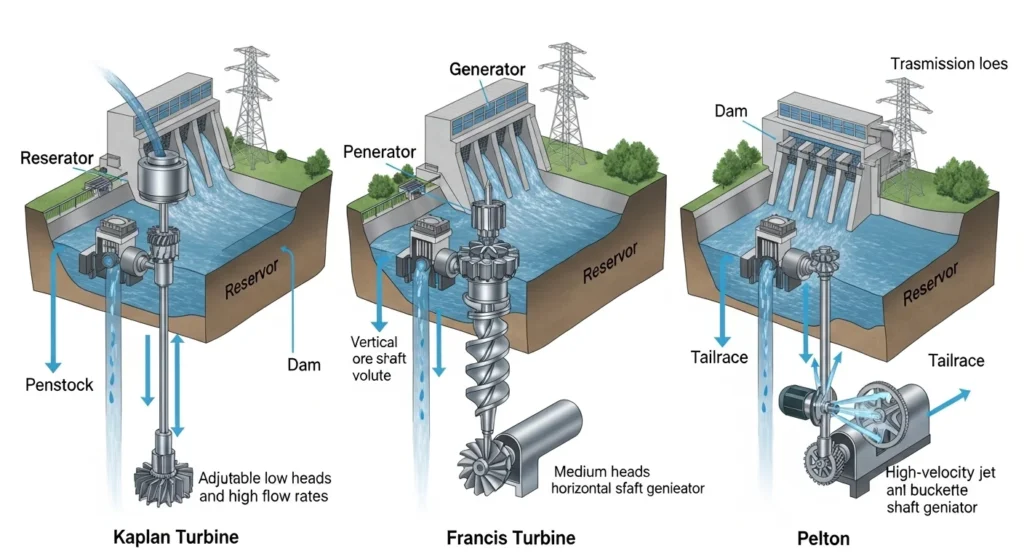

Imagine a large dam where water flows rapidly through huge pipes toward powerful turbines. As the water rushes through the turbines, massive machines begin to rotate, generating electricity that powers thousands of homes and industries. This process is happening every day in hydroelectric power plants around the world.
Hydropower is one of the oldest and most reliable sources of renewable energy. Many countries rely on hydroelectric plants to generate clean electricity without burning fossil fuels. At the heart of these power plants are hydroelectric generators, which convert mechanical energy from water-driven turbines into electrical power.
Understanding hydroelectric generator types is essential for electrical students, engineers, and technicians who want to work in power generation and renewable energy systems. Different generators are used depending on water flow, turbine design, and plant capacity.
In this article, you will learn about hydroelectric generator types, their working principle, key components, advantages and disadvantages, and real-world hydroelectric generator applications. We will also compare generator designs and provide practical guidance for selecting the right generator.
By the end of this article, you will have a clear understanding of how hydroelectric generators work and why they are critical in modern power systems.
2. What is a Hydroelectric Generator?
A hydroelectric generator is an electrical machine that converts mechanical energy from water-driven turbines into electrical energy.
In simple terms, moving water rotates a turbine. The turbine is connected to a generator. As the generator rotates, it produces electricity using electromagnetic induction.
Hydroelectric generators are designed to operate continuously for long periods while maintaining high efficiency. They are usually installed in power plants built near dams, rivers, or waterfalls.
Practical Example
Consider a large dam storing water at a high elevation. When the dam releases water, the flowing water spins large turbines connected to generators. These generators produce electricity that is transmitted through power lines to cities and towns.
This process allows natural water flow to be converted into useful electrical power.
3. Hydroelectric Generator Working Principle
The hydroelectric generator working principle is based on electromagnetic induction.
When a conductor moves inside a magnetic field, electricity is generated.
Step-by-Step Process
- Water Flow
Water stored in a reservoir flows through pipes called penstocks. - Turbine Rotation
The flowing water strikes the turbine blades, causing the turbine to rotate. - Generator Shaft Rotation
The turbine shaft is connected to the generator rotor. - Magnetic Field Interaction
As the rotor spins, it creates a rotating magnetic field. - Electricity Generation
The rotating magnetic field induces voltage in the stator windings. - Power Transmission
The generated electricity is transmitted through transformers and power lines.
Simple Analogy
Think of a water wheel used in old mills. Flowing water spins the wheel to grind grain. In hydroelectric plants, water spins turbines to generate electricity instead.
4. Types / Classification of Hydroelectric Generators
There are several hydroelectric generator types used in modern power plants.
Synchronous Generator
The synchronous generator is the most commonly used generator in hydroelectric power plants.
Features
- Operates at constant speed
- Produces stable voltage and frequency
- Suitable for large power stations
These generators are ideal for grid-connected hydroelectric systems.
Induction Generator
An induction generator, also called an asynchronous generator, can also be used in small hydroelectric plants.
Features
- Simple and robust design
- Lower installation cost
- Easy maintenance
However, it usually requires a connection to the electrical grid to operate.
Permanent Magnet Generator
Permanent magnet generators use strong magnets to produce a magnetic field instead of using field windings.
Features
- High efficiency
- Compact size
- Reduced maintenance
These generators are often used in small-scale hydroelectric systems.
Brushless Generator
Brushless generators eliminate the need for brushes and slip rings.
Features
- Reduced maintenance
- Longer operating life
- Improved reliability
They are widely used in modern hydroelectric plants.
Vertical Shaft Generator
Many large hydroelectric generators use vertical shaft designs.
Features
- Suitable for large turbines
- Better load distribution
- Efficient cooling
This design is common in large dam-based hydroelectric plants.
5. Main Components of a Hydroelectric Generator
Hydroelectric generators contain several important components.
Rotor
The rotor is the rotating part of the generator that produces a magnetic field.
Stator
The stator is the stationary part containing windings where electricity is generated.
Shaft
The shaft connects the turbine to the generator rotor.
Excitation System
This system provides the magnetic field required for electricity generation.
Cooling System
Generators produce heat during operation, so cooling systems prevent overheating.
Control System
Control systems monitor generator speed, voltage, and power output.
6. Advantages of Hydroelectric Generators
Hydroelectric generators provide many benefits.
- Renewable and clean energy source
- High energy conversion efficiency
- Low operating cost after installation
- Long service life
- No fuel required during operation
- Low environmental pollution compared to fossil fuels
These advantages make hydropower one of the most reliable renewable energy sources.
7. Disadvantages / Limitations
Despite their advantages, hydroelectric systems also have limitations.
- High construction cost for dams
- Environmental impact on rivers and ecosystems
- Dependence on water availability
- Limited suitable locations for hydro plants
- Possible displacement of communities near dams
Understanding hydroelectric generator advantages and disadvantages helps engineers design better systems.
8. Hydroelectric Generator Applications
There are many practical hydroelectric generator applications in modern energy systems.
Large Hydropower Plants
Major dams use large generators to supply electricity to national power grids.
Small Hydropower Systems
Small generators are used in rural areas and small rivers.
Industrial Power Supply
Hydroelectric generators provide reliable power for industries.
Remote Communities
Hydropower systems can supply electricity to isolated areas without grid connections.
Pumped Storage Systems
Some hydro plants store energy by pumping water to higher reservoirs during low demand.
9. Comparison Section
Difference Between Synchronous Generator and Induction Generator
| Feature | Synchronous Generator | Induction Generator |
|---|---|---|
| Speed | Constant speed | Variable speed |
| Grid Requirement | Can operate independently | Requires grid connection |
| Efficiency | Higher | Moderate |
| Complexity | More complex | Simpler design |
| Cost | Higher | Lower |
Understanding the difference between synchronous generator and induction generator helps engineers select suitable generators.
10. Selection Guide
Choosing the correct hydroelectric generator requires several considerations.
Water Flow Rate
The amount of flowing water determines the generator size and capacity.
Turbine Type
Different turbines require compatible generator designs.
Power Capacity
Large plants require high-capacity synchronous generators.
Maintenance Requirements
Choose systems that offer reliability and easy maintenance.
Budget
Installation cost and long-term operational costs must be considered.
These factors help engineers select the most suitable hydroelectric generator type.
11. Common Problems & Solutions
Q1: Why does a hydroelectric generator overheat?
Overheating may occur due to excessive load or cooling system failure.
Solution: Inspect cooling systems and reduce load if necessary.
Q2: Why does the generator produce unstable voltage?
This may be caused by excitation system problems.
Solution: Check the excitation system and voltage regulator.
Q3: Why is the generator making unusual noise?
Mechanical problems such as bearing wear may cause noise.
Solution: Perform regular maintenance and replace worn components.
Q4: Why does power output fluctuate?
Fluctuations may occur due to varying water flow.
Solution: Use proper control systems and turbine regulation.
12. Future Trends in Hydroelectric Generators
Hydropower technology continues to evolve.
Smart Power Plants
Modern hydro plants use digital monitoring and automated control systems.
Small Hydropower Development
Small and micro hydro systems are expanding in rural areas.
Advanced Generator Materials
New materials improve efficiency and durability.
Hybrid Renewable Systems
Hydropower is being integrated with solar and wind systems.
Environmental Improvements
New technologies are reducing ecological impact on rivers and wildlife.
These advancements will make hydroelectric power more sustainable in the future.
13. Conclusion
Hydroelectric generators play a vital role in modern power generation systems. They convert the energy of flowing water into electrical power that can supply homes, industries, and entire cities.
In this article, we explored different hydroelectric generator types, their working principle, main components, advantages and disadvantages, and real-world hydroelectric generator applications. We also compared generator designs and provided guidance on selecting the right generator.
For electrical students, engineers, and technicians, understanding hydroelectric generators is an important step toward working in renewable energy and power engineering.
As global demand for clean energy continues to grow, hydroelectric generators will remain one of the most reliable and sustainable sources of electricity.