
Imagine you are at home during a hot summer evening when suddenly the electricity goes out. The lights turn off, fans stop working, and important appliances such as refrigerators and internet routers shut down. In many areas, power outages can last from a few minutes to several hours. This situation can cause discomfort, food spoilage, and disruption of daily activities. To solve this problem, many homeowners install a Home Backup Generator.
A home backup generator is designed to provide electricity to a house when the main power supply fails. It acts as a reliable emergency power source that keeps essential appliances running during outages. Modern backup generators can automatically start when a power failure occurs and supply electricity until the main power returns.
For electrical students, technicians, and beginners, understanding the Home Backup Generator working principle is important because it shows how residential power backup systems operate. These systems are becoming increasingly popular due to frequent power interruptions and the growing use of electronic devices in homes.
In this article, you will learn what a home backup generator is, how it works, the different types available, and common Home Backup Generator applications. We will also discuss the Home Backup Generator advantages and disadvantages, selection tips, troubleshooting methods, and future trends in residential backup power systems.
What is a Home Backup Generator?
A Home Backup Generator is a power generation system installed in a house to supply electricity during a power outage.
Clear Definition
A home backup generator is a device that produces electrical power using fuel and supplies electricity to household circuits when the main power supply fails.
Simple Explanation
When the electricity from the utility company stops, the backup generator automatically or manually starts and provides power to essential appliances in the house.
Practical Example
For example, during a storm or power grid failure, a home backup generator can keep important appliances such as lights, refrigerators, internet routers, and security systems working.
Home Backup Generator Working Principle
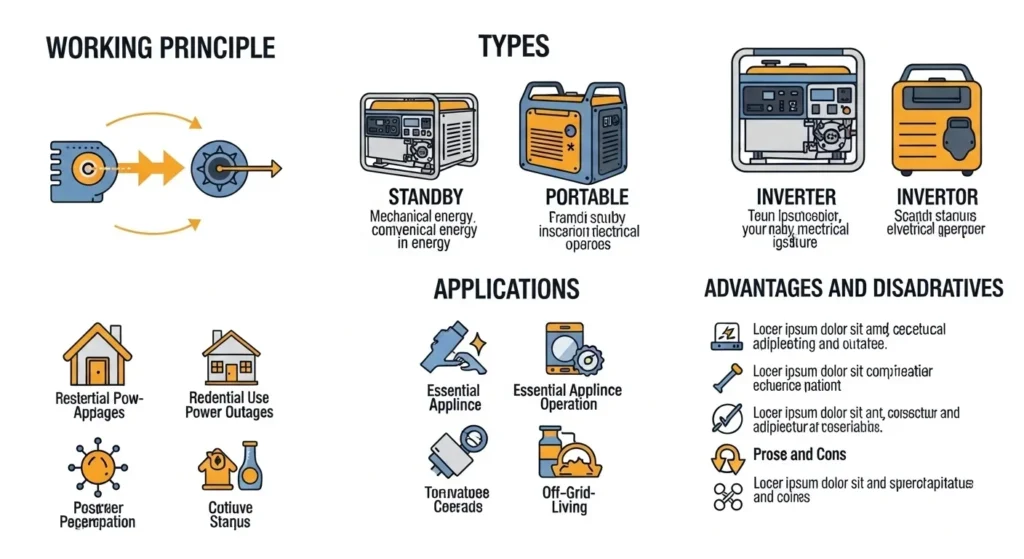
The Home Backup Generator working principle involves detecting a power outage, starting the generator engine, and supplying electricity to the house.
Step-by-Step Working Process
- Power Monitoring
- The system continuously monitors the main electrical supply.
- Power Failure Detection
- When a power outage occurs, the generator control system detects the loss of power.
- Generator Startup
- The generator engine starts automatically or manually.
- Electricity Generation
- The generator converts mechanical energy into electrical energy.
- Power Transfer
- A transfer switch connects the generator to the home electrical system.
- Power Supply to Appliances
- The generator supplies electricity to selected circuits in the house.
- Power Restoration
- When utility power returns, the generator stops and normal supply resumes.
Simple Analogy
A home backup generator works like an emergency power bank for your entire house. When the main power stops, the backup system immediately provides electricity.
Types of Home Backup Generator
Home backup generators are available in several types depending on their design and operation.
Portable Home Backup Generator
Portable generators are small and movable units.
Features:
- Easy to transport
- Lower cost
- Manual operation
They are commonly used for temporary power backup in homes.
Standby Home Backup Generator
Standby generators are permanently installed outside the house.
Features:
- Automatic operation
- Higher power capacity
- Connected directly to the home electrical system
They are the most reliable backup solution for homes.
Inverter Home Backup Generator
Inverter generators provide clean and stable electricity.
Features:
- Quiet operation
- Fuel efficient
- Safe for sensitive electronics
They are ideal for powering laptops, televisions, and electronic devices.
Solar Hybrid Backup Generator
Hybrid systems combine solar panels with battery storage and a generator.
Features:
- Renewable energy support
- Reduced fuel consumption
- Environmentally friendly
These systems are becoming popular in modern homes.
Main Components of a Home Backup Generator
A home backup generator system includes several important components.
Engine
The engine burns fuel to produce mechanical energy.
Function:
- Drives the generator alternator.
Alternator
The alternator converts mechanical energy into electrical energy.
Function:
- Produces electricity for the home.
Fuel System
The fuel system stores and supplies fuel such as gasoline, diesel, or natural gas.
Function:
- Provides energy for generator operation.
Transfer Switch
The transfer switch connects the generator to the home electrical system.
Function:
- Switches power between utility supply and generator.
Control Panel
The control panel monitors generator operation.
Function:
- Displays voltage, load, and system status.
Cooling System
The cooling system prevents overheating of the generator engine.
Function:
- Maintains safe operating temperature.
Home Backup Generator Advantages
Understanding Home Backup Generator advantages and disadvantages helps homeowners select the right backup system.
Advantages
- Provides electricity during power outages
- Protects food in refrigerators and freezers
- Supports essential home appliances
- Improves home safety and comfort
- Useful during storms and emergencies
- Increases property value
Real-World Benefits
Home backup generators allow families to continue daily activities even when the power grid fails.
Home Backup Generator Disadvantages / Limitations
Although backup generators are useful, they have some limitations.
Limitations
- Initial installation cost can be high
- Requires fuel for operation
- Needs regular maintenance
- May produce noise during operation
Proper installation and maintenance can reduce these issues.
Home Backup Generator Applications
There are many important Home Backup Generator applications in residential environments.
Residential Houses
Backup generators power essential appliances during outages.
Smart Homes
Modern smart homes use backup generators to support automation systems.
Home Offices
Backup generators keep computers and internet connections working.
Security Systems
They ensure that cameras and alarm systems continue functioning.
Emergency Lighting
Backup generators provide lighting during power failures.
Comparison: Home Backup Generator vs Portable Generator
Understanding the difference between home backup generator and portable generator helps users select the right system.
| Feature | Home Backup Generator | Portable Generator |
|---|---|---|
| Installation | Permanent | Temporary |
| Operation | Automatic or manual | Manual |
| Power Capacity | Higher | Lower |
| Convenience | High | Moderate |
| Cost | Higher | Lower |
Key Difference
The main difference between home backup generator and portable generator is that home backup generators are designed for residential electrical systems and can power multiple appliances.
Selection Guide
Choosing the right home backup generator requires careful planning.
Power Requirement
Calculate the total wattage of essential appliances.
Fuel Type
Select generators that use convenient fuel sources such as natural gas, diesel, or gasoline.
Noise Level
Choose low-noise models for residential areas.
Automatic Operation
Automatic generators provide better convenience during outages.
Budget Consideration
Consider installation cost, fuel cost, and maintenance expenses.
Tips for Beginners
- Identify essential appliances that require backup power.
- Always install the generator in a safe outdoor location.
- Follow electrical safety guidelines during installation.
Common Problems & Solutions
Why does the generator fail to start?
Possible reasons:
- Empty fuel tank
- Weak battery
- Faulty starter motor
Solution: Check fuel supply and battery condition.
Why is the generator producing low voltage?
Possible causes:
- Overloaded generator
- Faulty voltage regulator
Solution: Reduce load and inspect electrical components.
Why does the generator shut down automatically?
Generators may shut down due to safety protections.
Solution: Check oil level, temperature, and electrical load.
Why is the generator noisy?
Noise may occur due to engine vibration or improper installation.
Solution: Install the generator on a stable surface and use sound-reducing enclosures.
Future Trends in Home Backup Generator Technology
Residential backup power technology is continuously improving.
Smart Generator Monitoring
Future systems may allow remote monitoring through mobile applications.
Solar Integration
Backup generators may integrate with solar power systems.
Battery Energy Storage
Modern homes may combine generators with battery backup systems.
Eco-Friendly Generators
Manufacturers are developing low-emission and environmentally friendly generators.
Conclusion
A Home Backup Generator is an essential power solution that provides electricity during unexpected power outages. It helps maintain comfort, safety, and normal daily activities in residential environments.
Understanding the Home Backup Generator working principle helps electrical students and technicians learn how modern residential power systems operate. These generators supply electricity to important appliances such as lights, refrigerators, internet routers, and security systems.
Although backup generators require installation costs and regular maintenance, their benefits during emergencies make them extremely valuable. As technology advances, home backup generators will become smarter, more efficient, and better integrated with renewable energy systems.