
Imagine an electrician installing heat shrink tubing on a wire connection inside a control panel. The tubing must shrink tightly around the wire to protect it from moisture and mechanical damage. If the tubing is heated unevenly or with the wrong tool, it may burn or fail to seal properly.
This is where a heat gun becomes an essential tool.
A heat gun produces a stream of hot air that can be used for many electrical and industrial tasks. Electricians use it for shrinking insulation tubes, softening adhesives, bending plastics, and removing paint or labels. Unlike an open flame, a heat gun provides controlled heating, making it safer and more precise for electrical work.
For electrical students, technicians, and engineers, understanding how a heat gun works is important because it is widely used in wiring installations, cable repairs, and electronic assembly.
In this guide, you will learn the heat gun working principle, different types of heat guns, key components, and practical heat gun applications. We will also discuss heat gun advantages and disadvantages, how to choose the right model, and how to solve common problems when using this versatile tool.
Heat Gun?
A heat gun is a handheld electrical tool that produces a controlled stream of hot air. It is commonly used to heat, soften, shrink, or dry materials.
The tool works similarly to a hair dryer, but it produces much higher temperatures. While a hair dryer may produce air around 60–100°C, a heat gun can generate temperatures ranging from 200°C to over 600°C.
Simple Explanation
A heat gun blows very hot air onto a surface to change the material properties. Heat can soften plastics, shrink tubing, dry surfaces, or remove coatings.
Practical Example
When an electrician installs heat shrink tubing on a cable joint, the tubing is placed over the wire. A heat gun is then used to apply hot air. The tubing shrinks tightly around the wire, creating a strong insulating seal.
Without a heat gun, achieving a clean and safe shrink connection would be difficult.
Heat Gun Working Principle
The heat gun working principle is based on heating air using an electric heating element and blowing it through a nozzle using a fan.
The tool converts electrical energy into heat energy and directs the hot air toward the target surface.
Step-by-Step Working Process
- Power Supply ActivationWhen the heat gun is switched on, electrical current flows to the heating element.
- Heating Element OperationThe heating coil (usually made of nichrome wire) heats up rapidly.
- Air IntakeA built-in fan pulls air from the surrounding environment.
- Hot Air GenerationThe air passes over the heated element and becomes hot.
- Directed AirflowThe fan pushes the hot air through a nozzle toward the work surface.
Simple Analogy
Think of a heat gun like a powerful hair dryer that produces much hotter air. Instead of drying hair, it heats materials for electrical or industrial work.
Types / Classification of Heat Guns
Heat guns are available in different types depending on their power source and level of control.
Electric Heat Gun
Electric heat guns are the most common type used by electricians.
Features:
- Powered by electricity
- Adjustable temperature settings
- Lightweight and portable
They are widely used in electrical installation and repair work.
Gas-Powered Heat Gun
Gas heat guns use propane or butane as a fuel source.
Characteristics:
- Does not require electricity
- Suitable for outdoor work
- Portable for remote locations
However, they are less common in electrical installations.
Industrial Heat Gun
Industrial heat guns are high-power tools used in factories.
Features:
- Higher temperature output
- Continuous operation capability
- Used in manufacturing processes
They are designed for heavy-duty applications.
Digital Heat Gun
Digital heat guns provide precise temperature control.
Advantages:
- Digital display
- Adjustable airflow
- Accurate temperature control
These models are commonly used in electronics and delicate applications.
Main Components of a Heat Gun
A heat gun contains several important components that allow it to produce and control hot air.
Heating Element
The heating element is responsible for generating heat. It is usually made of nichrome wire, which can withstand very high temperatures.
Electric Motor and Fan
The fan pulls air into the tool and pushes it over the heating element to create hot airflow.
Nozzle
The nozzle directs hot air toward the target area. Different nozzles can be attached for specific tasks.
Temperature Control Switch
This control allows users to adjust the heat level depending on the application.
Housing and Handle
The outer body protects internal components, while the handle allows safe and comfortable operation.
Heat Gun Advantages and Disadvantages
Understanding heat gun advantages and disadvantages helps technicians use the tool effectively.
Advantages
- Provides controlled heating
- Safer than open flame
- Versatile for many tasks
- Portable and easy to use
- Adjustable temperature settings
- Improves efficiency in electrical work
These advantages make heat guns extremely useful in electrical and industrial work.
Disadvantages / Limitations
- Can cause burns if used improperly
- High temperature may damage sensitive materials
- Requires electricity for most models
- Not suitable for extremely precise heating in some applications
Proper training and safety practices are necessary when using a heat gun.
Heat Gun Applications
There are many practical heat gun applications across electrical, industrial, and household environments.
Electrical Wiring
Used for shrinking heat shrink tubing and insulating cable joints.
Paint Removal
Heat guns soften paint so it can be easily removed from surfaces.
Plastic Bending
Hot air softens plastic materials so they can be shaped or bent.
Adhesive Removal
Heat loosens glue, stickers, and labels.
Electronics Repair
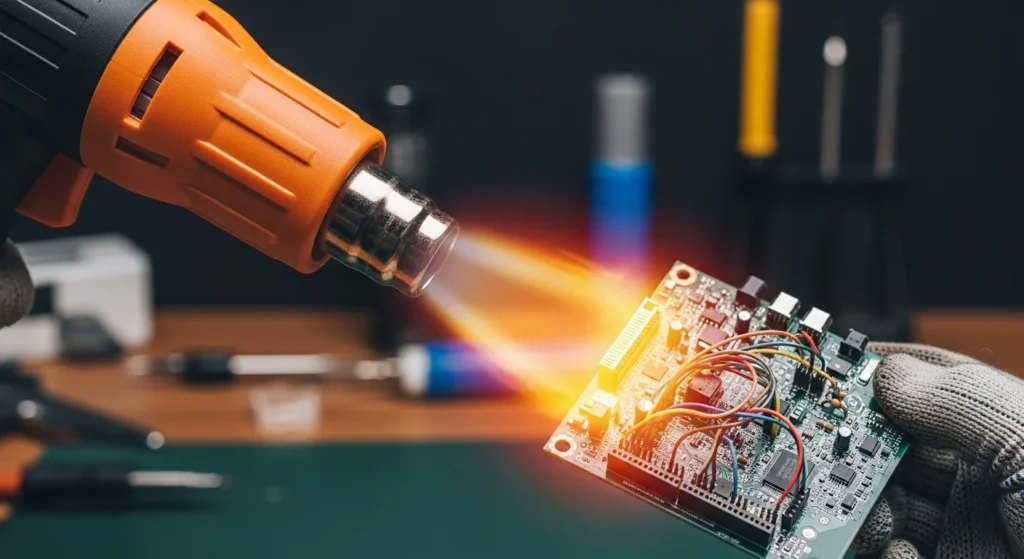
Technicians use heat guns for soldering and removing electronic components.
Industrial Manufacturing
Used for drying coatings, welding plastics, and forming materials.
Comparison Section
Difference Between Heat Gun and Hair Dryer
| Feature | Heat Gun | Hair Dryer |
|---|---|---|
| Temperature | Very high (200–600°C) | Low (60–100°C) |
| Purpose | Industrial and electrical work | Hair drying |
| Airflow Strength | Strong and focused | Gentle airflow |
| Temperature Control | Adjustable high heat | Limited heat control |
Understanding the difference between heat gun and hair dryer helps users select the correct tool.
Selection Guide
Choosing the right heat gun depends on several factors.
Temperature Range
Select a model with adjustable temperature settings for different tasks.
Power Rating
Higher wattage heat guns produce more heat and airflow.
Airflow Control
Adjustable airflow improves control and safety.
Safety Features
Look for tools with overheat protection and insulated handles.
Nozzle Compatibility
Multiple nozzle attachments allow the heat gun to perform different tasks.
Beginners should start with a basic electric heat gun with adjustable temperature settings.
Common Problems & Solutions
Why is the heat gun not producing heat?
Possible causes:
- Faulty heating element
- Power supply issue
Solution: Check the power source or replace the heating element.
Why is the airflow weak?
Possible causes:
- Blocked air intake
- Fan motor problem
Solution: Clean the air vents and inspect the fan.
Why is the tool overheating?
Possible causes:
- Continuous use without cooling
- Poor ventilation
Solution: Allow the tool to cool and ensure proper airflow.
Why is the plastic burning during heating?
Possible causes:
- Temperature set too high
- Heat applied too close
Solution: Reduce temperature and maintain proper distance.
Future Trends
Heat gun technology is evolving with improved efficiency and safety.
Smart Temperature Control
Future heat guns may include sensors that automatically adjust heat levels.
Energy-Efficient Designs
New heating elements will reduce energy consumption.
Cordless Heat Guns
Battery-powered models are becoming more popular for portable work.
Precision Industrial Heating
Advanced heat guns may provide extremely accurate temperature control for electronics manufacturing.
Conclusion
A heat gun is a powerful and versatile tool used in electrical, industrial, and household applications. It generates controlled hot air that can shrink tubing, soften materials, remove paint, and assist in many repair tasks.
In this guide, we explored the heat gun working principle, types of heat guns, important components, and common heat gun applications. We also discussed the heat gun advantages and disadvantages, compared it with similar tools, and explained how to choose the right model.
For electrical students, engineers, and technicians, learning how to use a heat gun safely and effectively is an important practical skill. When used correctly, this tool improves installation quality, saves time, and ensures reliable electrical insulation.
Mastering this tool will greatly enhance your electrical maintenance and repair capabilities.