
Imagine touching a metal body of a washing machine or refrigerator and suddenly feeling a small electric shock. This situation can be dangerous and even life-threatening. In many cases, such accidents happen because the electrical system does not have proper grounding. This is where the ground wire becomes extremely important.
In electrical installations, safety is the first priority. Electrical systems carry high voltage and current, which can cause serious damage to equipment and people if not properly controlled. A ground wire provides a safe path for unwanted electrical current to flow into the earth, preventing electric shocks and protecting equipment.
Modern homes, industries, and power systems rely heavily on proper grounding systems. Without grounding, electrical faults could damage appliances, start fires, or endanger human life.
In this article, you will learn everything about the Ground Wire, including the ground wire working principle, different types of grounding wires, key components, ground wire applications, and the ground wire advantages and disadvantages. This guide is designed for electrical students, technicians, engineers, and beginners who want to clearly understand how grounding improves electrical safety.
2. What is Ground Wire?
A ground wire is a safety conductor that connects electrical equipment to the earth (ground) to safely discharge unwanted electrical current.
In simple terms, the ground wire acts as a protective path for fault current. If an electrical fault occurs, the extra current flows into the earth instead of passing through a person or damaging equipment.
Simple Explanation
Think of the ground wire like a safety escape route.
If a problem occurs in an electrical system, the current needs a safe path to escape. The ground wire provides this path, directing electricity safely into the earth.
Practical Example
For example, consider a metal-body appliance such as a washing machine. If the internal wire touches the metal body due to insulation failure, the metal surface can become electrically charged.
If there is no ground wire, touching the appliance can give a shock.
However, if the appliance is grounded, the fault current flows through the ground wire into the earth, preventing shock.
3. Ground Wire Working Principle
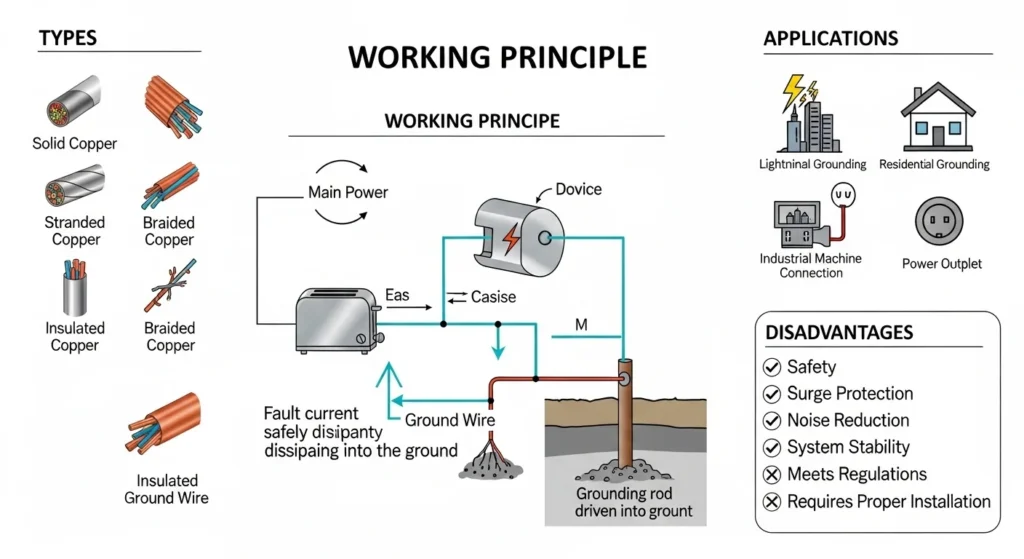
The ground wire working principle is based on providing a low-resistance path for fault current to flow safely into the earth.
Electricity always follows the path of least resistance. Grounding ensures that fault current prefers the ground path instead of passing through the human body.
Step-by-Step Working Principle
- Normal Operation
- Electricity flows through the live wire to the device.
- The neutral wire carries the current back to the source.
- Fault Condition
- A fault occurs when a live wire touches the metal body of equipment.
- Ground Connection
- The metal body is connected to the ground wire.
- Fault Current Flow
- The unwanted current flows through the ground wire into the earth.
- Protection Device Activation
- Circuit breakers or fuses detect the fault current and disconnect the power supply.
Simple Analogy
Imagine water leaking from a pipe.
If there is no drain system, the water spreads everywhere and causes damage. But if a proper drain exists, the water flows safely away.
Similarly, the ground wire safely drains unwanted electrical current.
4. Types / Classification of Ground Wires
Ground wires can be classified based on their application and design.
Equipment Ground Wire
This type connects the metal body of electrical equipment to the earth.
Features:
- Protects users from electric shock
- Used in household appliances and machinery
System Ground Wire
System grounding connects the electrical system to the earth.
Features:
- Stabilizes system voltage
- Used in power distribution systems
Bare Copper Ground Wire
Bare copper conductors are commonly used for grounding.
Features:
- High conductivity
- Durable and corrosion resistant
Insulated Ground Wire
This wire has insulation for additional safety.
Features:
- Used in indoor wiring systems
- Prevents accidental contact
5. Main Components of Grounding System
A grounding system consists of several important parts.
1. Ground Wire
The conductor that connects equipment to the grounding system.
Function:
- Provides a path for fault current.
2. Ground Rod (Earth Electrode)
A metal rod buried deep in the soil.
Function:
- Transfers electrical current into the earth.
3. Ground Clamp
Used to connect the ground wire to the ground rod.
Function:
- Ensures secure electrical connection.
4. Ground Bus Bar
A metal strip used in electrical panels.
Function:
- Connects multiple grounding wires together.
5. Protective Devices
Includes circuit breakers and fuses.
Function:
- Disconnect power during fault conditions.
6. Advantages of Ground Wire
Understanding the ground wire advantages and disadvantages helps engineers design safer electrical systems.
Advantages
- Protects people from electric shock
- Prevents electrical fires
- Protects electrical equipment from damage
- Stabilizes voltage levels
- Improves system reliability
- Allows protective devices to operate effectively
- Reduces risk of electrical faults
Real-World Benefits
Grounding systems are required in modern electrical codes because they significantly improve electrical safety in homes and industries.
7. Disadvantages / Limitations
Although grounding is essential, it also has certain limitations.
Limitations
- Requires proper installation and maintenance
- Poor grounding can cause equipment malfunction
- Installation cost for large systems
- Corrosion of grounding rods over time
- Soil resistance can affect grounding effectiveness
Proper design and periodic inspection are necessary to overcome these limitations.
8. Ground Wire Applications
There are many ground wire applications in electrical systems.
Home Electrical Systems
Ground wires protect household appliances such as:
- Refrigerators
- Washing machines
- Computers
- Air conditioners
Industrial Applications
Factories use grounding systems to protect large electrical machines and control panels.
Power Distribution Systems
Ground wires are used in:
- Transformers
- Substations
- Transmission systems
Lightning Protection Systems
Ground wires safely discharge lightning energy into the earth.
Communication Systems
Telecommunication equipment also requires grounding to prevent electrical interference.
9. Comparison: Ground Wire vs Neutral Wire
Understanding the difference between ground wire and neutral wire is important for beginners.
| Feature | Ground Wire | Neutral Wire |
|---|---|---|
| Purpose | Safety path for fault current | Completes electrical circuit |
| Current Flow | Only during faults | Carries normal return current |
| Connection | Connected to earth | Connected to power source |
| Safety Role | Protects users and equipment | Maintains circuit operation |
Key Difference
The main difference between ground wire and neutral wire is that the neutral wire carries normal current, while the ground wire only carries current during faults.
10. Selection Guide
Choosing the correct grounding wire depends on several factors.
Important Factors
- Wire Material
- Copper is commonly used due to high conductivity.
- Wire Size
- Must handle expected fault current safely.
- Soil Condition
- Soil resistance affects grounding efficiency.
- Electrical Load Larger systems require stronger grounding systems.
Tips for Beginners
- Always follow electrical safety standards.
- Use high-quality copper grounding wires.
- Ensure proper connection to the earth electrode.
11. Common Problems and Solutions
Q1: Why is grounding important?
Grounding protects people and equipment by safely directing fault current into the earth.
Q2: What happens if the ground wire breaks?
The system loses its safety path, increasing the risk of electric shock.
Q3: How can poor grounding be detected?
Signs include electrical shocks, equipment malfunction, or unstable voltage.
Q4: How often should grounding systems be checked?
Regular inspection is recommended to ensure proper connection and low resistance.
12. Future Trends in Grounding Technology
Grounding systems continue to improve with modern electrical technologies.
Smart Grounding Monitoring
Advanced sensors can monitor grounding performance in real time.
Improved Materials
New corrosion-resistant materials improve grounding durability.
Smart Grid Integration
Grounding systems are becoming more important in modern Smart Grid infrastructures.
Advanced Lightning Protection
Modern buildings use advanced grounding networks for lightning protection.
13. Conclusion
The ground wire is one of the most important safety components in electrical systems. It provides a safe path for unwanted electrical current to flow into the earth, protecting both people and equipment from electrical hazards. Understanding the ground wire working principle, types, components, and ground wire applications is essential for electrical students, technicians, and engineers.
Although grounding systems require proper installation and maintenance, their benefits greatly outweigh the limitations. Effective grounding prevents electric shocks, protects electrical devices, and improves overall system reliability.
As electrical systems become more advanced with smart grids and modern infrastructure, proper grounding will remain a fundamental requirement for electrical safety. Anyone working with electrical systems should develop a strong understanding of grounding principles to design and maintain safe electrical installations.