
Imagine cooking in a kitchen where steam, smoke, and strong food smells quickly fill the room. Without proper ventilation, the air becomes uncomfortable and even unhealthy. Similarly, in bathrooms, humidity and moisture can build up quickly after a shower, causing unpleasant odors and mold growth. In industrial environments, smoke, dust, and heat from machines can create unsafe working conditions. In all of these situations, exhaust fans play a very important role.
Exhaust fans are simple but essential ventilation devices used to remove unwanted air, heat, moisture, and pollutants from indoor spaces. By pulling stale air out and allowing fresh air to enter, they help maintain a healthy and comfortable environment.
For electrical students, engineers, technicians, and beginners, understanding exhaust fans is important because these systems combine electric motors, airflow mechanics, ventilation principles, and energy efficiency. They are commonly used in homes, commercial buildings, and industrial facilities.
In this article, we will explain the exhaust fans working principle, types, main components, advantages, disadvantages, and exhaust fans applications. We will also discuss the difference between exhaust fan and ventilation fan. By the end of this guide, you will clearly understand how exhaust fans work and why they are essential for proper ventilation.
What are Exhaust Fans?
Exhaust fans are mechanical ventilation devices designed to remove stale, humid, or contaminated air from indoor spaces and release it outside.
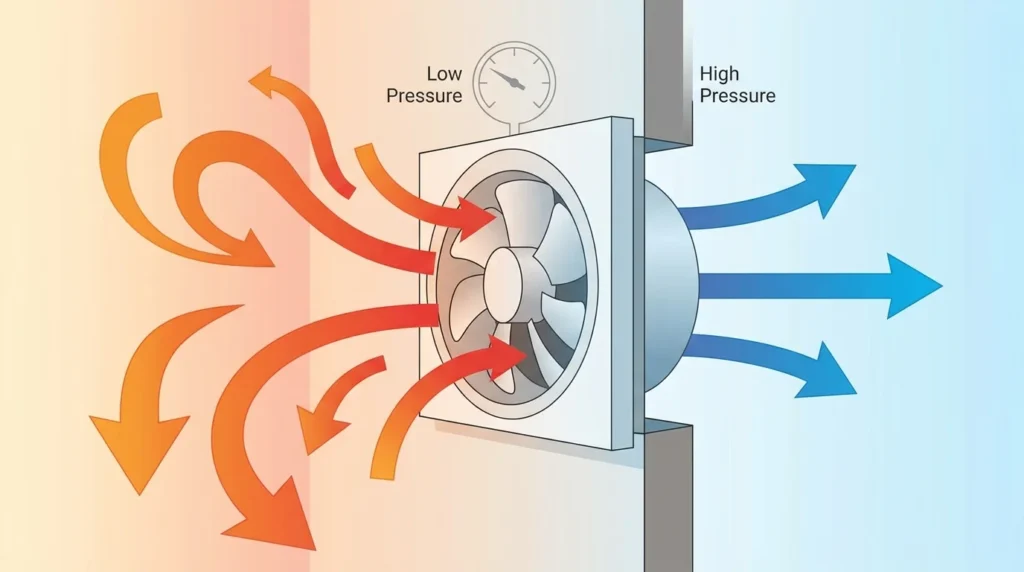
They operate using an electric motor that rotates fan blades to pull air out of a room. This creates negative pressure, which allows fresh air to enter from doors, windows, or ventilation openings.
Simple Explanation
An exhaust fan works like a suction device that pulls unwanted air out of a space. As it removes indoor air, fresh air automatically replaces it.
Practical Example
For example, in a bathroom, an exhaust fan removes humid air after a shower. This prevents condensation on walls and reduces the risk of mold growth.
Similarly, in kitchens, exhaust fans remove smoke, cooking fumes, and strong odors.
Exhaust Fans Working Principle
The exhaust fans working principle is based on air extraction through rotating blades powered by an electric motor.
When the fan rotates, it creates a pressure difference that forces indoor air to move outside.
Step-by-Step Working Process
- Electric motor starts
When power is supplied, the motor begins rotating the fan blades.
- Blades rotate at high speed
The rotating blades pull air toward the fan.
- Air is drawn from the room
Indoor air containing heat, moisture, or smoke is pulled into the fan.
- Air moves through the fan housing
The air passes through the fan assembly and exits through the exhaust opening.
- Air is expelled outside
The unwanted air is released outside the building.
- Fresh air enters the room
As the fan removes air, fresh air naturally enters through windows, doors, or ventilation openings.
Simple Analogy
Think of an exhaust fan like a vacuum cleaner for air. Instead of collecting dust, it removes unwanted air from a room.
Types of Exhaust Fans
Exhaust fans are available in different designs depending on installation location and airflow requirements.
Wall-Mounted Exhaust Fans
Wall-mounted exhaust fans are installed directly in walls.
Features include:
- Simple installation
- Commonly used in kitchens and bathrooms
- Direct air exhaust to outside
These are among the most widely used household exhaust fans.
Ceiling Exhaust Fans
Ceiling-mounted exhaust fans are installed in ceilings and connected to duct systems.
Benefits include:
- Ideal for bathrooms
- Hidden installation
- Efficient air removal
Window Exhaust Fans
Window exhaust fans are installed in window openings.
Advantages include:
- Easy installation
- Suitable for small rooms
- No duct system required
Inline Exhaust Fans
Inline fans are installed inside ventilation ducts.
Characteristics include:
- Quiet operation
- Suitable for large ventilation systems
- Used in commercial buildings
Industrial Exhaust Fans
Industrial exhaust fans are designed for large spaces such as factories.
Features include:
- High airflow capacity
- Heavy-duty construction
- Ability to remove heat, smoke, and fumes
Main Components of Exhaust Fans
Exhaust fans consist of several mechanical and electrical components that ensure proper operation.
Electric Motor
The electric motor powers the fan blades.
Most exhaust fans use single-phase induction motors.
Fan Blades
Fan blades rotate to move air out of the room.
Their design affects airflow efficiency.
Fan Housing
The housing protects internal components and guides airflow through the fan.
Exhaust Duct
In some installations, ducts carry air from the fan to the outside environment.
Protective Grille
The grille prevents objects from entering the fan and protects the blades.
Mounting Frame
The mounting frame secures the fan in the wall, ceiling, or window.
Control Switch
The switch allows users to turn the fan on or off.
Some modern systems include timers or humidity sensors.
Exhaust Fans Advantages
Understanding exhaust fans advantages and disadvantages helps engineers and technicians evaluate ventilation systems.
Key Advantages
- Improves indoor air quality
- Removes humidity and moisture
- Eliminates odors and smoke
- Prevents mold and mildew growth
- Reduces heat buildup
- Energy-efficient ventilation solution
- Simple installation and maintenance
Real-World Benefits
Exhaust fans help maintain healthy living conditions in homes and workplaces.
Disadvantages / Limitations
Although exhaust fans provide many benefits, they also have some limitations.
Common Limitations
- Cannot significantly cool a room like air conditioners
- Requires proper ventilation openings for fresh air
- May produce noise during operation
- Dust accumulation can reduce efficiency
- Large industrial fans require higher power
These factors should be considered during system design and installation.
Exhaust Fans Applications
The exhaust fans applications are widely seen in residential, commercial, and industrial environments.
Residential Applications
Exhaust fans are commonly used in:
- Kitchens
- Bathrooms
- Laundry rooms
They remove moisture, smoke, and odors.
Commercial Applications
Many commercial spaces use exhaust fans, including:
- Restaurants
- Office buildings
- Shopping malls
They maintain proper air circulation.
Industrial Applications
Industrial exhaust fans are used in:
- Factories
- Workshops
- Chemical plants
They remove smoke, fumes, and heat from machinery.
Agricultural Applications
Exhaust fans are also used in:
- Poultry farms
- Greenhouses
- Livestock buildings
They improve ventilation and temperature control.
Difference Between Exhaust Fan and Ventilation Fan
Understanding the difference between exhaust fan and ventilation fan helps clarify their roles in air circulation systems.
| Feature | Exhaust Fan | Ventilation Fan |
|---|---|---|
| Main Function | Removes indoor air | Circulates indoor air |
| Airflow Direction | Inside to outside | Inside circulation |
| Purpose | Remove heat, smoke, humidity | Improve airflow inside room |
| Installation | Wall, ceiling, window | Ceiling or wall |
| Typical Use | Kitchens, bathrooms | Living rooms, offices |
Exhaust fans remove contaminated air, while ventilation fans mainly circulate air within a space.
Selection Guide
Choosing the right exhaust fan requires evaluating several important factors.
Room Size
The fan capacity should match the room size.
Airflow capacity is usually measured in CFM (Cubic Feet per Minute).
Installation Location
Select a fan designed for:
- Wall mounting
- Ceiling mounting
- Window installation
Noise Level
Low-noise fans are preferred for homes and offices.
Energy Efficiency
Energy-efficient fans reduce electricity consumption.
Special Features
Some modern fans include:
- Humidity sensors
- Timer functions
- Automatic operation
Common Problems and Solutions
Exhaust fans may experience common operational issues.
Why is the exhaust fan not working?
Possible causes:
- Power supply failure
- Faulty switch
- Motor damage
Solution: Check electrical connections and inspect the motor.
Why is the exhaust fan making noise?
Cause:
Loose screws or worn bearings.
Solution:
Tighten components and replace damaged bearings.
Why is airflow weak?
Cause:
Dust accumulation on blades or blocked vents.
Solution:
Clean the fan and ventilation openings.
Why is the fan vibrating?
Cause:
Improper installation or unbalanced blades.
Solution:
Reinstall the fan correctly and inspect blade alignment.
Future Trends
Exhaust fan technology continues to improve with new innovations.
Smart Exhaust Fans
Modern exhaust fans now include:
- Smart sensors
- Automatic humidity detection
- Remote control operation
Energy-Efficient Motors
Advanced motor technologies reduce electricity consumption while maintaining strong airflow.
Quiet Operation Technology
New blade designs reduce noise levels significantly.
Integrated Ventilation Systems
Future ventilation systems may combine exhaust fans with air purification and smart ventilation control.
These improvements will make exhaust fans more efficient and reliable.
Conclusion
Exhaust fans are essential ventilation devices used to remove unwanted air, humidity, and pollutants from indoor environments. Their simple design and effective operation make them widely used in homes, offices, and industrial facilities.
In this article, we discussed the exhaust fans working principle, types, components, advantages, disadvantages, and exhaust fans applications. We also explained the difference between exhaust fan and ventilation fan, helping beginners understand how different ventilation systems work.
For electrical students, engineers, and technicians, understanding exhaust fans provides valuable knowledge about airflow mechanics, electric motors, and ventilation systems.
As technology advances, exhaust fans will continue to evolve with smarter controls, improved efficiency, and quieter operation, making them even more effective for maintaining healthy indoor environments.