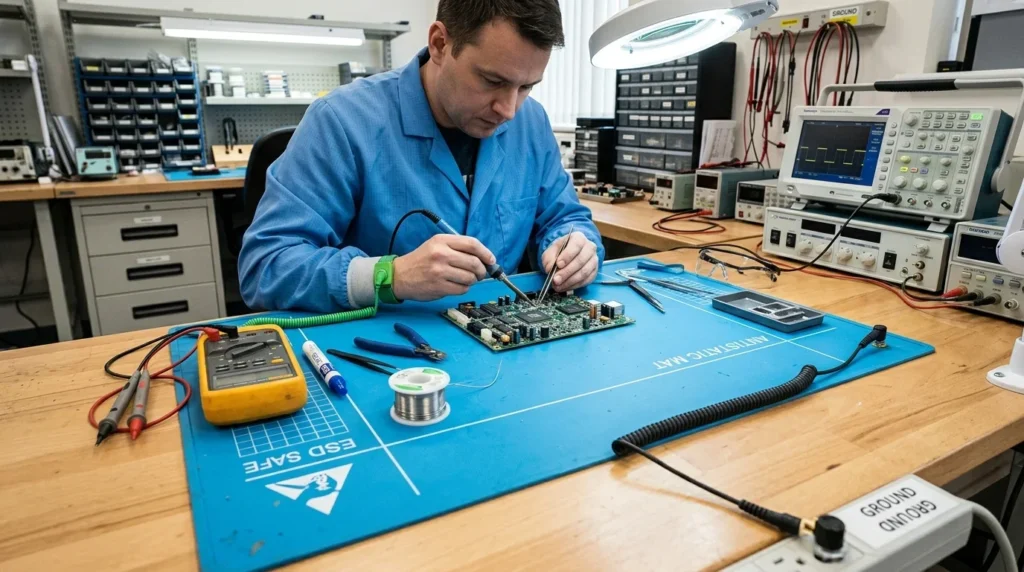

Imagine you are repairing a laptop motherboard or assembling a delicate electronic circuit in a lab. Everything seems fine, but suddenly a tiny electronic component stops working. Surprisingly, the damage may not be caused by a tool or wiring mistake. Instead, it might be caused by electrostatic discharge (ESD) from your body.
Static electricity can easily damage sensitive electronic components such as integrated circuits, microchips, and semiconductor devices. Even a very small electrostatic charge that humans cannot feel can destroy these components. This is why engineers and technicians use protective equipment such as ESD mats in electronic workstations.
An ESD mat is a special protective surface designed to safely discharge static electricity and prevent damage to electronic devices. It is widely used in electronics repair labs, manufacturing plants, research laboratories, and computer hardware workshops.
For electrical students, technicians, and engineers, understanding how ESD protection works is essential. In this article, you will learn about ESD mat working principle, types, components, ESD mat applications, and ESD mat advantages and disadvantages. You will also learn how to choose the right ESD mat and solve common problems when using one.
What is an ESD Mat?
An ESD mat (Electrostatic Discharge mat) is a specially designed surface that prevents the buildup of static electricity and safely dissipates it to the ground.
In simple terms, an ESD mat protects sensitive electronic components from damage caused by static electricity. It provides a controlled path for electrical charges to move safely to the ground instead of passing through electronic devices.
These mats are usually placed on workbenches or floors where electronic assembly, testing, or repair is performed.
Practical Example
Suppose an electronics technician is repairing a smartphone motherboard. The circuit board contains sensitive microchips that can be damaged by static electricity. If the technician places the board on an ESD mat, any static charge from the body or tools will safely discharge to the ground without harming the electronic components.
This simple protective layer helps prevent costly damage in electronics work.
ESD Mat Working Principle
The ESD mat working principle is based on safely controlling and dissipating electrostatic charges.
Instead of allowing static electricity to suddenly discharge through electronic components, the ESD mat provides a slow and controlled path to ground.
Step-by-Step Working Process
- Static charge generationStatic electricity builds up on the human body or tools due to friction or movement.
- Contact with ESD matWhen a person touches the ESD mat or places electronic components on it, the charge transfers to the mat.
- Controlled dischargeThe mat slowly conducts the electrical charge through its conductive layers.
- Grounding connectionThe charge flows through a grounding wire connected to the electrical ground.
- Safe neutralizationThe electrostatic charge safely disappears without damaging electronic components.
Simple Analogy
Think of an ESD mat like a safe drain for electricity. Just like water flows safely through a drain pipe, static electricity flows safely through the mat to the ground.
Types of ESD Mats
Different types of ESD mats are available depending on where and how they are used.
Table ESD Mats
Table ESD mats are placed on workbenches where electronics assembly or repair work is performed.
They protect circuit boards, components, and tools from static electricity.
Floor ESD Mats
Floor ESD mats are installed on workshop floors where technicians stand while working.
They help discharge static electricity from the human body through special footwear or grounding straps.
Rubber ESD Mats
Rubber ESD mats are made from durable rubber material with conductive properties.
They are commonly used in industrial electronics manufacturing environments.
Vinyl ESD Mats
Vinyl ESD mats are flexible and lightweight.
They are often used in laboratories, repair stations, and small workshops.
Three-Layer ESD Mats
These mats contain multiple layers designed for better static control.
The top layer dissipates static electricity, the middle layer controls resistance, and the bottom layer provides grounding.
Main Components of an ESD Mat
An ESD mat may look simple, but it is designed with several important layers and components.
Static Dissipative Surface
The top layer is designed to control static electricity.
It allows electrostatic charges to move slowly instead of causing sudden discharge.
Conductive Layer
This layer helps transfer electrical charges toward the grounding point.
Grounding Snap
A metal snap connector is attached to the mat.
It connects the mat to a grounding wire.
Ground Wire
The ground wire connects the ESD mat to an electrical grounding system.
This allows static electricity to safely discharge.
Base Layer
The bottom layer provides mechanical strength and prevents slipping on the work surface.
ESD Mat Advantages and Disadvantages
Understanding ESD mat advantages and disadvantages helps technicians use them effectively.
Advantages
- Protects sensitive electronic components from static damage
- Reduces risk of electrostatic discharge
- Improves safety in electronic work environments
- Durable and long-lasting
- Easy to install and maintain
- Affordable protection for expensive equipment
- Essential for professional electronics workstations
These advantages make ESD mats a standard requirement in electronics industries.
Disadvantages / Limitations
Despite their usefulness, ESD mats also have some limitations.
- Requires proper grounding to work effectively
- Low-quality mats may not provide reliable protection
- Can wear out over time with heavy use
- Requires regular cleaning and maintenance
- Static protection depends on correct installation
Understanding these limitations helps ensure proper usage.
ESD Mat Applications
The ESD mat applications are widespread in many technical fields.
Electronics Manufacturing
Factories use ESD mats to protect sensitive semiconductor devices during assembly.
Computer Repair Workshops
Technicians use ESD mats when repairing laptops, smartphones, and motherboards.
Laboratories
Research labs use ESD mats to protect electronic testing equipment.
Aerospace and Defense Industry
Highly sensitive electronics in aircraft and defense systems require strict ESD protection.
Educational Institutions
Engineering laboratories use ESD mats to teach students safe electronics handling.
Difference Between ESD Mat and Anti-Static Mat
Understanding the difference between anti-static mat and ESD mat helps choose the right protection method.
| Feature | ESD Mat | Anti-Static Mat |
|---|---|---|
| Static Control | Dissipates static electricity | Prevents static buildup |
| Protection Level | Higher protection | Moderate protection |
| Grounding | Requires grounding connection | Sometimes optional |
| Electronics Work | Highly recommended | Basic protection |
| Industrial Use | Common in electronics manufacturing | Used in general environments |
Both mats help reduce static electricity, but ESD mats provide stronger protection for sensitive electronics.
Selection Guide: How to Choose the Right ESD Mat
Choosing the correct ESD mat is important for effective protection.
Consider Material Quality
High-quality rubber or vinyl mats provide better durability and static control.
Check Resistance Rating
Good ESD mats have controlled electrical resistance to ensure safe discharge.
Size and Thickness
Select a mat size that covers the entire workspace.
Grounding System
Ensure the mat includes a reliable grounding cable and connector.
Certification
Choose mats that meet international ESD safety standards.
Common Problems and Solutions
Why is static damage still occurring?
The mat may not be properly grounded.
Solution: Check the grounding connection and ensure it is connected to earth ground.
Why is the mat not dissipating static electricity?
The mat may be dirty or worn out.
Solution: Clean the mat regularly using recommended cleaning solutions.
Why are components sticking to the surface?
Static buildup may still be present.
Solution: Ensure proper grounding and use an ESD wrist strap with the mat.
Why is the mat slipping on the table?
The bottom surface may be worn.
Solution: Use anti-slip backing or replace the mat.
Future Trends in ESD Protection
As electronics become smaller and more sensitive, ESD protection technology continues to improve.
Advanced Materials
New materials provide better static control and longer lifespan.
Smart ESD Monitoring
Future systems may include sensors that monitor static levels in real time.
Integrated Workstations
Modern electronic workstations may include built-in ESD protection surfaces.
Improved Grounding Systems
Advanced grounding technologies will provide better safety and reliability.
These improvements will help protect increasingly sensitive electronic components.
Conclusion
An ESD mat is a critical safety tool used in electronics work to protect sensitive components from electrostatic discharge. Even a small amount of static electricity can damage delicate electronic devices, making ESD protection extremely important in modern technology environments.
Understanding the ESD mat working principle, types, components, and ESD mat applications helps electrical students and technicians maintain safe workstations. Proper installation and grounding ensure that static electricity is safely dissipated without harming electronic circuits.
Although ESD mats have some limitations, their benefits far outweigh the drawbacks. By selecting the right mat and maintaining it properly, technicians can prevent costly electronic damage and ensure reliable circuit assembly and repair.
For anyone working with electronics, using an ESD mat is not just a recommendation—it is an essential professional practice.