
Imagine receiving your monthly electricity bill and wondering how the electricity company knows exactly how much energy your home used. Every appliance in your house—from lights and fans to refrigerators and air conditioners—consumes electrical energy. To measure this consumption accurately, a device called an Energy Meter is used.
An Energy Meter is installed in almost every home, office, and industrial facility. It records the amount of electrical energy consumed over time and helps utility companies calculate electricity bills. Without energy meters, it would be impossible to measure electricity usage fairly and efficiently.
Understanding the Energy Meter working principle is very important for electrical students, engineers, technicians, and beginners. It helps in learning how electrical energy is measured, monitored, and controlled in real-world systems.
In this article, you will learn what an Energy Meter is, how it works, its main components, and different types of energy meters used today. We will also discuss Energy Meter applications, Energy Meter advantages and disadvantages, common problems, and future technologies in energy measurement.
What is Energy Meter?
Definition
An Energy Meter is an electrical measuring device used to measure the total electrical energy consumed by a load over a period of time. The unit of measurement is usually kilowatt-hour (kWh).
Simple Explanation
In simple terms, an energy meter records how much electricity your home or building uses. It measures both voltage and current and calculates the energy consumed.
Practical Example
For example, if a 1000-watt electric heater runs for one hour, it consumes 1 kilowatt-hour (kWh) of energy. The energy meter records this consumption and adds it to the total usage.
Electricity companies use this reading to prepare the electricity bill.
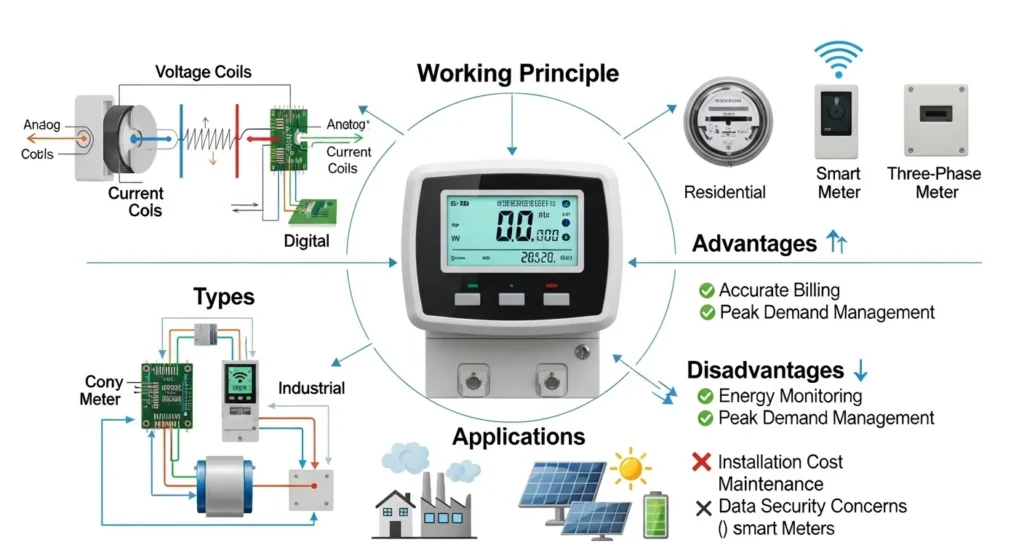
Energy Meter Working Principle
The Energy Meter working principle is based on measuring electrical power and calculating the total energy used over time.
Energy is calculated using the formula:
Energy = Power × Time
Where:
- Power is measured in watts
- Time is measured in hours
Step-by-Step Working Process
- Voltage Detection
The energy meter measures the supply voltage coming from the electrical line.
- Current Detection
It also measures the current flowing through the connected electrical load.
- Power Calculation
The meter multiplies voltage and current to calculate the electrical power.
- Energy Measurement
Power is multiplied by time to calculate total energy consumption.
- Display of Reading
The total energy consumed is displayed on the meter in kilowatt-hours (kWh).
Simple Analogy
Think of an energy meter like a water meter used in homes. Just as a water meter measures how much water flows through a pipe, an energy meter measures how much electricity flows through a circuit.
Types of Energy Meter
Energy meters are classified based on technology and application.
Induction Type Energy Meter
This is the traditional and most widely used mechanical energy meter.
It works on the electromagnetic induction principle. A rotating aluminum disc moves according to the electrical power consumed.
Characteristics:
- Mechanical design
- Rotating disc mechanism
- Common in older homes
Electronic Energy Meter
Electronic energy meters use digital circuits and electronic sensors to measure energy.
Features include:
- Higher accuracy
- Digital display
- Compact size
- Better reliability
Smart Energy Meter
Smart meters are modern digital meters with communication capability.
They can send electricity usage data directly to the utility company.
Benefits:
- Real-time monitoring
- Remote meter reading
- Improved energy management
Prepaid Energy Meter
In prepaid meters, consumers pay for electricity in advance.
Electricity usage decreases the balance stored in the meter.
Advantages:
- Better control of electricity expenses
- No surprise electricity bills
Main Components of an Energy Meter
An energy meter contains several important parts that work together to measure electricity usage.
Current Coil
The current coil carries the load current and produces a magnetic field proportional to the current.
Voltage Coil
The voltage coil is connected across the supply voltage and creates a magnetic field related to the voltage level.
Aluminum Disc
In induction meters, a lightweight aluminum disc rotates due to the interaction of magnetic fields.
The speed of the disc is proportional to power consumption.
Register Mechanism
This component records the total rotation of the disc and converts it into energy units (kWh).
Display Unit
Modern digital meters use LCD displays to show electricity consumption.
Energy Meter Advantages and Disadvantages
Advantages
Energy meters provide several real-world benefits:
- Accurate measurement of electricity consumption
- Helps calculate electricity bills fairly
- Encourages energy conservation
- Enables monitoring of power usage
- Supports energy management in industries
Modern digital meters also provide remote monitoring and advanced analytics.
Disadvantages / Limitations
Despite their usefulness, energy meters have some limitations:
- Mechanical meters may lose accuracy over time
- Smart meters require communication infrastructure
- Initial installation cost can be high
- Electrical faults may affect meter readings
However, regular maintenance and modern technology reduce these issues.
Energy Meter Applications
Energy meters are used in many areas of electrical systems.
Residential Applications
Energy meters measure electricity consumption in homes and apartments.
They help utility companies generate electricity bills.
Industrial Applications
Industries use energy meters to monitor power consumption of machines and production equipment.
This helps manage energy efficiency.
Commercial Applications
Offices, shopping malls, and commercial buildings use energy meters to track energy usage.
Renewable Energy Systems
Energy meters are also used in solar and wind power systems to measure energy generation and consumption.
Comparison: Induction Meter vs Digital Energy Meter
Understanding the difference between induction energy meter and digital energy meter is helpful for beginners.
| Feature | Induction Energy Meter | Digital Energy Meter |
|---|---|---|
| Technology | Mechanical | Electronic |
| Accuracy | Moderate | High |
| Display | Rotating dial | Digital screen |
| Maintenance | Higher | Lower |
| Data Monitoring | Limited | Advanced monitoring |
Digital meters are now replacing traditional induction meters in many countries.
Selection Guide: How to Choose the Right Energy Meter
Selecting the correct energy meter depends on several factors.
Consider Load Type
Choose a meter suitable for the type of load:
- Residential load
- Industrial load
- Commercial systems
Accuracy Class
Higher accuracy meters provide more reliable energy measurement.
Communication Features
Smart meters provide remote monitoring and data analysis.
Installation Requirements
Ensure the meter matches the voltage and current rating of the electrical system.
Budget
Basic digital meters are affordable, while smart meters provide advanced features at higher cost.
Common Problems & Solutions
Problem 1: Energy Meter Not Displaying Reading
Possible Causes:
- Power supply issue
- Internal meter fault
Solution:
Check supply voltage and consult a qualified technician.
Problem 2: Incorrect Meter Reading
Possible Causes:
- Faulty wiring
- Aging mechanical meter
Solution:
Inspect wiring and replace the meter if necessary.
Problem 3: Meter Running Too Fast
Possible Causes:
- Electrical leakage
- Faulty appliances
Solution:
Check the electrical system and disconnect suspected loads.
Future Trends in Energy Meter Technology
Energy measurement technology continues to evolve rapidly.
Smart Grid Integration
Smart meters are becoming part of advanced smart grid systems for better energy distribution.
IoT-Based Energy Monitoring
Internet-connected meters allow real-time monitoring through mobile applications.
Renewable Energy Integration
Modern meters support solar power systems and net-metering technology.
AI-Based Energy Analysis
Future systems may use artificial intelligence to analyze energy usage patterns and suggest efficiency improvements.
Conclusion
An Energy Meter is an essential device in modern electrical systems. It measures the total electrical energy consumed by homes, industries, and commercial buildings. Understanding the Energy Meter working principle helps electrical students and professionals learn how energy measurement works in real-world applications.
Energy meters come in different types, including induction meters, electronic meters, smart meters, and prepaid meters. Each type has its own advantages depending on the application.
Modern energy meters provide accurate measurement, improved monitoring, and better energy management. However, selecting the right meter and maintaining it properly is important for reliable performance.
By understanding Energy Meter applications, components, and technologies, engineers and technicians can improve energy efficiency and support the development of smarter electrical systems.