
Imagine a large power plant producing electricity for thousands of homes. Inside the plant, massive boilers burn fuel to generate steam, which drives turbines to produce electrical power. During this process, a large amount of heat leaves the system through hot exhaust gases. If this heat is wasted, the system becomes less efficient and consumes more fuel.
This is where an economizer becomes extremely important. An economizer is a device designed to recover waste heat from exhaust gases and use it to preheat water before it enters the boiler. By doing this, the system saves fuel, improves efficiency, and reduces operating costs.
In modern industries, energy efficiency is a top priority. Power plants, factories, and heating systems use economizers to make better use of energy resources and reduce environmental impact.
In this article, you will learn the economizer working principle, different types of economizers, their main components, and their applications in industry. We will also discuss the economizer advantages and disadvantages, common problems, and tips for selecting the right economizer system. This guide is written in simple language so electrical students, technicians, and beginners can clearly understand the concept.
2. What is Economizer?
An economizer is a heat recovery device used in boilers and power plants to improve efficiency by using waste heat from exhaust gases to preheat feedwater.
Simple Explanation
In simple terms, an economizer captures heat that would normally escape through the chimney and uses it to warm water before it enters the boiler. This reduces the amount of fuel required to produce steam.
Practical Example
Consider a thermal power plant where fuel is burned to generate steam. Without an economizer, the hot gases leaving the boiler go directly into the chimney. With an economizer installed, these hot gases pass through tubes containing feedwater, transferring heat to the water before it reaches the boiler.
This process increases efficiency and reduces fuel consumption.
3. Economizer Working Principle
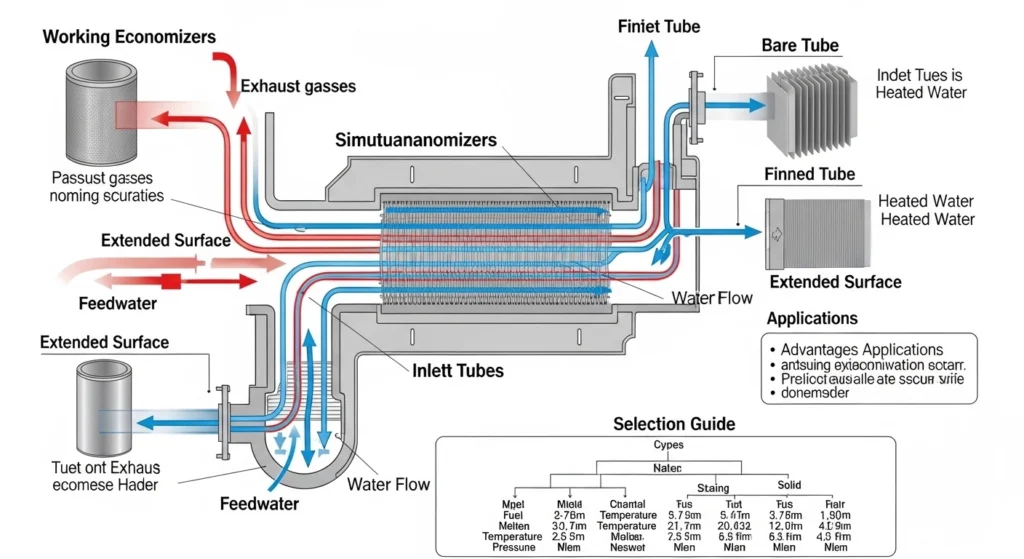
The economizer working principle is based on heat exchange between hot exhaust gases and cold feedwater.
Step-by-Step Working
The operation of an economizer typically follows these steps:
- Hot flue gases exit the boiler furnace.
- These gases pass through economizer tubes.
- Cold feedwater flows inside the tubes.
- Heat from the exhaust gases transfers to the water.
- The preheated water then enters the boiler.
Because the water is already warm, the boiler needs less energy to convert it into steam.
Easy Analogy
Think of boiling water for tea. If the water is already warm before placing it on the stove, it will boil faster and require less heat. The economizer performs the same function in a boiler system.
Key Benefits of the Working Process
- Reduces fuel consumption
- Improves boiler efficiency
- Reduces heat waste
4. Types / Classification
Economizers are classified based on design, material, and working conditions.
Non-Condensing Economizer
This is the most common type used in boilers.
Features
- Operates above the condensation temperature of flue gases
- Prevents corrosion caused by acidic condensation
- Suitable for standard industrial boilers
Usage
Widely used in power plants and manufacturing industries.
Condensing Economizer
This type is designed to recover additional heat by condensing water vapor from exhaust gases.
Features
- Higher efficiency compared to non-condensing types
- Extracts latent heat from water vapor
- Suitable for high-efficiency heating systems
Usage
Common in modern heating systems and advanced industrial boilers.
Feedwater Economizer
This economizer specifically preheats boiler feedwater before it enters the steam drum.
Features
- Installed in the exhaust path of the boiler
- Improves steam generation efficiency
5. Main Components
An economizer consists of several important parts that allow it to perform heat exchange efficiently.
1. Heat Exchange Tubes
These tubes carry feedwater and allow heat transfer from exhaust gases.
2. Inlet Header
The inlet header distributes feedwater evenly into the economizer tubes.
3. Outlet Header
After heating, the water exits through the outlet header and flows into the boiler.
4. Casing
The casing encloses the economizer system and directs exhaust gases through the heat exchange area.
5. Support Structure
The economizer is mounted on strong structures to withstand high temperatures and mechanical stress.
6. Advantages
The economizer advantages and disadvantages are important for understanding its value in industrial systems.
Advantages
- Improves boiler efficiency
- Reduces fuel consumption
- Saves energy costs
- Decreases greenhouse gas emissions
- Extends boiler life
- Improves steam production efficiency
Real-World Benefits
Power plants using economizers can significantly reduce operational costs while producing the same amount of energy.
7. Disadvantages / Limitations
Despite its benefits, economizers have some limitations.
Disadvantages
- Initial installation cost can be high
- Requires regular maintenance
- Corrosion risk in certain conditions
- Fouling caused by soot or dust buildup
However, proper design and maintenance can minimize these issues.
8. Economizer Applications
The economizer applications are found in many industries where heat recovery improves efficiency.
Power Plants
Economizers are widely used in thermal power plants to increase steam generation efficiency.
Industrial Boilers
Factories that use steam boilers rely on economizers to reduce fuel consumption.
HVAC Systems
Modern heating, ventilation, and air conditioning systems use economizers to improve energy efficiency.
Data Centers
Some cooling systems use economizer technology to reduce electricity consumption.
9. Comparison Section
Many students ask about the difference between economizer and air preheater. Both devices recover heat but operate differently.
| Feature | Economizer | Air Preheater |
|---|---|---|
| Function | Preheats boiler feedwater | Preheats combustion air |
| Heat Source | Flue gas heat | Flue gas heat |
| Position in Boiler | Before the boiler inlet | Before furnace air intake |
| Purpose | Improve boiler efficiency | Improve combustion efficiency |
Understanding the difference between economizer and air preheater helps engineers design efficient thermal systems.
10. Selection Guide
Choosing the right economizer depends on several technical factors.
Important Selection Factors
- Boiler capacity
- Flue gas temperature
- Fuel type
- Water flow rate
- Space availability
Tips for Beginners
- Always check compatibility with boiler systems
- Choose corrosion-resistant materials
- Ensure easy maintenance access
Proper selection improves long-term reliability.
11. Common Problems & Solutions
Problem 1: Tube Leakage
Cause: Corrosion or mechanical damage.
Solution: Regular inspection and timely replacement of damaged tubes.
Problem 2: Reduced Heat Transfer
Cause: Soot or dust accumulation on tubes.
Solution: Clean the economizer regularly to maintain efficiency.
Problem 3: Excessive Pressure Drop
Cause: Blocked gas flow or poor design.
Solution: Improve airflow and maintain proper system design.
12. Future Trends
Economizer technology continues to improve as industries focus on energy efficiency.
Advanced Materials
Modern economizers use corrosion-resistant alloys to increase durability.
Smart Monitoring Systems
Sensors and automation help monitor temperature, pressure, and performance.
Energy Efficiency Regulations
Governments and industries encourage heat recovery technologies to reduce energy waste.
Economizers will play a major role in sustainable power generation.
13. Conclusion
An economizer is an essential heat recovery device used in boilers and power plants to improve energy efficiency. By capturing waste heat from exhaust gases and using it to preheat feedwater, the economizer significantly reduces fuel consumption and improves system performance.
Understanding the economizer working principle, types, components, and economizer applications helps engineers and technicians design more efficient thermal systems. While there are some limitations such as maintenance requirements and installation costs, the long-term benefits usually outweigh these challenges.
For electrical students and beginners, learning about economizers is important because they are widely used in modern power generation and industrial systems. As energy efficiency becomes increasingly important worldwide, economizers will continue to play a vital role in improving boiler performance and reducing energy waste.