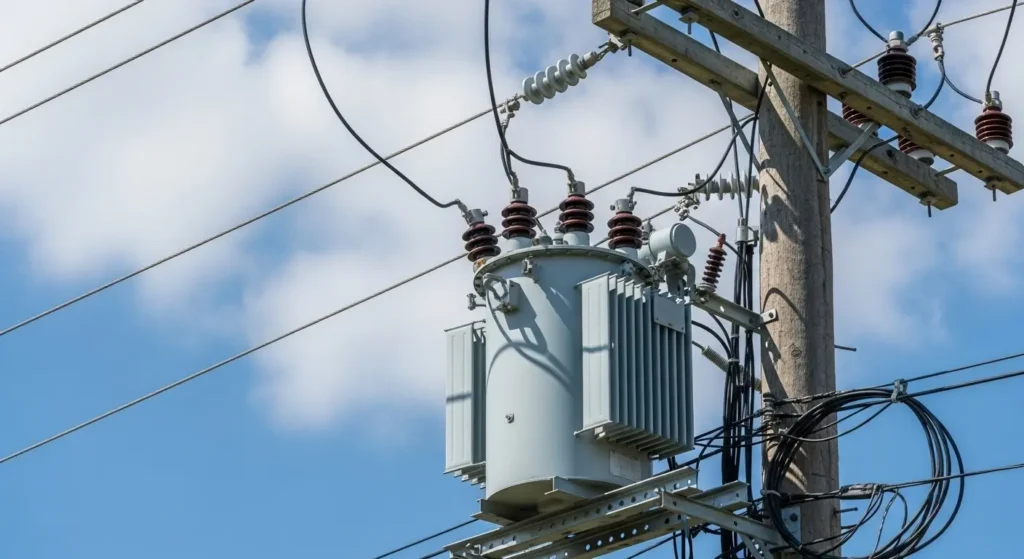

Imagine you are standing near a residential street. You see a gray metal box mounted on an electric pole. From that box, wires go into nearby houses. Inside those homes, people are using fans, lights, refrigerators, and mobile chargers safely at 220–240 volts.
But the electricity coming from the power station is not 220 volts. It is transmitted at very high voltage, sometimes 11kV or even higher. So how does it become safe for home use?
The answer is a Distribution Transformer.
Understanding the Distribution Transformer is essential for every electrical student, technician, and engineer. It plays a key role in the final stage of power delivery. Without it, electricity from power plants would be too dangerous for homes and small industries.
In this article, you will learn the Distribution Transformer working principle, types, components, applications, advantages and disadvantages, comparison with power transformers, selection tips, and troubleshooting guidance. I will explain everything clearly, just like guiding a junior engineer in the field.
2. What is Distribution Transformer?
A Distribution Transformer is an electrical device used to reduce high distribution voltage to a lower voltage suitable for homes, offices, and small industries.
Simple Definition
It is a step-down transformer that operates at the final stage of the power distribution system.
Simple Explanation
Electricity is generated at power plants and transmitted at high voltage to reduce power losses. Before reaching consumers, this high voltage must be reduced to a safe level. The Distribution Transformer performs this function.
For example:
- Input voltage: 11kV
- Output voltage: 400V (three-phase) or 230V (single-phase)
Practical Example
In most residential areas, you will find a pole-mounted transformer rated 25 kVA, 63 kVA, or 100 kVA. That is a Distribution Transformer supplying electricity to nearby homes.
3. Distribution Transformer Working Principle
The Distribution Transformer working principle is based on electromagnetic induction.
It works on the same basic principle as other transformers but is specially designed for continuous operation at varying loads.
Step-by-Step Working
- High Voltage Input
High-voltage AC (like 11kV) enters the primary winding. - Magnetic Field Creation
AC current creates a changing magnetic field in the iron core. - Magnetic Flux Transfer
The magnetic flux links with the secondary winding. - Induced Voltage
A lower voltage is induced in the secondary winding. - Output Supply
Reduced voltage is supplied to consumers.
Easy Analogy
Think of water flowing through a large pipe at high pressure. Before entering your home, the pressure is reduced using a valve.
The transformer works like that valve — reducing voltage to a safe level.
Key Points
- Works only with AC supply
- Frequency remains the same
- Voltage decreases, current increases
- Designed for high efficiency at low load
4. Types / Classification of Distribution Transformer
4.1 Oil-Immersed Distribution Transformer
This is the most common type.
- Core and windings are immersed in transformer oil
- Oil provides cooling and insulation
- Used in outdoor installations
These are reliable and widely used in rural and urban areas.
4.2 Dry-Type Distribution Transformer
In this type, no oil is used.
- Air-cooled
- Installed indoors
- Safer in fire-sensitive areas
Used in hospitals, malls, and commercial buildings.
4.3 Pole-Mounted Transformer
- Installed on electric poles
- Used in residential areas
- Small capacity (25–100 kVA)
4.4 Pad-Mounted Transformer
- Installed at ground level
- Enclosed in locked metal cabinets
- Used in underground distribution systems
Each type is selected based on location and safety requirements.
5. Main Components of Distribution Transformer
Understanding components helps in maintenance and troubleshooting.
5.1 Core
- Made of laminated silicon steel
- Provides magnetic path
- Reduces energy loss
5.2 Primary Winding
- Connected to high voltage
- Usually fewer turns, thicker insulation
5.3 Secondary Winding
- Provides low voltage output
- More turns compared to primary
5.4 Transformer Oil (in oil type)
- Provides cooling
- Acts as insulation
- Prevents overheating
5.5 Tank
- Protects internal parts
- Filled with oil (in oil type)
5.6 Bushings
- Insulated terminals
- Allow safe connection of external wires
5.7 Conservator (in larger units)
- Maintains oil level
- Handles oil expansion
Each component plays an important role in safe and efficient operation.
6. Distribution Transformer Advantages
The Distribution Transformer advantages and disadvantages must be understood clearly.
Advantages
- High efficiency at low loads
- Continuous operation capability
- Reliable for residential supply
- Low maintenance requirement
- Long service life
- Compact design for pole mounting
Real-World Benefits
- Safe electricity for homes
- Reduced transmission losses
- Stable voltage supply
- Economical power distribution
7. Disadvantages / Limitations
Even though it is essential, there are some limitations:
- Efficiency decreases at full load
- Oil leakage risk (in oil type)
- Regular maintenance required
- Limited capacity compared to power transformers
- Exposure to weather in outdoor installations
Understanding these practical limitations helps engineers design better systems.
8. Distribution Transformer Applications
The Distribution Transformer applications are mainly at the consumer level.
8.1 Residential Areas
- Supplies 230V to homes
- Powers lights, fans, and appliances
8.2 Commercial Buildings
- Offices
- Shopping malls
- Hospitals
8.3 Small Industries
- Workshops
- Small factories
- Water pumping stations
8.4 Rural Electrification
- Villages
- Agricultural pump systems
8.5 Renewable Energy Systems
- Solar distribution networks
- Local microgrids
It is the final link between the grid and the end user.
9. Comparison Section
Difference Between Distribution Transformer and Power Transformer
Many students ask about the difference between power transformer and distribution transformer.
| Feature | Distribution Transformer | Power Transformer |
|---|---|---|
| Purpose | Final voltage reduction | Transmission level |
| Location | Near consumers | Power stations/substations |
| Capacity | Low to medium (25–500 kVA) | Very high (MVA range) |
| Load Condition | Operates at varying load | Operates near full load |
| Efficiency Focus | High at low load | High at full load |
| Voltage Level | 11kV to 400V | 132kV and above |
This difference between power transformer and distribution transformer is mainly based on location, capacity, and load condition.
10. Selection Guide
Choosing the right Distribution Transformer requires careful planning.
1. Load Calculation
Calculate total connected load in kW or kVA.
2. Future Expansion
Add 20–30% extra capacity for future growth.
3. Voltage Rating
Match primary and secondary voltage properly.
4. Installation Location
- Indoor → Dry type
- Outdoor → Oil type
5. Cooling Requirement
Check ambient temperature conditions.
6. Safety Standards
Follow national electrical standards.
For beginners: Never select transformer rating without proper load estimation.
11. Common Problems & Solutions
Q1: Why is the transformer overheating?
Reason: Overloading or low oil level.
Solution: Reduce load and check oil.
Q2: Why is output voltage low?
Reason: High load or loose connection.
Solution: Tighten terminals and check load.
Q3: Why is oil leaking?
Reason: Damaged gasket.
Solution: Replace gasket immediately.
Q4: Why is there humming noise?
Reason: Loose core laminations.
Solution: Mechanical tightening required.
Q5: Why do fuses blow frequently?
Reason: Short circuit in secondary.
Solution: Inspect distribution lines.
Routine inspection prevents major failures.
12. Future Trends
The transformer industry is evolving.
Smart Transformers
Integrated monitoring sensors for temperature and load.
Eco-Friendly Insulation
Use of biodegradable oils.
Energy-Efficient Designs
Lower core losses using advanced materials.
IoT Monitoring
Remote health monitoring and predictive maintenance.
Future Distribution Transformer systems will focus on efficiency, safety, and smart grid compatibility.
13. Conclusion
A Distribution Transformer is one of the most important devices in the electrical power system. It safely reduces high voltage to usable levels for homes and small industries.
Understanding the Distribution Transformer working principle, components, applications, and the difference between power transformer and distribution transformer is essential for every electrical professional.
Although it has some limitations, its advantages in safety, reliability, and efficiency make it indispensable. As a future engineer, always focus on correct selection, proper installation, and routine maintenance. Strong knowledge of Distribution Transformer technology will build a solid foundation in power distribution engineering.