
Imagine a heavy crane lifting several tons of steel in a construction site. When the operator presses the control button, the motor must produce very high starting torque to lift the load instantly. In many such situations, engineers use a DC Series Motor because it can generate powerful starting torque.
Electric motors are widely used in industries to convert electrical energy into mechanical motion. Among different types of DC motors, the DC Series Motor is known for its strong starting power and ability to handle heavy loads. This is why it is commonly used in electric trains, cranes, hoists, and industrial lifting machines.
For electrical students, technicians, and engineers, understanding this motor is very important. Knowing how the DC Series Motor working principle operates helps professionals choose the right motor for specific tasks and maintain equipment properly.
In this article, you will learn what a DC Series Motor is, how it works, its types, components, advantages and disadvantages, and its real-world applications. The explanation is written in simple and clear language, just like a senior electrical engineer explaining the concept to a junior technician or student.
What is a DC Series Motor?
A DC Series Motor is a type of DC motor in which the field winding is connected in series with the armature winding.
Because the field winding and armature are connected in series, the same current flows through both. When the current increases, the magnetic field strength also increases, producing very high torque.
Simple Explanation
In a DC series motor:
- The field winding and armature winding are connected in one path.
- The same electric current flows through both windings.
- Higher current produces a stronger magnetic field and greater torque.
This design allows the motor to produce powerful starting torque, making it ideal for heavy-load applications.
Practical Example
A common example is an electric crane. When lifting heavy materials, the motor must produce strong torque at the beginning. A DC series motor performs this task efficiently.
DC Series Motor Working Principle
The DC Series Motor working principle is based on the interaction between a magnetic field and a current-carrying conductor.
When current flows through the armature conductors placed in a magnetic field, a force is generated according to electromagnetic force laws. This force produces rotation.
Step-by-Step Operation
- DC voltage is applied to the motor terminals.
- Current flows through the series field winding.
- The field winding creates a magnetic field.
- The same current flows through the armature winding.
- Armature conductors interact with the magnetic field.
- Electromagnetic force produces torque.
- The commutator reverses current direction to maintain rotation.
Easy Analogy
Think of the motor like a person pushing a heavy cart.
- The stronger the push (current),
- The stronger the movement (torque).
Because current increases under load, the motor automatically produces more torque when needed.
Key Characteristics
- High starting torque
- Speed varies with load
- Speed increases when load decreases
This is why DC series motors must never run without load.
Types / Classification of DC Series Motor
Although the basic design is similar, DC series motors can be classified based on construction and control methods.
Standard DC Series Motor
This is the most common type used in traditional electrical machines.
Features:
- Series field winding connected with armature
- High starting torque
- Simple design
Used in cranes, hoists, and traction systems.
Compensated DC Series Motor
In this motor, compensating windings are added to reduce armature reaction.
Features:
- Improved performance
- Better efficiency
- Reduced sparking at brushes
Often used in high-performance traction motors.
Interpole Series Motor
Interpole windings are added between the main poles.
Features:
- Better commutation
- Reduced sparking
- Improved reliability
Common in heavy industrial motors.
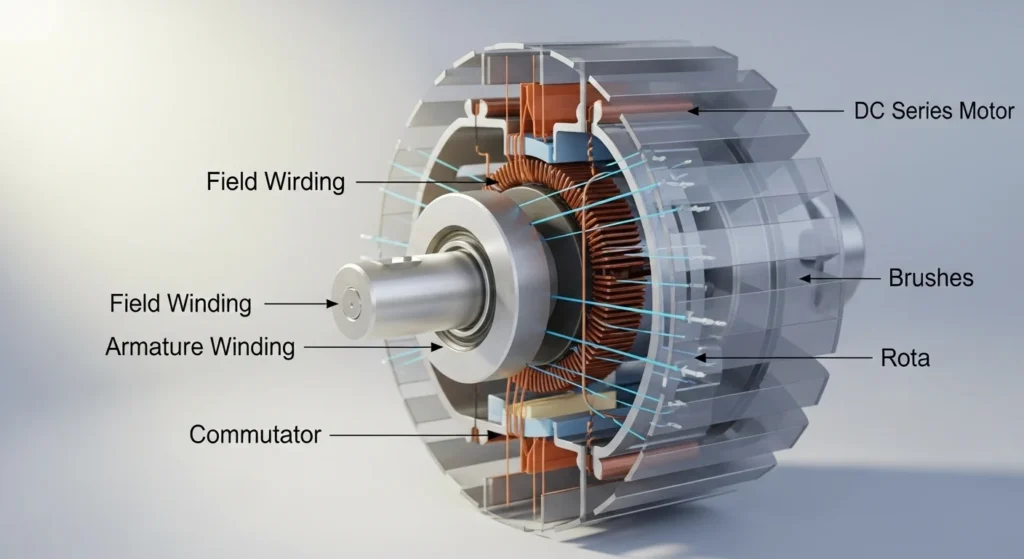
Main Components of DC Series Motor
A DC series motor contains several important parts that work together to produce motion.
Armature
The armature is the rotating part of the motor.
Functions:
- Carries electric current
- Produces torque through electromagnetic interaction
Series Field Winding
The series field winding produces the magnetic field.
Features:
- Connected in series with armature
- Carries full armature current
- Uses thick wire with fewer turns
Commutator
The commutator is a mechanical switching device.
Functions:
- Reverses current direction
- Maintains continuous rotation
Brushes
Brushes are typically made of carbon or graphite.
Functions:
- Transfer electrical current to the rotating commutator.
Stator
The stator forms the stationary structure of the motor and holds the field poles.
Shaft
The shaft transfers mechanical power from the motor to the connected machine or load.
DC Series Motor Advantages
The DC Series Motor advantages and disadvantages must be considered before selecting the motor.
Advantages include:
- Very high starting torque
- Simple construction
- Strong performance under heavy loads
- Good acceleration
- Reliable for traction systems
- Suitable for lifting equipment
- Capable of handling large load variations
Because of these benefits, series motors are widely used in industrial lifting and transportation systems.
Disadvantages / Limitations
Despite its benefits, the DC series motor has some limitations.
- Speed varies significantly with load
- Dangerous high speed under no-load condition
- Requires careful load control
- Brushes require maintenance
- Not suitable for constant speed applications
Proper operation and maintenance help reduce these issues.
DC Series Motor Applications
The DC Series Motor applications are mainly found where high starting torque is required.
Electric Traction
- Electric trains
- Trams
- Electric locomotives
These systems require powerful motors for acceleration.
Lifting Equipment
- Cranes
- Hoists
- Elevators
Heavy loads require high torque at startup.
Industrial Machines
- Rolling mills
- Press machines
- Heavy conveyors
Automobile Systems
In older systems, series motors were used in starter motors of vehicles.
Comparison: DC Series Motor vs DC Shunt Motor
Understanding the difference between DC series motor and DC shunt motor helps engineers select the right motor.
| Feature | DC Series Motor | DC Shunt Motor |
|---|---|---|
| Field Connection | Series with armature | Parallel with armature |
| Starting Torque | Very high | Moderate |
| Speed Regulation | Poor | Excellent |
| No-load Operation | Dangerous | Safe |
| Applications | Cranes, traction | Fans, machine tools |
Both motors serve different purposes depending on load and speed requirements.
Selection Guide
Choosing the right DC motor requires careful consideration.
1. Load Requirement
If the application requires very high starting torque, a DC series motor is ideal.
2. Speed Control
Avoid using series motors where constant speed is required.
3. Safety Conditions
Ensure the motor always operates with a load.
4. Power Supply
Verify that the available power supply matches the motor rating.
5. Maintenance Capability
Series motors require periodic inspection of brushes and commutator.
Common Problems & Solutions
Motor Running Too Fast
Cause:
- Motor running without load.
Solution:
- Always connect the motor to a proper load.
Excessive Sparking
Cause:
- Dirty commutator
- Brush wear
Solution:
- Clean commutator
- Replace brushes
Motor Overheating
Cause:
- Overload
- Poor ventilation
Solution:
- Reduce load
- Improve cooling system
Motor Not Starting
Cause:
- Power supply problem
- Broken winding
Solution:
- Check supply voltage
- Inspect winding connections
Future Trends
Modern industries are gradually shifting toward AC drives and brushless motors, but DC series motors still play an important role in certain applications.
Future developments include:
- Improved motor insulation
- Advanced electronic speed controllers
- Smart monitoring systems
- Integration with industrial automation
- Energy-efficient motor designs
These improvements will help extend the life and efficiency of traditional DC motors.
Conclusion
The DC Series Motor is one of the most powerful DC motors used in electrical engineering. Its ability to produce very high starting torque makes it ideal for heavy-duty applications such as cranes, electric trains, and lifting machines.
In this article, we explored the DC Series Motor working principle, types, components, advantages and disadvantages, and real-world applications. Understanding these concepts helps electrical students and technicians select the right motor for different tasks and maintain equipment properly.
Although modern motor technologies are evolving rapidly, DC series motors remain important in industries where strong starting torque and heavy-load performance are required.
Learning about DC motors provides a strong foundation for understanding advanced electrical machines and motor control systems.