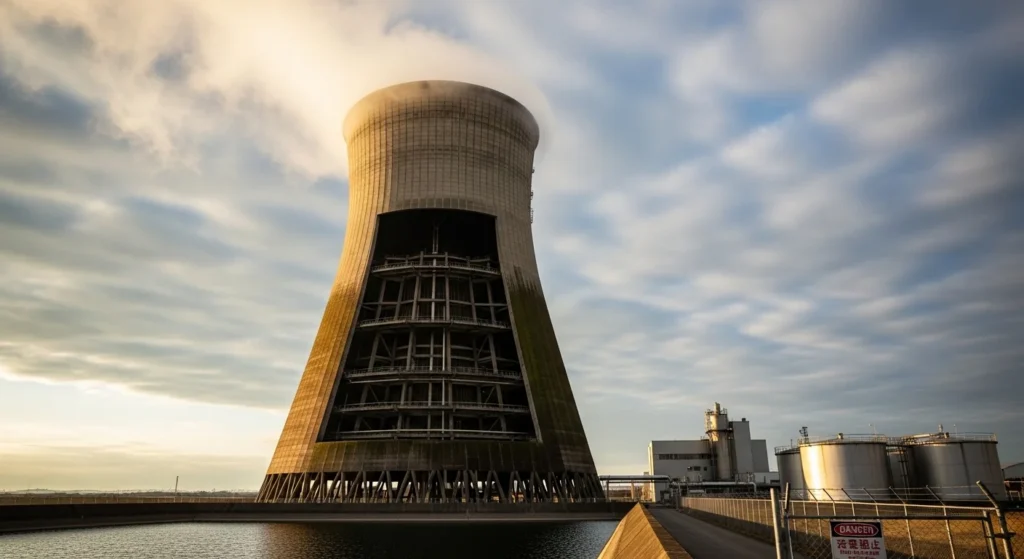

Imagine a large thermal power plant producing electricity for thousands of homes. Inside the plant, machines generate a huge amount of heat while producing power. If this heat is not removed efficiently, equipment can overheat, system efficiency will drop, and the entire plant may shut down. This is where a Cooling Tower becomes extremely important.
A cooling tower is a vital part of many industrial systems that require continuous heat removal. It helps remove excess heat from water used in industrial processes and power generation. By cooling the water and sending it back into the system, the cooling tower ensures smooth and efficient operation.
Cooling towers are commonly used in power plants, chemical industries, oil refineries, air-conditioning plants, and large manufacturing facilities. Without proper cooling systems, many modern industries would not operate safely or efficiently.
In this article, you will learn the Cooling Tower working principle, different types of cooling towers, Cooling Tower applications, components, and the Cooling Tower advantages and disadvantages. The explanation is written in simple and clear language so electrical students, engineers, technicians, and beginners can easily understand how cooling towers work in real engineering systems.
2. What is a Cooling Tower?
A Cooling Tower is a heat rejection device used to remove excess heat from water by transferring it to the atmosphere.
In industrial systems, water is often used to absorb heat from machines and equipment. This hot water must be cooled before it can be reused. A cooling tower performs this cooling process efficiently.
Simple Explanation
A cooling tower cools hot water by exposing it to air. As water interacts with air, a small portion of the water evaporates. This evaporation removes heat from the remaining water, lowering its temperature.
Practical Example
Consider a thermal power plant. Steam turbines generate electricity but produce hot water during the process. This hot water enters the cooling tower, where it is cooled by air and evaporation. The cooled water is then reused in the system.
This continuous cooling cycle allows power plants to operate safely and efficiently.
3. Cooling Tower Working Principle
The Cooling Tower working principle is based on evaporative cooling.
When warm water comes in contact with moving air, a small amount of the water evaporates. This evaporation removes heat from the remaining water, causing it to cool.
Step-by-Step Operation
- Hot water from the industrial process enters the cooling tower.
- Water is distributed over fill material inside the tower.
- Air flows through the tower using natural draft or fans.
- Some water evaporates when it contacts the air.
- Heat is removed from the remaining water.
- The cooled water collects in a basin at the bottom.
- The cooled water is pumped back into the system.
Simple Analogy
Think about how your body cools through sweating. When sweat evaporates from your skin, it removes heat from your body.
A cooling tower works in a similar way—evaporation removes heat from water.
Key Heat Transfer Processes
Cooling towers remove heat through:
- Evaporation
- Convection
- Heat transfer between air and water
These processes allow cooling towers to handle very large amounts of heat.
4. Types / Classification of Cooling Towers
Cooling towers are classified based on airflow method and design.
Natural Draft Cooling Tower
Natural draft cooling towers rely on natural airflow created by temperature differences.
Features
- Very large tower structures
- No mechanical fans required
- Common in large power plants
Advantages
- Low operating energy cost
- High capacity cooling
Mechanical Draft Cooling Tower
Mechanical draft towers use fans to move air through the tower.
Features
- Controlled airflow
- Smaller size than natural draft towers
These are widely used in industries.
Mechanical draft towers are further divided into two types.
Induced Draft Cooling Tower
Fans are placed at the top of the tower to pull air upward.
Benefits:
- Higher cooling efficiency
- Better airflow distribution
Forced Draft Cooling Tower
Fans are installed at the base to push air into the tower.
Benefits:
- Easier maintenance
- Lower initial cost
However, these systems may have lower efficiency compared to induced draft towers.
Crossflow Cooling Tower
In crossflow towers, air flows horizontally across falling water.
Features:
- Simple design
- Lower fan power requirement
Counterflow Cooling Tower
In counterflow towers, air flows upward opposite to falling water.
Features:
- Better heat transfer
- Higher efficiency
Counterflow cooling towers are widely used in modern industrial plants.
5. Main Components of a Cooling Tower
A cooling tower contains several components that ensure effective cooling.
Water Distribution System
This system distributes hot water evenly across the tower.
Function:
- Ensures uniform cooling
- Improves heat transfer efficiency
Fill Material
Fill material increases the surface area between water and air.
Function:
- Improves evaporation
- Enhances heat transfer
Cooling Fan
Fans move air through the tower.
Function:
- Increase airflow
- Improve cooling performance
Drift Eliminators
Drift eliminators capture water droplets carried by air.
Function:
- Prevent water loss
- Reduce environmental impact
Cold Water Basin
This basin collects cooled water at the bottom of the tower.
Function:
- Store cooled water
- Supply water back to the system
Air Inlet and Outlet
These openings allow air to move through the tower.
Function:
- Maintain airflow for cooling process
6. Advantages of Cooling Tower
There are several Cooling Tower advantages and disadvantages, but the benefits are significant.
Advantages
- Efficient heat removal system
- Recycles cooling water
- Reduces industrial overheating risks
- Supports large-scale power generation
- Improves equipment lifespan
- Saves energy in cooling processes
Cooling towers are essential for modern industrial and power systems.
7. Disadvantages / Limitations
Despite their benefits, cooling towers also have some limitations.
- Require regular maintenance
- Water treatment is necessary to prevent scaling and corrosion
- Water evaporation causes water loss
- Large installations require significant space
Proper system design and maintenance can minimize these limitations.
8. Cooling Tower Applications
There are many Cooling Tower applications in modern industries.
Thermal Power Plants
Cooling towers remove heat from steam condensers.
HVAC Systems
Large commercial buildings use cooling towers for air-conditioning systems.
Chemical Industries
Chemical plants require cooling towers to remove heat from reactors and processes.
Oil Refineries
Cooling towers help maintain stable temperatures during oil processing.
Manufacturing Industries
Used in steel plants, food processing, and plastic manufacturing.
These applications show the importance of cooling towers in industrial operations.
9. Comparison: Cooling Tower vs Heat Exchanger
Understanding the difference between cooling tower and heat exchanger is useful.
| Feature | Cooling Tower | Heat Exchanger |
|---|---|---|
| Cooling Method | Evaporative cooling | Heat transfer without evaporation |
| Water Contact | Direct contact with air | Fluids separated by walls |
| Efficiency | Very high for large heat loads | Moderate |
| Applications | Power plants, HVAC | Industrial heat transfer |
Both devices are used for heat removal but operate differently.
10. Selection Guide
Choosing the correct cooling tower requires several considerations.
Cooling Capacity
Determine the amount of heat that must be removed.
Environmental Conditions
Ambient temperature and humidity affect cooling tower performance.
Water Quality
Poor water quality may cause scaling and corrosion.
Space Availability
Large towers require more installation space.
Maintenance Requirements
Select designs that allow easy inspection and cleaning.
Proper selection improves efficiency and system reliability.
11. Common Problems & Solutions
Why is cooling tower efficiency low?
Possible causes:
- Dirty fill material
- Poor airflow
- Blocked water distribution system
Solution: Clean components and improve airflow.
Why does the tower lose too much water?
Possible reasons:
- Excessive evaporation
- Poor drift eliminators
Solution: Install proper drift control systems.
Why does scaling occur?
Scaling occurs due to mineral deposits in water.
Solution:
- Use water treatment systems
- Perform regular cleaning
12. Future Trends
Cooling tower technology continues to evolve with modern engineering.
Smart Monitoring Systems
Sensors monitor temperature, airflow, and water quality.
Energy-Efficient Designs
Modern towers use improved fans and materials to reduce energy consumption.
Hybrid Cooling Towers
These combine dry and wet cooling technologies to improve efficiency.
Environmentally Friendly Systems
New designs reduce water consumption and environmental impact.
These innovations will make cooling systems more sustainable in the future.
13. Conclusion
A Cooling Tower is an essential component in many industrial and power generation systems. It removes excess heat from water through evaporation and airflow, allowing systems to operate safely and efficiently.
Understanding the Cooling Tower working principle, types, and Cooling Tower applications helps engineers design reliable cooling systems. Cooling towers play a critical role in power plants, HVAC systems, and manufacturing industries where large amounts of heat must be removed continuously.
Although cooling towers require maintenance and proper water treatment, their ability to handle massive heat loads makes them indispensable in modern engineering. As technology continues to evolve, cooling towers will become more energy-efficient, environmentally friendly, and intelligent.
For electrical students, engineers, and technicians, learning about cooling towers provides valuable knowledge for working with industrial cooling systems and power plant operations.