
Imagine a large city where thousands of homes, hospitals, factories, and offices require electricity every second. Power plants must produce this electricity efficiently while reducing fuel consumption and environmental impact. Traditional power plants generate electricity but often waste a significant amount of heat energy during the process. Engineers began searching for ways to use that wasted heat to produce additional power.
This challenge led to the development of the Combined Cycle Power Plant, one of the most efficient power generation systems used today. Instead of allowing exhaust heat to escape into the atmosphere, this system captures it and uses it to generate extra electricity.
Combined cycle technology is widely used in modern energy systems because it increases efficiency and reduces fuel usage. Many countries rely on combined cycle plants to produce large amounts of electricity with lower emissions compared to older technologies.
In this article, you will learn about the Combined Cycle Power Plant working principle, its types, major components, advantages and disadvantages, and real-world applications. This guide is written in simple language so electrical students, engineers, technicians, and beginners can easily understand how this powerful technology works.
2. What is a Combined Cycle Power Plant?
A Combined Cycle Power Plant is a power generation system that uses two different thermodynamic cycles to produce electricity from the same fuel source. These cycles are the gas turbine cycle and the steam turbine cycle.
In simple words, the plant first produces electricity using a gas turbine. Instead of wasting the hot exhaust gases from the turbine, the plant uses that heat to produce steam, which drives another turbine to generate more electricity.
This method significantly improves the efficiency of the power plant.
Simple Explanation
Think of it like cooking two meals using the same heat source. First, you cook one dish directly on the stove. Then you use the remaining heat to cook another dish. Nothing is wasted.
Similarly, a combined cycle plant uses energy twice to generate more electricity.
Practical Example
Many modern natural gas power stations use combined cycle systems. A single plant can achieve efficiency levels above 60%, which is much higher than traditional thermal power plants.
3. Combined Cycle Power Plant Working Principle
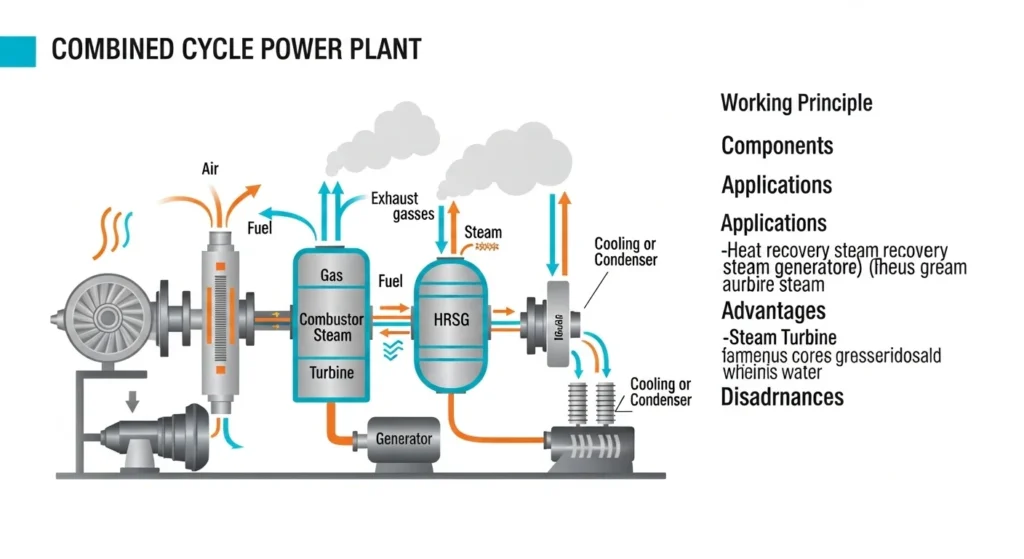
The Combined Cycle Power Plant working principle is based on utilizing waste heat from a gas turbine to produce additional electricity using a steam turbine.
The process occurs in two stages.
Step-by-Step Working Process
- Air Compression
Air from the atmosphere enters a compressor where it is compressed to high pressure.
- Fuel Combustion
Natural gas or another fuel is injected into the combustion chamber. The compressed air mixes with the fuel and burns at high temperature.
- Gas Turbine Rotation
The hot gases expand rapidly and pass through the gas turbine. This rotation drives a generator that produces electricity.
- Exhaust Heat Recovery
Instead of releasing hot exhaust gases into the atmosphere, they pass through a device called the Heat Recovery Steam Generator (HRSG).
- Steam Production
The HRSG converts exhaust heat into steam.
- Steam Turbine Operation
The high-pressure steam drives a steam turbine connected to another generator, producing additional electricity.
Simple Analogy
It works like using the heat from a kitchen oven to warm another dish after cooking the main meal.
Instead of wasting energy, the system captures and reuses it.
4. Types / Classification
Combined cycle power plants can be classified based on configuration and operating design.
Single-Shaft Combined Cycle
In this design, the gas turbine, steam turbine, and generator are connected to a single shaft.
Features
- Compact design
- Easier synchronization
- Suitable for smaller plants
Multi-Shaft Combined Cycle
In this configuration, gas turbines and steam turbines operate with separate generators.
Features
- Higher flexibility
- Better for large-scale power plants
- Easier maintenance
Integrated Combined Cycle
This advanced design integrates different energy systems, such as coal gasification with combined cycle technology.
Features
- Improved efficiency
- Lower emissions
- Advanced technology
5. Main Components
A Combined Cycle Power Plant includes several important components that work together to produce electricity.
Gas Turbine
The gas turbine converts fuel energy into mechanical energy by expanding hot gases.
Compressor
The compressor increases air pressure before it enters the combustion chamber.
Combustion Chamber
Fuel burns in this chamber, producing high-temperature gases.
Heat Recovery Steam Generator (HRSG)
The HRSG captures waste heat from the gas turbine exhaust and converts it into steam.
Steam Turbine
Steam produced in the HRSG rotates the steam turbine to generate additional power.
Generator
Generators convert mechanical energy from turbines into electrical energy.
Condenser
The condenser cools steam and converts it back into water for reuse in the system.
6. Advantages
The Combined Cycle Power Plant advantages and disadvantages must be understood to evaluate its efficiency.
Advantages
- Very high efficiency compared to traditional power plants
- Lower fuel consumption
- Reduced greenhouse gas emissions
- Better use of waste heat energy
- Faster startup time compared to coal plants
- Lower operating costs in the long term
- Suitable for large-scale electricity production
These benefits make combined cycle plants popular in modern power generation.
7. Disadvantages / Limitations
Despite many advantages, combined cycle plants have some limitations.
- High initial installation cost
- Requires skilled operation and maintenance
- Dependence on natural gas supply
- Performance may decrease in extremely hot climates
- Complex design compared to simple cycle plants
Engineers must consider these factors when planning new power plants.
8. Applications
Combined cycle power plants have many practical uses.
Power Generation for Cities
Many countries use combined cycle plants to supply electricity to residential areas.
Industrial Power Supply
Large industries require stable and efficient electricity, which combined cycle plants can provide.
Grid Support
These plants help stabilize national power grids by quickly adjusting power output.
Modern Energy Systems
Combined cycle plants often work alongside renewable energy systems to maintain stable electricity supply.
9. Comparison Section
Difference Between Combined Cycle Power Plant and Simple Cycle Power Plant
| Feature | Combined Cycle Power Plant | Simple Cycle Power Plant |
|---|---|---|
| Efficiency | Very high (50–60%+) | Lower (30–40%) |
| Energy Use | Uses waste heat | Waste heat is lost |
| Power Output | Higher electricity generation | Lower power generation |
| Complexity | More complex system | Simple design |
| Cost | Higher installation cost | Lower installation cost |
This table clearly shows the difference between simple cycle and combined cycle power plants.
10. Selection Guide
Choosing the right power plant depends on several factors.
Fuel Availability
Combined cycle plants work best where natural gas supply is reliable.
Power Demand
Large cities or industrial areas require high-efficiency plants.
Environmental Regulations
Combined cycle plants produce fewer emissions than coal plants.
Budget and Investment
Although initial costs are higher, long-term efficiency can reduce operating costs.
Space Availability
These plants require significant infrastructure space.
11. Common Problems & Solutions
Q1: Why does a combined cycle power plant lose efficiency?
Efficiency may decrease due to turbine wear, poor fuel quality, or inadequate maintenance.
Q2: What happens if the HRSG fails?
If the Heat Recovery Steam Generator stops working, the plant will operate only as a simple gas turbine plant.
Q3: How can efficiency be improved?
Efficiency improves with proper maintenance, high-quality fuel, and modern turbine technology.
Q4: Is combined cycle power generation reliable?
Yes. With proper design and maintenance, these plants are highly reliable.
12. Future Trends
Power generation technology continues to evolve.
Advanced Gas Turbines
New turbines operate at higher temperatures, improving efficiency.
Hydrogen Fuel
Future combined cycle plants may use hydrogen instead of natural gas.
Carbon Capture Technology
Modern plants may include systems that capture carbon dioxide emissions.
Integration with Renewable Energy
Combined cycle plants will work alongside solar and wind power to stabilize energy grids.
These innovations will make combined cycle plants even more efficient and environmentally friendly.
13. Conclusion
The Combined Cycle Power Plant is one of the most efficient and advanced technologies used for modern electricity generation. By combining gas turbine and steam turbine cycles, it captures waste heat and converts it into additional power.
This system significantly improves efficiency, reduces fuel consumption, and lowers environmental impact compared to traditional thermal power plants. Understanding the Combined Cycle Power Plant working principle, major components, and real-world applications is important for electrical students, engineers, and technicians.
Although the technology requires higher initial investment and complex design, its long-term benefits make it a preferred solution for large-scale power generation.
As energy demand continues to grow, combined cycle plants will remain an essential part of modern power systems while new technologies further improve their performance and sustainability.