
Imagine a situation where a water pump in your home suddenly stops working. The power supply is normal, the switch is on, but the motor does not start. Many technicians immediately suspect a winding fault inside the motor. Before replacing the motor or sending it for rewinding, a simple test using a multimeter can help diagnose the problem.
Motor winding faults are one of the most common causes of motor failure in homes, workshops, and industries. Learning how to check motor winding with multimeter is an essential skill for electrical students, engineers, and technicians. It helps save time, reduce maintenance costs, and quickly identify whether the motor is repairable.
A multimeter is one of the most useful electrical tools. With proper knowledge, it can be used to check continuity, resistance, short circuits, and insulation problems inside motor windings.
In this article, you will learn the check motor winding with multimeter working principle, step-by-step testing methods, types of winding faults, troubleshooting techniques, and practical tips used by experienced electricians. By the end, you will confidently understand how to diagnose motor winding problems safely and accurately.
2. What is Check Motor Winding with Multimeter?
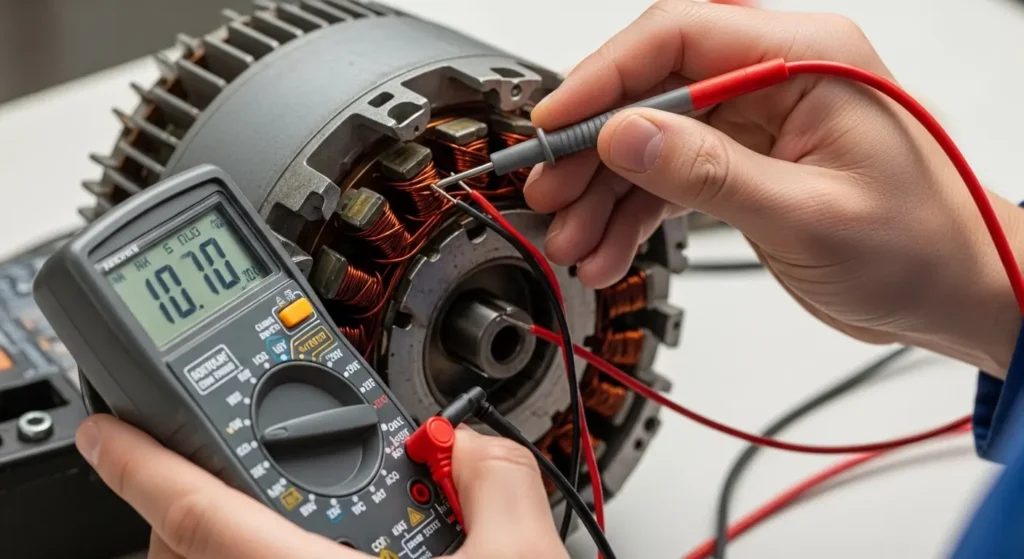
Checking motor winding with a multimeter means testing the electrical condition of the motor coils using a digital or analog multimeter. The purpose is to determine whether the winding is healthy, open, shorted, or grounded.
Motor windings are coils of insulated copper wire placed inside the stator of an electric motor. When electrical current flows through these coils, a magnetic field is produced that rotates the motor shaft.
If the winding becomes damaged due to overheating, insulation failure, or mechanical stress, the motor may stop working.
Using a multimeter, technicians can check:
- Winding resistance
- Continuity of coils
- Short circuits between windings
- Ground faults
Practical Example
Suppose a single-phase motor in a ceiling fan stops working. By measuring the winding resistance with a multimeter, you can quickly identify whether the winding is open or burned.
This simple test can prevent unnecessary motor replacement.
3. Working Principle
The check motor winding with multimeter working principle is based on measuring electrical resistance and continuity in the motor coils.
A multimeter sends a small electrical signal through the winding and measures the resistance of the circuit.
Step-by-Step Principle
- Power Supply is Turned Off
- Always disconnect the motor from electricity.
- Multimeter is Set to Resistance Mode
- Usually marked as Ω (Ohms).
- Test Leads are Connected to Winding Terminals
- The multimeter measures electrical resistance.
- Resistance Value is Displayed
- A healthy winding shows a small resistance value.
- Fault Detection
- Infinite resistance = open winding
- Very low resistance = short circuit
Simple Analogy
Think of a winding like a water pipe.
- If the pipe is broken → water cannot flow → open circuit
- If the pipe is blocked → resistance increases
- If two pipes connect accidentally → short circuit
The multimeter simply checks how easily electricity flows through the winding.
4. Types / Classification of Motor Winding Tests
Motor winding tests using a multimeter can be classified into several types depending on the fault being tested.
Continuity Test
A continuity test checks whether the winding circuit is complete.
If the multimeter beeps or shows a resistance value, the winding is continuous.
If no reading appears, the winding may be broken.
Resistance Test
This test measures the electrical resistance of the winding.
Normal winding resistance is usually a few ohms depending on motor size.
Unbalanced resistance between windings indicates a fault.
Ground Fault Test
This test checks whether the winding is touching the motor body.
One probe touches the motor casing and the other touches the winding terminal.
If the multimeter shows resistance, insulation may be damaged.
Short Circuit Test
This test identifies internal short circuits between winding turns.
If resistance is extremely low, it indicates a possible shorted winding.
5. Main Components
To check motor winding properly, several tools and motor parts are involved.
Multimeter
The multimeter is the primary measuring instrument used to test resistance and continuity.
Motor Terminals
These are the connection points where winding wires are accessible for testing.
Stator Windings
The stator contains copper windings that produce the rotating magnetic field.
Insulation Layer
The insulation protects winding wires from touching each other or the motor body.
Motor Frame
The outer casing that protects internal components and helps dissipate heat.
6. Advantages
Checking motor winding with a multimeter offers many practical benefits.
- Quick and simple testing method
- Requires only basic electrical tools
- Helps identify winding faults early
- Saves repair and replacement costs
- Suitable for students and beginners
- Useful for preventive maintenance
- Portable and easy to use in field work
These benefits make it one of the most common motor diagnostic techniques used by technicians.
7. Disadvantages / Limitations
Although useful, multimeter testing also has some limitations.
- Cannot detect all internal winding faults
- Does not measure insulation strength accurately
- Limited ability to detect turn-to-turn short circuits
- Requires basic electrical knowledge
- May give misleading readings in complex motors
For advanced testing, technicians sometimes use insulation testers or specialized motor analyzers.
8. Applications
The check motor winding with multimeter applications are very wide in electrical maintenance.
Home Appliances
- Ceiling fans
- Washing machines
- Water pumps
- Air coolers
Industrial Equipment
- Conveyor motors
- Compressor motors
- Industrial pumps
- Machine tool motors
Electrical Maintenance
Technicians use this method during:
- Preventive maintenance
- Motor troubleshooting
- Repair inspections
- Workshop diagnostics
Because of its simplicity, the multimeter remains the most common tool for quick motor testing.
9. Comparison Section
Difference Between Multimeter Test and Megger Test
| Feature | Multimeter Test | Megger Test |
|---|---|---|
| Purpose | Check continuity and resistance | Check insulation resistance |
| Voltage Used | Very low test voltage | High test voltage |
| Accuracy | Basic fault detection | More detailed insulation testing |
| Equipment Cost | Low | Higher |
| Application | Quick troubleshooting | Professional maintenance |
Understanding the difference between multimeter test and megger test helps technicians choose the right diagnostic method.
10. Selection Guide
Choosing the right multimeter is important for accurate motor winding testing.
Key Factors to Consider
Digital Display
Digital multimeters provide clear readings and are easier for beginners.
Resistance Range
Choose a multimeter that can measure small resistance values accurately.
Continuity Buzzer
A built-in buzzer helps quickly detect winding continuity.
Safety Rating
Select a multimeter with proper electrical safety standards.
Tips for Beginners
- Always disconnect power before testing.
- Label motor terminals before removing wires.
- Compare resistance values between windings.
- Use proper safety gloves when testing.
These simple precautions improve safety and testing accuracy.
11. Common Problems & Solutions
Why does the motor show infinite resistance?
This usually indicates a broken or open winding inside the motor.
Why does the multimeter show very low resistance?
This may indicate a short circuit in the winding.
Why does the motor body show continuity with winding?
This means the winding insulation may be damaged and touching the motor frame.
Why do windings show unequal resistance?
Possible reasons include:
- Partial winding damage
- Overheating
- Loose internal connections
In such cases, professional inspection may be required.
12. Future Trends
Motor testing technology is improving with modern diagnostic tools.
Smart Motor Analyzers
Advanced instruments can analyze winding condition in real time.
Predictive Maintenance Systems
Industries now use sensors and software to monitor motor health before failure occurs.
Digital Diagnostic Tools
New devices combine multimeter functions with advanced testing capabilities.
Despite these innovations, the multimeter remains an essential tool for quick field testing.
13. Conclusion
Learning how to check motor winding with multimeter is a valuable skill for anyone working with electric motors. It provides a quick and reliable method to identify common winding faults such as open circuits, short circuits, and ground faults.
In this guide, we explored the check motor winding with multimeter working principle, testing methods, classifications, advantages and disadvantages, and practical troubleshooting steps. These techniques are widely used in homes, workshops, and industries to diagnose motor problems efficiently.
For electrical students and technicians, mastering this simple testing method builds a strong foundation in motor maintenance. While advanced diagnostic tools exist, the multimeter remains one of the most practical and accessible instruments in electrical engineering.
With regular practice and careful safety precautions, you can confidently inspect motor windings and prevent costly equipment failures.