
Imagine entering a large electrical distribution panel in a factory or commercial building. Inside the panel, you may notice thick metal bars connecting multiple circuit breakers and electrical components. These bars are responsible for carrying large amounts of electrical current safely and distributing it to different circuits. These important components are known as Busbars.
In modern electrical power systems, efficient power distribution is essential. Instead of using many individual cables, engineers often use busbars because they can carry high current and distribute power in a compact and organized way. Busbars are widely used in substations, switchgear panels, distribution boards, and industrial power systems.
For electrical students, technicians, and engineers, understanding the Busbar working principle is very important. Busbars play a key role in safe electrical distribution and equipment protection. They help reduce wiring complexity, improve reliability, and support high-power systems.
In this article, you will learn what a busbar is, how it works, its different types, and Busbar applications in electrical systems. We will also explain Busbar advantages and disadvantages, selection guidelines, troubleshooting tips, and future developments in busbar technology.
What is a Busbar?
A Busbar is a metallic conductor used in electrical power distribution systems to collect and distribute electrical power to multiple circuits.
Clear Definition
A busbar is a thick metal bar or strip made of copper or aluminum that carries large electrical current and distributes it to different electrical circuits.
Simple Explanation
Instead of connecting many wires together, engineers use a busbar as a central point where electricity enters and then spreads to different outgoing circuits.
Practical Example
For example, inside a distribution board, the incoming power from the main supply is connected to a busbar. From this busbar, electricity is distributed to multiple circuit breakers that supply power to different rooms or machines.
Busbar Working Principle
The Busbar working principle is based on electrical conduction. The busbar acts as a low-resistance path that carries electrical current from one point to several circuits.
Because busbars have a large cross-sectional area, they can safely carry high current without excessive heating.
Step-by-Step Working Process
- Power Input
- Electrical power enters the system through the main supply.
- Connection to Busbar
- The incoming supply is connected directly to the busbar.
- Current Distribution
- The busbar distributes electrical current to multiple outgoing circuits.
- Load Supply
- Circuit breakers connected to the busbar supply electricity to different loads.
- Efficient Power Flow
- Electricity flows smoothly through the low-resistance metal conductor.
Simple Analogy
Think of a busbar like a water distribution pipe in a building. A large main pipe carries water and distributes it to smaller pipes that supply different rooms. Similarly, a busbar distributes electrical power to different circuits.
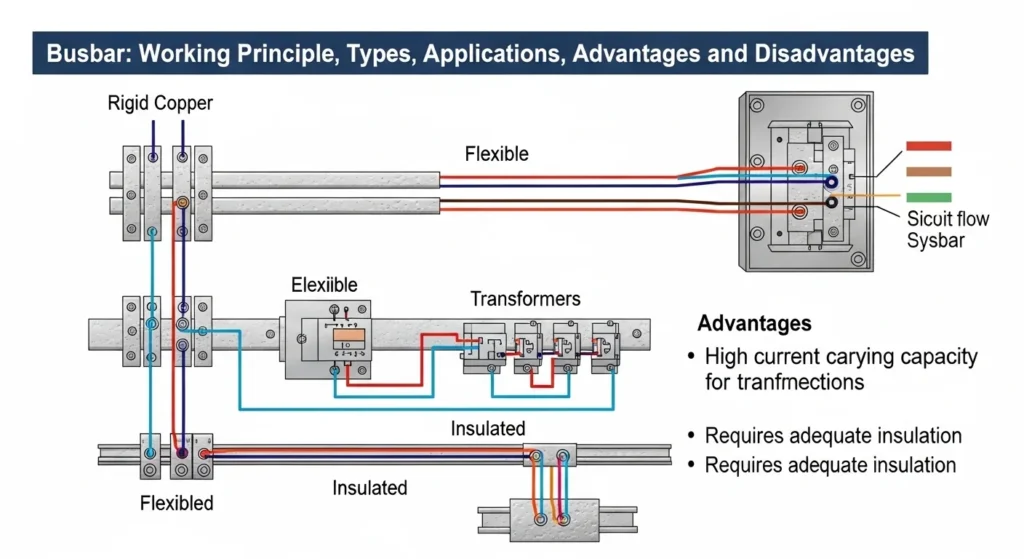
Types of Busbar
Busbars are classified based on their design, material, and installation method.
Copper Busbar
Copper is the most commonly used busbar material.
Features:
- Excellent electrical conductivity
- High strength and durability
- Suitable for high current systems
Copper busbars are widely used in industrial power systems.
Aluminum Busbar
Aluminum busbars are lighter and cheaper than copper.
Features:
- Lower cost
- Lightweight design
- Good electrical conductivity
They are often used in large power distribution systems.
Laminated Busbar
A laminated busbar consists of multiple layers of conductive material separated by insulation.
Features:
- Reduced electrical losses
- Better heat dissipation
- Improved electromagnetic performance
These busbars are commonly used in power electronics.
Flexible Busbar
Flexible busbars are made from thin conductive layers.
Features:
- Can bend easily
- Suitable for compact electrical systems
- Reduces vibration issues
They are used in modern electronic equipment.
Insulated Busbar
Insulated busbars have protective insulation coating.
Features:
- Improved safety
- Reduced risk of short circuits
- Better environmental protection
They are often used in enclosed switchgear systems.
Main Components of a Busbar System
A busbar system contains several important parts that ensure proper electrical distribution.
Conductive Busbar
The main metal bar that carries electrical current.
Function:
- Distributes electrical power to multiple circuits.
Insulators
Insulators support the busbar while preventing electrical contact with the panel structure.
Function:
- Maintain electrical isolation.
Busbar Supports
Mechanical supports hold the busbars in place.
Function:
- Provide stability and proper spacing.
Circuit Breaker Connections
Circuit breakers are connected to the busbar.
Function:
- Control and protect electrical circuits.
Protective Enclosure
Many busbars are installed inside metal or insulated enclosures.
Function:
- Protect users from electrical hazards.
Busbar Advantages
Understanding Busbar advantages and disadvantages helps engineers design better electrical systems.
Advantages
- Can carry very high electrical current
- Reduces complex wiring
- Improves electrical efficiency
- Easy installation and maintenance
- Better heat dissipation
- Compact design for switchgear panels
Real-World Benefits
Because of these advantages, busbars are widely used in modern electrical power distribution systems.
Busbar Disadvantages / Limitations
Although busbars are highly useful, they have some limitations.
Limitations
- Higher initial installation cost
- Requires proper insulation and protection
- Risk of short circuit if poorly installed
- Requires accurate design for current capacity
Proper engineering design helps reduce these limitations.
Busbar Applications
There are many Busbar applications in electrical power systems.
Electrical Substations
Busbars distribute power from transformers to multiple feeders.
Switchgear Panels
Busbars connect circuit breakers inside switchgear systems.
Industrial Power Systems
Factories use busbars for high-current power distribution.
Data Centers
Modern data centers use busbars for efficient power distribution.
Renewable Energy Systems
Busbars connect solar inverters, batteries, and distribution equipment.
Comparison: Busbar vs Cable
Understanding the difference between busbar and cable helps in selecting the right power distribution method.
| Feature | Busbar | Cable |
|---|---|---|
| Current Capacity | Very high | Limited |
| Installation | Fixed inside panels | Flexible routing |
| Cooling | Better heat dissipation | Less efficient cooling |
| Maintenance | Easier inspection | More complex |
| Cost | Higher initial cost | Lower initial cost |
Key Difference
The main difference between busbar and cable is that busbars are rigid conductors used for high-current distribution, while cables are flexible wires used for general electrical connections.
Selection Guide
Choosing the correct busbar depends on several factors.
Important Factors
Material Selection
Copper busbars offer better conductivity, while aluminum busbars reduce cost.
Current Rating
The busbar must be designed to carry the expected electrical load.
Installation Environment
Busbars used in outdoor environments require additional protection.
Safety Standards
Ensure the busbar system meets electrical safety regulations.
Tips for Beginners
- Always calculate current capacity before selecting a busbar.
- Ensure proper insulation and spacing.
- Use high-quality connectors and supports.
Common Problems & Solutions
Why does the busbar overheat?
Possible reasons:
- Excessive current
- Poor ventilation
- Loose connections
Solution: Check load capacity and tighten connections.
Why does corrosion occur on busbars?
Corrosion may occur due to humidity or environmental exposure.
Solution: Use protective coatings or insulated busbars.
Why do busbars produce vibration noise?
High electrical current can create electromagnetic forces.
Solution: Install proper busbar supports.
Why does the system trip frequently?
Possible causes include overload or short circuits.
Solution: Inspect circuit breakers and busbar connections.
Future Trends in Busbar Technology
Electrical power systems are evolving with new busbar technologies.
Smart Busbar Systems
Modern systems include monitoring sensors for current and temperature.
High-Efficiency Materials
New alloys improve conductivity and durability.
Compact Busbar Designs
Manufacturers are developing space-saving busbar systems.
Integration with Renewable Energy
Busbars are increasingly used in solar and battery energy storage systems.
Conclusion
A Busbar is an essential component in electrical power distribution systems. It provides a reliable and efficient method for carrying and distributing large electrical currents in substations, switchgear, and industrial installations.
Understanding the Busbar working principle, types, and Busbar applications helps electrical students and technicians design safer and more efficient power systems. Busbars reduce wiring complexity, improve system organization, and support high-power electrical networks.
Although busbars require careful design and installation, their advantages in high-current handling and efficient power distribution make them a preferred solution in modern electrical engineering.
As technology continues to advance, busbar systems will become even more efficient, compact, and integrated with smart monitoring systems.