
Imagine driving a car on a busy road when suddenly traffic stops in front of you. You press the brake pedal, and within seconds the vehicle slows down safely. This smooth stopping action happens because of the braking system, and one of its most important components is the brake rotor.
Over time, brake rotors wear out due to friction and heat produced during braking. When rotors become too thin, warped, or damaged, they must be replaced. This process is known as brake rotor replacement. Proper brake rotor replacement is essential for vehicle safety, braking performance, and long-term reliability.
For students, engineers, technicians, and beginners, understanding the brake rotor replacement working principle and maintenance process is important because braking systems are critical in automotive and mechanical engineering. A faulty rotor can increase stopping distance, create vibration, and reduce braking efficiency.
In this article, you will learn what brake rotor replacement is, how the brake rotor replacement working principle works, different rotor types, main components, and practical brake rotor replacement applications. We will also explore advantages, disadvantages, troubleshooting tips, and future trends in braking technology.
What is Brake Rotor Replacement?
Brake rotor replacement is the process of removing worn or damaged brake rotors and installing new ones to restore proper braking performance.
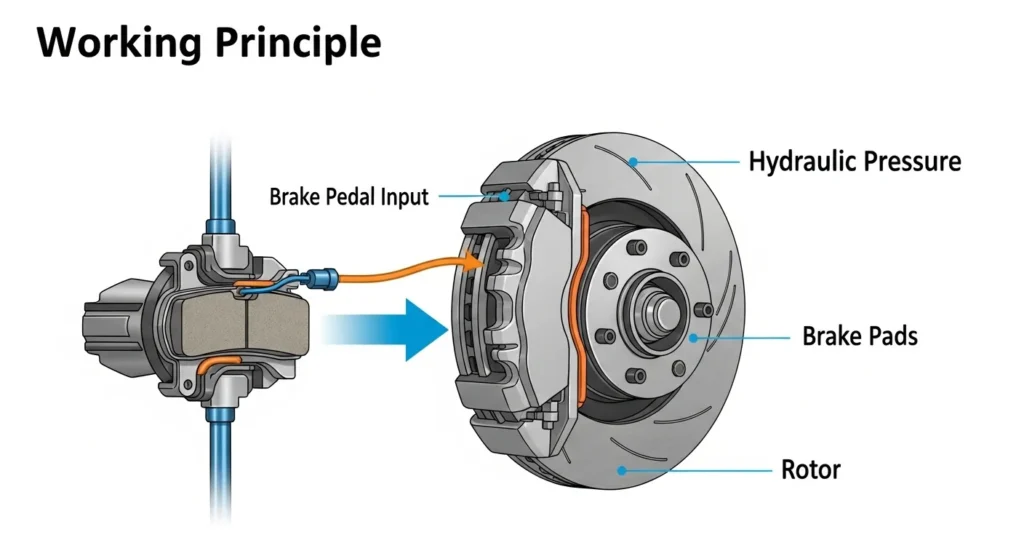
A brake rotor, also called a brake disc, is a metal disc attached to the wheel hub. When the brake pedal is pressed, brake pads clamp onto the rotor to slow down the wheel.
Simple Explanation
In simple terms, brake rotors work like a spinning disc that the brake pads press against to create friction. This friction slows down the vehicle.
When rotors wear out or become uneven, replacing them ensures safe and smooth braking.
Practical Example
If a car driver feels vibration in the steering wheel while braking, the brake rotors may be warped. In such cases, brake rotor replacement helps restore smooth braking performance.
Brake Rotor Replacement Working Principle
The brake rotor replacement working principle is based on restoring the braking system by installing a new rotor that allows brake pads to create proper friction.
Step-by-Step Operation
- The vehicle is lifted and the wheel is removed.
- The brake caliper is detached from the rotor.
- The worn or damaged rotor is removed from the hub.
- A new rotor is installed in its place.
- The brake caliper and pads are reinstalled.
- The wheel is mounted back and the braking system is tested.
Simple Analogy
Think of brake rotors like the surface of a grinding wheel. If the surface becomes uneven or damaged, it cannot work properly. Replacing the rotor restores a smooth surface for braking.
Types / Classification of Brake Rotors
Brake rotors are available in different designs depending on vehicle performance requirements.
Solid Brake Rotors
Solid rotors are simple metal discs without ventilation.
Features:
- Simple construction
- Low manufacturing cost
- Used in smaller vehicles
Vented Brake Rotors
Vented rotors contain internal cooling channels.
Features:
- Improved heat dissipation
- Better braking performance
- Common in modern vehicles
Drilled Brake Rotors
These rotors contain small drilled holes.
Features:
- Improved heat release
- Better performance in wet conditions
They are commonly used in performance vehicles.
Slotted Brake Rotors
Slotted rotors contain grooves on the rotor surface.
Features:
- Removes debris and gas buildup
- Provides better braking performance
Drilled and Slotted Rotors
These rotors combine both drilling and slotting features.
Features:
- Maximum cooling performance
- Used in high-performance vehicles
Main Components of a Brake Rotor System
Several parts work together during brake rotor replacement.
Brake Rotor
The rotor is the rotating metal disc connected to the wheel hub.
Function:
- Provides friction surface for brake pads
- Converts kinetic energy into heat
Brake Pads
Brake pads press against the rotor when the brake pedal is applied.
Function:
- Generate friction
- Slow down the rotating wheel
Brake Caliper
The brake caliper holds the brake pads and presses them against the rotor.
Function:
- Applies pressure to brake pads
- Controls braking force
Wheel Hub
The wheel hub connects the rotor to the vehicle wheel.
Function:
- Supports the rotor
- Allows wheel rotation
Brake Fluid System
Brake fluid transfers pressure from the brake pedal to the caliper.
Function:
- Hydraulic force transmission
- Enables efficient braking
Advantages of Brake Rotor Replacement
Proper rotor replacement offers several benefits.
Brake rotor replacement advantages include:
- Restores safe braking performance
- Reduces vibration during braking
- Improves vehicle control
- Extends life of brake pads
- Prevents damage to other brake components
- Maintains vehicle safety standards
Regular replacement ensures reliable braking operation.
Disadvantages / Limitations
Although necessary, brake rotor replacement has some limitations.
Brake rotor replacement advantages and disadvantages should both be considered.
Brake Rotor Replacement Limitations
- Requires mechanical tools and experience
- Replacement parts may be costly
- Incorrect installation may cause braking problems
- Requires periodic maintenance
However, these limitations are minor compared to the safety benefits.
Brake Rotor Replacement Applications
Brake rotor replacement is mainly used in transportation and mechanical systems.
Vehicle Applications
Brake rotor replacement is common in:
- Cars
- Trucks
- Motorcycles
- Buses
These vehicles rely on disc braking systems.
Industrial Applications
In industrial machinery, braking systems with rotors are used in:
- Conveyor systems
- Heavy equipment
- Industrial cranes
Modern Technology Applications
Advanced braking systems are used in:
- Electric vehicles
- High-speed trains
- Aerospace systems
These brake rotor replacement applications highlight the importance of reliable braking components.
Comparison Section
Difference Between Brake Rotor and Brake Drum
| Feature | Brake Rotor | Brake Drum |
|---|---|---|
| Shape | Flat disc | Cylindrical drum |
| Braking Method | Pads clamp on rotor | Shoes press inside drum |
| Heat Dissipation | Better cooling | Lower cooling efficiency |
| Performance | Higher braking performance | Used in older vehicles |
Understanding the difference between brake rotor and brake drum helps technicians select proper braking systems.
Selection Guide
Choosing the correct rotor is important during replacement.
Important Factors
- Vehicle model compatibility
- Rotor material quality
- Rotor thickness
- Cooling design
- Driving conditions
Tips for Beginners
- Always check manufacturer specifications.
- Replace rotors in pairs for balanced braking.
- Inspect brake pads during replacement.
- Choose high-quality materials for durability.
Proper rotor selection ensures safe braking performance.
Common Problems & Solutions
Why do brake rotors vibrate during braking?
This may happen due to warped rotors.
Solution:
- Replace damaged rotors
- Ensure proper installation
Why do brake rotors wear quickly?
Excessive braking or poor-quality materials may cause fast wear.
Solution:
- Use high-quality rotors
- Inspect braking system regularly
Why does braking produce noise?
Noise may occur due to uneven rotor surface or worn brake pads.
Solution:
- Replace rotors or pads
- Clean brake components
Why does braking feel weak?
Weak braking may occur due to worn rotors or contaminated brake pads.
Solution:
- Inspect and replace damaged components
Future Trends
Brake system technology continues to evolve with modern vehicles.
Advanced Materials
New composite materials improve heat resistance and durability.
Smart Brake Monitoring
Sensors can monitor rotor temperature and wear.
Electric Vehicle Braking Systems
Electric vehicles combine regenerative braking with traditional rotors.
Lightweight Rotors
Carbon-ceramic rotors reduce weight and improve performance.
These technologies will improve braking efficiency and safety in the future.
Conclusion
Brake rotors are a critical part of the vehicle braking system. They provide the surface where brake pads create friction to slow down or stop a vehicle. Over time, rotors wear out due to heat and friction, making brake rotor replacement necessary for maintaining safe braking performance.
In this article, we explained what brake rotor replacement is, the brake rotor replacement working principle, and the different types of rotors used in modern vehicles. We also explored brake rotor replacement applications, important components, advantages and disadvantages, and practical troubleshooting tips.
For technicians, engineers, and beginners, understanding brake rotor maintenance is essential because the braking system directly affects vehicle safety. Proper inspection, timely replacement, and correct installation can greatly improve braking performance and extend the lifespan of the entire braking system.