
In daily life, electricity is essential for lighting homes, running machines, and powering industries. However, if not handled properly, it can become extremely dangerous. For example, a technician working on a live panel without proper insulation or safety tools can suffer severe electric shock within seconds. Similarly, faulty wiring in a home can lead to fire accidents.
This is why understanding electrical hazards is very important for electrical students, engineers, and technicians. Electrical accidents can cause injuries, equipment damage, and even loss of life. Most of these accidents happen due to lack of awareness, poor maintenance, or ignoring safety rules.
In this article, you will learn what electrical hazards are, their types, causes, safety components, prevention methods, applications in real life, and future safety technologies. The explanation is simple and practical, helping beginners understand real-world electrical safety.
2. What Is an Electrical Hazard? (2026)
Electrical hazards are among the most common causes of workplace accidents, property damage, and electrical fires. They occur whenever electricity is used, generated, transmitted, or distributed in an unsafe manner. Understanding what an electrical hazard is and how it occurs is essential for preventing electric shocks, burns, equipment failures, and other serious accidents.
Whether in homes, offices, factories, or construction sites, identifying electrical hazards early helps create a safer environment for people and electrical systems.
Definition of Electrical Hazard
An electrical hazard is any unsafe condition involving electricity that has the potential to cause electric shock, burns, arc flash, explosions, fires, equipment damage, or even loss of life. These hazards can result from faulty electrical equipment, damaged wiring, improper installation, poor maintenance, or unsafe work practices.
In simple terms, an electrical hazard exists whenever electrical energy can accidentally come into contact with people, equipment, or combustible materials and cause harm.
Simple Explanation
Electrical hazards occur when electrical current flows in an uncontrolled or unintended path. Instead of safely traveling through electrical conductors, the current may pass through the human body, damaged insulation, metal surfaces, or other unintended paths.
This can lead to serious injuries, electrical fires, short circuits, or damage to electrical appliances and machinery. Even a small mistake, such as touching an exposed wire or using damaged electrical equipment, can create a dangerous situation.
Practical Examples of Electrical Hazards
Electrical hazards can occur in everyday life as well as in industrial environments. Some common examples include:
- Accidentally touching an exposed live wire.
- Using electrical appliances with damaged power cords.
- Overloading electrical sockets or extension boards.
- Faulty insulation causing leakage current.
- Wet hands coming into contact with electrical equipment.
- Loose or damaged electrical connections creating sparks.
- Working near overhead power lines without proper safety precautions.
- Using defective switches, plugs, or circuit breakers.
- Improper grounding (earthing) of electrical equipment.
- Short circuits that generate excessive heat and cause fires.
These situations can lead to electric shock, burns, equipment failure, or fire if they are not identified and corrected promptly.
Why Understanding Electrical Hazards Is Important
Recognizing electrical hazards is the first step toward preventing accidents and ensuring electrical safety. By identifying potential dangers early and following proper safety practices, individuals and organizations can:
- Reduce the risk of electric shock and burns.
- Prevent electrical fires and explosions.
- Protect electrical equipment from damage.
- Improve workplace and home safety.
- Comply with electrical safety standards and regulations.
- Minimize downtime and costly repairs.
Understanding electrical hazards is essential for electricians, engineers, technicians, students, and anyone who works with or uses electrical systems. Proper awareness, regular inspections, and safe working practices can significantly reduce the risk of electrical accidents and create a safer environment for everyone.
3. Working Principle of Electrical Hazards (2026)
The working principle of electrical hazards is based on the uncontrolled or unintended flow of electric current. Under normal operating conditions, electricity travels safely through insulated conductors and electrical devices. However, when insulation is damaged, equipment becomes faulty, or safety measures fail, the current may flow through unintended paths, creating hazardous conditions.
Since electricity always follows the path of least resistance, it can pass through metal objects, damaged wiring, water, or even the human body, resulting in electric shock, burns, arc flash, equipment damage, or electrical fires.
Step-by-Step Working Process
Step 1: Power Flows Through the Electrical Circuit
Electricity is supplied from the power source and flows through conductors, cables, switches, and electrical equipment to operate appliances and machines safely.
Step 2: Insulation or Equipment Failure Occurs
If the insulation around a wire becomes damaged or an electrical device develops a fault, the current can escape from its intended path.
Common causes include:
- Damaged insulation
- Loose electrical connections
- Worn-out cables
- Moisture entering electrical equipment
- Mechanical damage to wires
Step 3: Current Finds an Unintended Path
Escaping current naturally seeks the easiest path to the ground (earth). This unintended path may include:
- The human body
- Metal equipment frames
- Wet surfaces
- Building structures
- Conductive objects
If a person comes into contact with the energized part, electrical current may pass through their body, causing serious injury.
Step 4: Heat and Electrical Energy Are Released
As electric current flows through resistance, electrical energy is converted into heat according to Joule’s Law. Excessive heat can cause:
- Overheating of wires
- Melting of insulation
- Electrical arcing
- Equipment damage
- Fire hazards
In severe cases, electrical arcs can produce extremely high temperatures capable of causing explosions and serious burns.
Step 5: Electrical Hazard Occurs
The uncontrolled flow of electricity may result in one or more dangerous conditions, including:
- Electric shock
- Electrical burns
- Arc flash
- Arc blast
- Short circuit
- Electrical fire
- Damage to electrical equipment
- Power system failure
The severity of the hazard depends on factors such as voltage, current, exposure time, and the path the current takes through the body.
Simple Analogy
Imagine electricity flowing through a system like water flowing inside a pipeline.
- Water pipes represent electrical wires.
- Water represents electric current.
- Pipe insulation represents wire insulation.
- A leak in the pipe is similar to damaged electrical insulation.
- Flooding caused by the leak is like an electrical accident resulting from uncontrolled current.
As long as the pipe remains intact, the water flows safely. Similarly, electricity is safe when it remains inside properly insulated conductors. When the insulation fails, electricity can escape and create dangerous situations.
Key Principle
The fundamental principle of electrical hazards is that electricity must always remain within its intended circuit. Whenever electric current escapes due to damaged insulation, faulty equipment, poor grounding, overloaded circuits, or unsafe work practices, it creates a potential hazard that can lead to electric shock, burns, arc flashes, equipment failure, or fire.
Understanding this working principle helps electricians, engineers, technicians, and students identify electrical hazards early, apply appropriate safety measures, and prevent accidents in residential, commercial, and industrial electrical systems.
4. Types / Classification of Electrical Hazards
4.1 Electric Shock: Causes, Effects, and Safety Measures (2026)
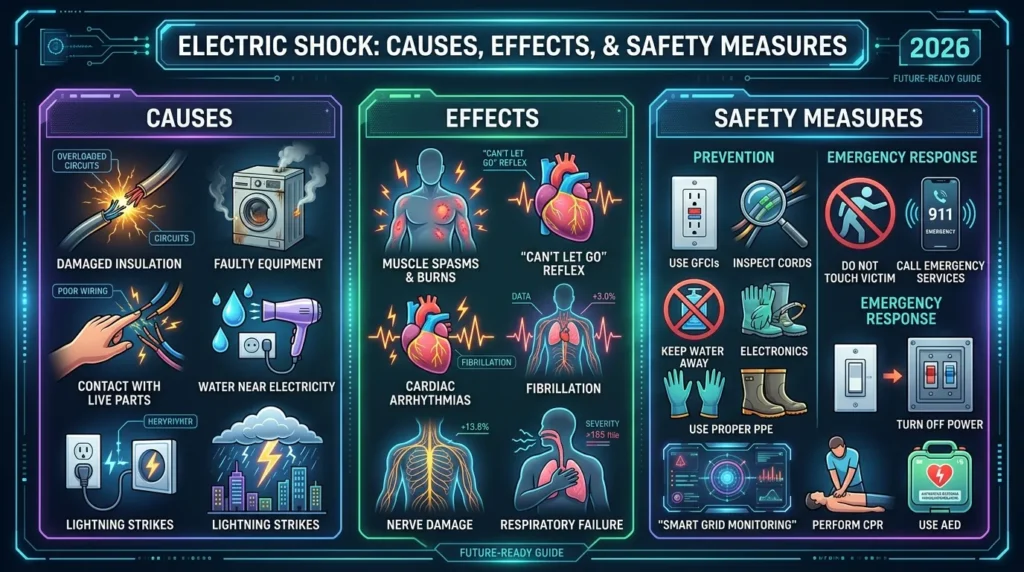
Electric shock is one of the most common and dangerous electrical hazards. It occurs when electric current passes through the human body after coming into contact with an energized conductor or faulty electrical equipment. The severity of the shock depends on several factors, including the amount of current, the voltage, the path the current takes through the body, and the duration of contact.
Even a small electric current can cause pain or muscle spasms, while a higher current can lead to severe burns, cardiac arrest, respiratory failure, or even death. Understanding the causes and effects of electric shock is essential for preventing electrical accidents in homes, workplaces, and industrial environments.
How Electric Shock Occurs
Electric shock happens when the human body becomes part of an electrical circuit. Instead of electricity flowing safely through wires, it passes through the body to reach the ground or another conductor.
Common situations that can cause electric shock include:
- Touching exposed live wires.
- Using damaged electrical appliances.
- Contact with faulty electrical equipment.
- Working with electricity using wet hands.
- Damaged insulation exposing live conductors.
- Poor grounding (earthing) of electrical systems.
- Accidental contact with overhead power lines.
Effects of Electric Shock
The impact of an electric shock depends on the strength of the current and the duration of exposure. Possible effects include:
- Mild tingling or numbness.
- Pain and muscle contractions.
- Difficulty breathing.
- Severe electrical burns.
- Damage to nerves and internal organs.
- Irregular heartbeat (cardiac arrhythmia).
- Cardiac arrest.
- Loss of consciousness.
- Death in severe cases.
Even if no visible injuries are present, a person who has received an electric shock should be medically evaluated because internal injuries may not appear immediately.
Factors That Affect the Severity of Electric Shock
Several factors determine how dangerous an electric shock can be:
- Current Magnitude: Higher current causes more severe injuries.
- Voltage Level: Higher voltage increases the risk of serious shock.
- Duration of Contact: Longer exposure results in greater damage.
- Current Path: Current passing through the heart or brain is especially dangerous.
- Body Resistance: Wet skin greatly reduces body resistance, allowing more current to flow.
Safety Measures to Prevent Electric Shock
The risk of electric shock can be greatly reduced by following proper electrical safety practices.
Some important safety measures include:
- Never touch exposed electrical wires.
- Always switch off the power supply before maintenance.
- Use insulated tools and personal protective equipment (PPE).
- Keep electrical equipment away from water and moisture.
- Ensure proper grounding (earthing) of electrical installations.
- Replace damaged cables, plugs, and switches immediately.
- Install Residual Current Devices (RCDs) or Ground Fault Circuit Interrupters (GFCIs).
- Regularly inspect electrical systems for faults or damage.
- Follow electrical safety standards and procedures at all times.
Practical Example
A person attempts to plug in an appliance with a damaged power cord while standing on a wet floor. Because the insulation is broken, electric current flows through the person’s body to the ground, causing an electric shock. This accident could have been prevented by replacing the damaged cord and keeping the area dry.
Key Takeaway
Electric shock occurs when electric current passes through the human body due to unintended contact with a live electrical source. It can cause injuries ranging from mild tingling to severe burns, heart failure, and even death. By using proper insulation, grounding, protective devices, and safe working practices, most electric shock accidents can be prevented, making electrical systems much safer for everyone.
4.2 Electrical Burns: Causes, Effects, and Prevention (2026)
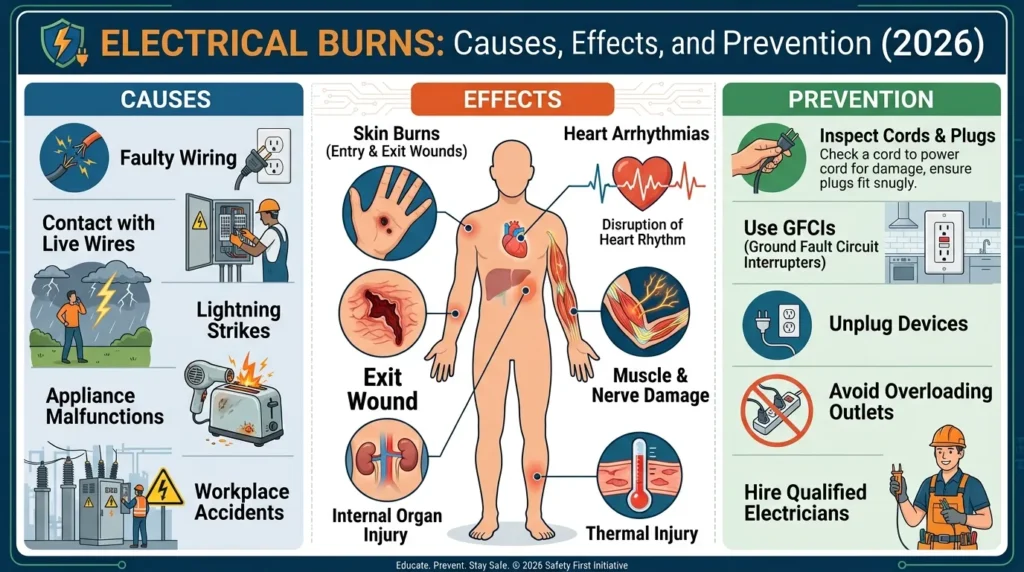
Electrical burns are serious injuries caused when electric current passes through the body or when a person is exposed to the intense heat generated by an electrical arc or short circuit. Unlike ordinary burns, electrical burns can damage not only the skin but also muscles, nerves, blood vessels, and internal organs, making them one of the most dangerous types of electrical injuries.
These burns are common in workplaces where employees work with high-voltage equipment, electrical panels, power lines, transformers, and industrial machinery.
How Electrical Burns Occur
Electrical burns occur when electrical energy is converted into heat as current passes through body tissues or during an electrical fault such as an arc flash.
Common causes include:
- Direct contact with live electrical conductors.
- High-voltage electrical equipment.
- Arc flash or arc blast incidents.
- Short circuits producing intense heat.
- Faulty wiring or damaged insulation.
- Contact with exposed electrical terminals.
The amount of damage depends on the voltage level, current, duration of contact, and the path the current takes through the body.
Types of Electrical Burns
1. External Burns
External burns are injuries that affect the outer layers of the skin when a person comes into contact with electricity or is exposed to the intense heat produced by an electrical arc. These burns are usually visible immediately after the accident and may range from minor skin redness to deep burn wounds, depending on the voltage and duration of exposure.
Common signs of external burns include redness, swelling, blisters, charred skin, pain, and burn marks at the point where the electrical current entered or exited the body. Although the skin injury may appear small, there can still be serious damage beneath the surface. Therefore, every electrical burn should be treated as a medical emergency and examined by a healthcare professional.
Common Symptoms:
Visible burn marks at the contact point
Redness and swelling
Blisters on the skin
Pain or burning sensation
Blackened or charred skin
2. Internal Burns
Internal burns are often much more serious because electrical current generates heat inside the body as it passes through muscles, nerves, and blood vessels.
These injuries may not be visible on the skin but can result in:
- Severe muscle damage.
- Nerve injuries.
- Damage to internal organs.
- Blood vessel damage.
- Tissue destruction.
- Long-term disability.
High-voltage accidents frequently cause extensive internal burns even when the external wound appears small.
Effects of Electrical Burns
Electrical burns can have serious short-term and long-term consequences, including:
- Severe skin burns.
- Deep tissue damage.
- Muscle destruction.
- Nerve damage.
- Loss of sensation.
- Infection of burned tissue.
- Permanent scarring.
- Reduced movement of affected limbs.
- Organ damage in severe cases.
If left untreated, electrical burns can become life-threatening.
High-Voltage Electrical Burns
High-voltage systems pose an especially high risk because they carry enough energy to produce extremely high temperatures within a fraction of a second.
High-voltage electrical burns may cause:
- Extensive internal tissue destruction.
- Severe external burns.
- Arc flash injuries.
- Cardiac arrest.
- Multiple organ damage.
- Permanent disability.
- Fatal injuries.
For this reason, only trained personnel should work on high-voltage electrical installations using approved safety procedures and protective equipment.
Safety Measures to Prevent Electrical Burns
Electrical burns can be prevented by following proper electrical safety practices.
Important safety measures include:
- Switch off the power supply before working on electrical equipment.
- Wear insulated gloves and other Personal Protective Equipment (PPE).
- Use insulated tools when performing electrical work.
- Keep electrical equipment properly maintained.
- Replace damaged wires and insulation immediately.
- Follow Lockout/Tagout (LOTO) procedures during maintenance.
- Maintain safe distances from high-voltage equipment.
- Install proper grounding and protective devices.
- Never touch exposed live conductors.
Practical Example
An electrician accidentally touches an energized conductor inside a high-voltage switchboard while performing maintenance. The electrical current passes through the hand and arm, generating intense heat that causes severe external burns on the skin and deep internal damage to muscles and nerves. This accident could have been prevented by isolating the power supply, following Lockout/Tagout (LOTO) procedures, and wearing appropriate PPE.
Key Takeaway
Electrical burns occur when electric current or the intense heat produced by electrical faults damages body tissues. They can cause both external skin injuries and severe internal tissue damage, especially in high-voltage systems. Following proper electrical safety procedures, using personal protective equipment, and maintaining electrical installations are essential for preventing electrical burn injuries and ensuring a safe working environment.
4.3 Arc Flash Hazard: Causes, Effects, and Prevention (2026)
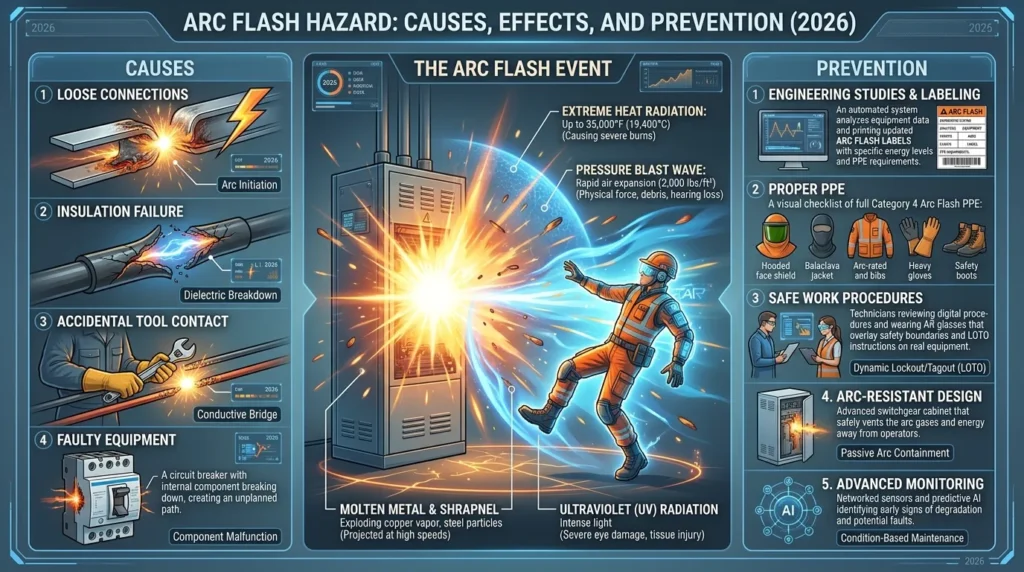
An arc flash hazard is one of the most dangerous electrical hazards encountered in electrical installations and industrial power systems. It occurs when an electrical fault or short circuit causes a sudden release of enormous electrical energy through the air, producing an intense flash of light, extreme heat, high-pressure waves, and molten metal.
An arc flash can reach temperatures of up to 35,000°C (63,000°F), which is several times hotter than the surface of the sun. Even without direct contact with electricity, a person standing nearby can suffer severe burns, eye injuries, hearing damage, or life-threatening injuries.
How an Arc Flash Occurs
An arc flash occurs when electricity jumps through the air between energized conductors or between a conductor and ground due to insulation failure or an electrical fault.
Common causes include:
- Short circuits.
- Loose or damaged electrical connections.
- Equipment failure.
- Damaged insulation.
- Dust, moisture, or corrosion inside electrical panels.
- Accidental contact with live conductors.
- Using improper tools near energized equipment.
Once the fault occurs, a powerful electrical arc forms instantly, releasing a massive amount of thermal and mechanical energy.
Effects of an Arc Flash
An arc flash can cause catastrophic damage to both people and electrical equipment.
Some of the most serious effects include:
- Extremely high temperatures that cause severe burns.
- Explosive pressure waves (arc blast).
- Molten metal splashing onto nearby workers.
- Intense ultraviolet (UV) and infrared radiation.
- Eye injuries or temporary/permanent blindness.
- Hearing damage from the loud explosion.
- Damage to electrical panels, switchgear, and cables.
- Fire or explosion in electrical installations.
- Fatal injuries in severe incidents.
Why Arc Flash Is So Dangerous
Unlike ordinary electric shock, an arc flash does not require direct contact with a live conductor. A worker standing close to the fault can still be seriously injured by the intense heat, pressure, and flying debris produced by the electrical arc.
High-energy industrial equipment such as switchgear, motor control centers (MCCs), transformers, and distribution panels presents the greatest risk of arc flash incidents.
Safety Measures to Prevent Arc Flash Hazards
The risk of an arc flash can be significantly reduced by following proper electrical safety procedures.
Important preventive measures include:
- De-energize electrical equipment before maintenance whenever possible.
- Follow Lockout/Tagout (LOTO) procedures.
- Wear arc-rated Personal Protective Equipment (PPE).
- Use insulated tools designed for electrical work.
- Maintain electrical panels and switchgear regularly.
- Tighten loose electrical connections.
- Keep electrical equipment clean and dry.
- Maintain safe working distances from energized equipment.
- Perform regular arc flash risk assessments.
- Follow electrical safety standards such as NFPA 70E and IEC guidelines.
Practical Example
An electrician opens an energized switchboard to perform maintenance. A loose connection causes a short circuit, creating an electrical arc. Within milliseconds, the arc flash releases intense heat, a bright flash of light, and an explosive pressure wave that causes severe burns and damages nearby electrical equipment. This accident could have been prevented by isolating the power supply, following Lockout/Tagout (LOTO) procedures, and wearing appropriate arc-rated PPE.
Key Takeaway
An arc flash hazard is a sudden release of electrical energy caused by a short circuit or equipment fault. It produces extreme heat, intense light, molten metal, and explosive pressure waves, making it one of the most serious hazards in electrical engineering. Proper maintenance, safe work practices, protective equipment, and adherence to electrical safety standards are essential for preventing arc flash accidents and protecting both workers and electrical systems.
4.4 Electrical Fire Hazard: Causes, Effects, and Prevention (2026)
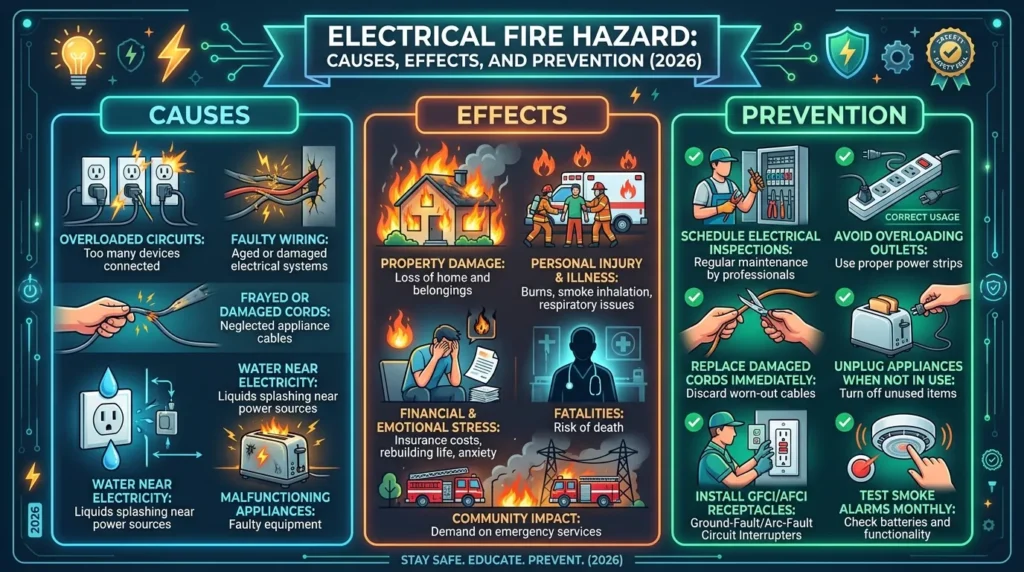
An electrical fire hazard is a dangerous condition in which faulty electrical systems or equipment generate enough heat to ignite nearby combustible materials. Electrical fires are among the leading causes of property damage, equipment failure, and workplace accidents in residential, commercial, and industrial buildings.
Most electrical fires occur due to overloaded circuits, short circuits, damaged wiring, loose electrical connections, or faulty electrical equipment. If these problems are not detected and corrected in time, they can lead to overheating, sparks, smoke, and eventually a fire.
How an Electrical Fire Hazard Occurs
Electrical fires occur when excessive electrical current or faulty connections produce more heat than the electrical system can safely handle. As the temperature increases, wire insulation may melt, sparks may be generated, and nearby combustible materials such as wood, paper, plastic, or fabric can catch fire.
Common causes include:
- Overloaded electrical circuits.
- Short circuits.
- Loose or damaged electrical connections.
- Faulty switches, sockets, or plugs.
- Damaged insulation on electrical cables.
- Defective electrical appliances.
- Poor maintenance of electrical systems.
- Improper wiring installations.
Effects of Electrical Fire Hazards
Electrical fires can have serious consequences for people, buildings, and equipment.
Some common effects include:
- Damage to electrical wiring and equipment.
- Destruction of buildings and property.
- Smoke inhalation injuries.
- Severe burns.
- Power outages.
- Business interruptions.
- Financial losses.
- Risk of explosions in industrial facilities.
- Loss of life in severe cases.
Electrical fires can spread rapidly if they are not controlled immediately.
Warning Signs of an Electrical Fire Hazard
Recognizing early warning signs can help prevent electrical fires before they become serious.
Common warning signs include:
- Burning smell near electrical outlets or equipment.
- Frequently tripping circuit breakers.
- Flickering or dimming lights.
- Hot switches, plugs, or sockets.
- Sparking outlets.
- Discolored or blackened electrical outlets.
- Buzzing sounds from electrical panels or appliances.
- Melted wire insulation.
If any of these signs are noticed, the electrical system should be inspected by a qualified electrician as soon as possible.
Safety Measures to Prevent Electrical Fire Hazards
Most electrical fires can be prevented by following proper electrical safety practices.
Important preventive measures include:
- Avoid overloading electrical outlets and extension cords.
- Install correctly rated circuit breakers and fuses.
- Replace damaged wires and cables immediately.
- Inspect electrical systems regularly.
- Tighten loose electrical connections.
- Use high-quality electrical equipment and accessories.
- Keep combustible materials away from electrical panels.
- Ensure proper grounding (earthing) of electrical installations.
- Never use damaged electrical appliances.
- Install smoke detectors and suitable fire extinguishers near electrical equipment.
Practical Example
A homeowner connects several high-power appliances to a single extension board. The circuit becomes overloaded, causing the wires to overheat. After some time, the insulation melts, sparks are produced, and nearby wooden furniture catches fire. This incident could have been prevented by distributing the electrical load properly and using a circuit with the correct current rating.
Key Takeaway
An electrical fire hazard occurs when electrical faults such as overloaded circuits, short circuits, damaged wiring, or loose connections generate excessive heat, causing nearby materials to ignite. Regular maintenance, proper circuit protection, quality electrical installations, and safe operating practices are essential for preventing electrical fires and protecting people, property, and electrical systems.
4.5 Explosion Hazard: Causes, Effects, and Prevention (2026)
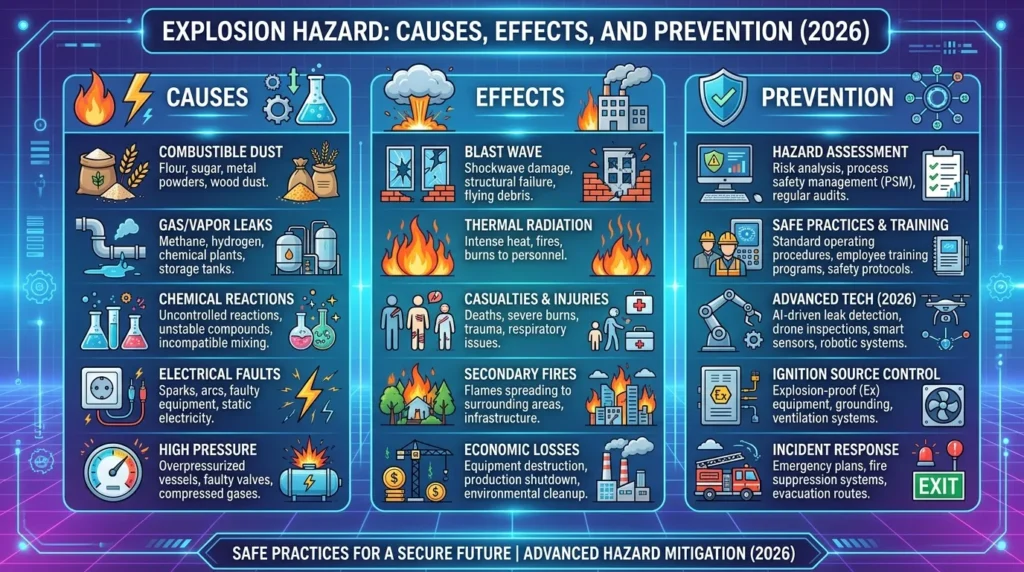
An explosion hazard is a serious electrical hazard that occurs when an electrical spark, arc flash, or high-energy discharge ignites flammable gases, vapors, dust, or combustible materials. These hazards are most common in industrial plants, oil and gas facilities, chemical factories, mining operations, fuel storage areas, and grain processing plants, where explosive substances may be present.
Even a small electrical spark can ignite a flammable atmosphere, leading to a powerful explosion that can cause severe injuries, fatalities, equipment damage, and large-scale property destruction.
How an Explosion Hazard Occurs
An explosion hazard develops when three elements are present at the same time:
- A flammable gas, vapor, dust, or combustible material.
- Oxygen (air) to support combustion.
- An ignition source, such as an electrical spark or arc.
When an electrical fault creates a spark or high-energy discharge, it can ignite the flammable mixture, resulting in a rapid explosion followed by fire.
Common causes include:
- Electrical sparks from faulty equipment.
- Arc flash incidents.
- Short circuits.
- Static electricity discharge.
- Overheated electrical equipment.
- Loose electrical connections.
- Defective switches or motors operating in hazardous areas.
Effects of Explosion Hazards
Electrical explosions can have devastating consequences for both people and facilities.
Some of the major effects include:
- Powerful blast waves.
- Severe burns and life-threatening injuries.
- Fire following the explosion.
- Damage to buildings and industrial equipment.
- Flying debris causing physical injuries.
- Loss of production and equipment failure.
- Environmental damage.
- Fatal accidents in severe cases.
In industrial environments, explosions can spread rapidly and trigger multiple secondary explosions if flammable materials are stored nearby.
High-Risk Areas
Explosion hazards are most likely to occur in locations where flammable substances are present, including:
- Oil and gas refineries.
- Chemical manufacturing plants.
- Fuel storage terminals.
- Mining operations.
- Paint and solvent factories.
- Grain silos and flour mills.
- Pharmaceutical manufacturing facilities.
- LPG and natural gas installations.
These locations require specially designed explosion-proof electrical equipment to reduce the risk of ignition.
Safety Measures to Prevent Explosion Hazards
The risk of electrical explosions can be greatly reduced by following proper safety practices.
Important preventive measures include:
- Use explosion-proof or flameproof electrical equipment in hazardous areas.
- Regularly inspect and maintain electrical installations.
- Eliminate loose electrical connections and faulty wiring.
- Properly ground (earth) electrical systems to prevent static electricity.
- Keep flammable gases and vapors under control through adequate ventilation.
- Follow hazardous area classification standards.
- Avoid using electrical equipment that is not certified for explosive environments.
- Install gas detection and fire protection systems.
- Ensure workers receive proper electrical safety training.
- Follow Lockout/Tagout (LOTO) procedures during maintenance.
Practical Example
In an oil refinery, a damaged electrical motor produces sparks while operating. Flammable gas leaking into the surrounding area comes into contact with the spark, causing an explosion followed by a fire. This accident could have been prevented by using certified explosion-proof equipment, maintaining the motor properly, and detecting the gas leak before operation.
Key Takeaway
An explosion hazard occurs when an electrical spark, arc flash, or high-energy discharge ignites flammable gases, vapors, dust, or combustible materials. These hazards are especially dangerous in industrial environments where explosive atmospheres may exist. Proper equipment selection, regular maintenance, hazardous area protection, grounding, ventilation, and strict compliance with electrical safety standards are essential for preventing explosions and ensuring a safe workplace.
5. Main Components Involved in Electrical Safety (2026)
Electrical safety depends on several important components that work together to prevent electric shocks, electrical fires, equipment damage, and other hazards. These devices and materials are designed to control the flow of electricity, detect faults, and disconnect the power supply whenever unsafe conditions occur. Understanding their functions is essential for designing and maintaining safe electrical systems.
5.1 Insulation Materials
Insulation materials are protective coverings placed around electrical conductors to prevent current from escaping. They ensure that electricity flows only through the intended path and reduce the risk of accidental contact with live wires.
Common insulation materials include PVC (Polyvinyl Chloride), XLPE (Cross-linked Polyethylene), and rubber, which provide excellent electrical insulation and mechanical protection.
Functions
- Prevent electrical current leakage.
- Protect wires and cables from damage.
- Reduce the risk of electric shock.
- Prevent short circuits between conductors.
- Improve the safety and durability of electrical systems.
5.2 Circuit Breakers
A circuit breaker is an automatic protective device that interrupts the electrical supply whenever it detects abnormal conditions such as an overload, short circuit, or ground fault. Unlike a fuse, a circuit breaker can usually be reset after the fault has been corrected.
Circuit breakers are widely used in residential, commercial, and industrial electrical installations to protect both people and equipment.
Functions
- Automatically disconnect power during faults.
- Protect electrical circuits from overload.
- Prevent damage caused by short circuits.
- Reduce the risk of electrical fires.
- Allow safe restoration of power after fault clearance.
5.3 Fuses
A fuse is one of the simplest and most reliable electrical protection devices. It contains a thin metal element that melts when excessive current flows through it, breaking the circuit and stopping the flow of electricity.
Although a blown fuse must be replaced, it provides quick and effective protection against dangerous overcurrent conditions.
Functions
- Protect circuits from excessive current.
- Prevent overheating of electrical wiring.
- Reduce the risk of electrical fires.
- Provide simple and economical circuit protection.
- Disconnect faulty circuits automatically.
5.4 Earthing (Grounding) System
The earthing system, also known as the grounding system, provides a low-resistance path for fault current to flow safely into the earth. If an electrical fault occurs, the fault current is diverted away from people and electrical equipment, significantly reducing the risk of electric shock.
A properly designed earthing system is one of the most important safety features in any electrical installation.
Functions
- Provide a safe path for fault current.
- Protect people from electric shock.
- Help circuit breakers and fuses operate quickly.
- Protect electrical equipment from damage.
- Improve the overall safety of electrical installations.
5.5 Protective Devices
Protective devices continuously monitor electrical systems and respond automatically when abnormal operating conditions are detected. These devices include protective relays, Residual Current Devices (RCDs), Ground Fault Circuit Interrupters (GFCIs), Earth Leakage Circuit Breakers (ELCBs), and safety switches.
They play a critical role in minimizing electrical hazards and ensuring the safe operation of power systems.
Functions
- Detect abnormal electrical conditions.
- Monitor leakage current and earth faults.
- Disconnect faulty circuits automatically.
- Protect people and electrical equipment.
- Improve the reliability and safety of electrical systems.
Key Takeaway
The main components involved in electrical safety—including insulation materials, circuit breakers, fuses, earthing systems, and protective devices—work together to prevent electrical hazards and ensure safe operation. Proper installation, regular inspection, and routine maintenance of these components help reduce the risk of electric shock, electrical fires, equipment failure, and other accidents in residential, commercial, and industrial environments.
6. Advantages of Electrical Safety Systems
- Protect human life
- Reduce fire risk
- Protect electrical equipment
- Improve system reliability
- Reduce maintenance cost
- Ensure safe working environment
7. Disadvantages / Limitations
- Initial installation cost is high
- Requires regular maintenance
- Needs trained professionals
- Fault detection may take time
- Improper installation reduces effectiveness
8. Applications of Electrical Safety Systems (2026)
Electrical safety systems are used in residential, commercial, industrial, and utility power systems to protect people, electrical equipment, and property from hazards such as electric shock, short circuits, overloads, arc flashes, and electrical fires. Modern safety technologies help ensure that electrical installations operate efficiently while minimizing the risk of accidents and equipment failure.
Below are some of the most common applications of electrical safety systems.
8.1 Residential Applications
Electrical safety systems play a vital role in protecting homes and families from electrical accidents. Modern residential installations include various protective devices that automatically disconnect the power supply when dangerous conditions are detected.
Common residential applications include:
- Safe electrical wiring systems.
- Circuit breakers in distribution boards.
- Residual Current Devices (RCDs) or GFCIs.
- Proper earthing (grounding) systems.
- Surge protection devices.
- Overload and short-circuit protection.
- Protection for household appliances and electronic devices.
Benefits
- Reduces the risk of electric shock.
- Prevents electrical fires.
- Protects household appliances.
- Improves overall home electrical safety.
8.2 Industrial Applications
Industrial facilities use advanced electrical safety systems because they operate heavy machinery, high-voltage equipment, and large electrical networks. Protective devices help prevent equipment damage, production downtime, and workplace accidents.
Common industrial applications include:
- Factory machine protection.
- High-voltage power distribution systems.
- Motor Control Centers (MCCs).
- Power Control Centers (PCCs).
- Protective relay systems.
- Arc flash protection systems.
- Automation and process control safety.
- Emergency shutdown systems.
Benefits
- Protects expensive industrial equipment.
- Improves worker safety.
- Reduces production interruptions.
- Minimizes electrical accidents.
8.3 Commercial Applications
Commercial buildings require reliable electrical safety systems to ensure continuous operation and protect employees, customers, and valuable equipment.
Common commercial applications include:
- Shopping malls.
- Hospitals and healthcare facilities.
- Office buildings.
- Hotels.
- Educational institutions.
- Airports.
- Data centers.
- Commercial complexes.
Electrical safety devices protect lighting systems, HVAC equipment, elevators, computers, emergency power systems, and communication equipment.
Benefits
- Provides safe operation of electrical systems.
- Prevents business interruptions.
- Protects occupants and electrical equipment.
- Ensures compliance with electrical safety standards.
8.4 Modern Technology Applications
Advancements in technology have significantly improved electrical safety through intelligent monitoring and automation systems. These modern solutions continuously monitor electrical networks, detect faults in real time, and help prevent serious accidents.
Common modern applications include:
- Smart grid protection systems.
- IoT-based electrical monitoring.
- Automated fault detection systems.
- Smart circuit breakers.
- Remote equipment monitoring.
- Predictive maintenance systems.
- AI-based fault analysis.
- Real-time energy management systems.
Benefits
- Detects faults before they become serious.
- Improves system reliability.
- Reduces maintenance costs.
- Minimizes downtime.
- Enhances energy efficiency and operational safety.
Key Takeaway
Electrical safety systems are essential in homes, industries, commercial buildings, and modern smart power networks. From protecting residential wiring with circuit breakers to monitoring industrial equipment with intelligent automation and IoT-based systems, these safety solutions help prevent electric shock, overloads, short circuits, electrical fires, and equipment failures. As electrical technology continues to advance, modern safety systems are becoming smarter, faster, and more reliable, ensuring safer and more efficient electrical installations across all sectors.
9. Comparison Section
Difference Between Safe System and Unsafe System
| Feature | Safe Electrical System | Unsafe Electrical System |
|---|---|---|
| Protection | High | Low |
| Risk Level | Low | High |
| Maintenance | Regular | Poor |
| Equipment Life | Long | Short |
This shows the difference between safe and unsafe electrical systems clearly.
10. Selection Guide for Electrical Safety Equipment (2026)
Selecting the right electrical safety equipment is essential for protecting people, electrical systems, and property from hazards such as electric shock, overloads, short circuits, arc flashes, and electrical fires. The correct safety devices should match the electrical system’s voltage, current, operating environment, and applicable safety standards. Choosing high-quality equipment not only improves safety but also increases the reliability and lifespan of electrical installations.
10.1 How to Choose Proper Electrical Safety Equipment
Before purchasing or installing electrical safety equipment, consider the following important factors:
1. Check the Voltage Rating
Always select safety equipment that is designed for the operating voltage of the electrical system. Using equipment with an incorrect voltage rating may result in insulation failure or equipment damage.
Examples:
- Choose low-voltage devices for residential installations.
- Use high-voltage-rated equipment for industrial power systems.
2. Select Certified Equipment
Always purchase electrical products that comply with recognized national or international safety standards.
Look for certifications such as:
- IEC (International Electrotechnical Commission)
- UL (Underwriters Laboratories)
- CE Marking
- ISO-certified manufacturers
Certified equipment offers better reliability, quality, and safety.
3. Ensure High-Quality Insulation
Proper insulation protects electrical conductors from moisture, heat, chemicals, and mechanical damage while preventing current leakage.
When selecting insulated equipment, consider:
- Heat resistance.
- Moisture resistance.
- Flame-retardant properties.
- Mechanical strength.
- Long service life.
4. Choose the Correct Circuit Breaker Rating
Circuit breakers should match the electrical load and cable capacity. An incorrectly sized breaker may either trip unnecessarily or fail to protect the circuit during a fault.
Consider:
- Current rating (Ampere).
- Voltage rating.
- Breaking capacity.
- Type of load (resistive, inductive, or motor load).
5. Follow Electrical Safety Standards
All electrical installations should comply with applicable electrical codes and safety regulations.
Following recognized standards helps:
- Improve workplace safety.
- Reduce electrical accidents.
- Protect electrical equipment.
- Ensure legal compliance.
- Increase system reliability.
10.2 Tips for Beginners Working with Electricity
If you are new to electrical work, following basic safety practices can significantly reduce the risk of accidents.
Important safety tips include:
- Always switch off the power supply before starting any electrical work.
- Verify that the circuit is de-energized using a voltage tester.
- Use insulated hand tools designed for electrical work.
- Wear appropriate Personal Protective Equipment (PPE), including insulated gloves and safety shoes.
- Never touch exposed live wires.
- Keep hands and the work area dry.
- Do not overload electrical outlets or extension cords.
- Replace damaged cables, plugs, and switches immediately.
- Follow Lockout/Tagout (LOTO) procedures during maintenance.
- Never work on live electrical circuits unless it is absolutely necessary and proper protective equipment and safety procedures are in place.
- If you are unsure about an electrical task, seek assistance from a qualified electrician.
Key Takeaway
Choosing the proper electrical safety equipment is one of the most effective ways to prevent electric shock, electrical fires, equipment damage, and workplace accidents. By selecting correctly rated and certified equipment, ensuring proper insulation, installing suitable circuit breakers, and following recognized safety standards, you can create a safer electrical system. Beginners should always prioritize safe work practices, use appropriate PPE, and avoid working on energized circuits whenever possible to minimize the risk of injury.
11. Common Electrical Safety Problems and Their Solutions (2026)
Electrical systems can develop various problems over time due to overloading, poor maintenance, damaged components, or improper installation. Identifying these issues early and applying the correct solution helps prevent electric shock, electrical fires, equipment damage, and costly downtime. Regular inspections and timely maintenance are essential for ensuring the safe and reliable operation of electrical systems.
11.1 Problem: Frequent Tripping of the Circuit Breaker
A circuit breaker that trips repeatedly is a sign that the electrical system is experiencing an abnormal condition. This usually happens when the current exceeds the breaker’s rated capacity or a fault develops in the circuit.
Possible Causes
- Overloaded electrical circuit.
- Short circuit.
- Ground (earth) fault.
- Faulty electrical appliance.
- Defective circuit breaker.
Solution
- Disconnect unnecessary electrical loads.
- Check the circuit for overload conditions.
- Inspect wiring for short circuits or damaged insulation.
- Test connected appliances for faults.
- Replace a defective circuit breaker if necessary.
- Have the system inspected by a qualified electrician.
11.2 Problem: Electric Shock from Electrical Appliances
Receiving an electric shock while touching an appliance usually indicates a fault in the appliance or its electrical installation. This problem should never be ignored because it can lead to serious injury.
Possible Causes
- Damaged insulation.
- Improper earthing (grounding).
- Internal wiring faults.
- Moisture inside the appliance.
- Leakage current.
Solution
- Stop using the appliance immediately.
- Inspect the power cord and plug for damage.
- Improve the earthing system.
- Replace damaged cables or insulation.
- Test for leakage current.
- Repair or replace faulty equipment before reuse.
11.3 Problem: Wire Overheating
Overheated electrical wires are a major fire hazard. Excessive heat usually indicates that the wiring is carrying more current than it is designed to handle.
Possible Causes
- Overloaded circuits.
- Undersized cables.
- Loose electrical connections.
- Poor ventilation.
- Continuous heavy electrical loads.
Solution
- Reduce the electrical load on the circuit.
- Use wires with the correct current rating.
- Tighten loose electrical connections.
- Replace damaged or overheated cables.
- Install properly rated circuit breakers and protective devices.
11.4 Problem: Burning Smell from Electrical Equipment
A burning smell coming from electrical equipment is a warning sign that something is overheating or beginning to fail. Ignoring this symptom can result in an electrical fire.
Possible Causes
- Melting wire insulation.
- Loose electrical connections.
- Overheated motors or transformers.
- Faulty switches or sockets.
- Electrical arcing.
Solution
- Switch off the power supply immediately.
- Disconnect the affected equipment.
- Inspect the wiring and electrical components.
- Replace damaged parts before restoring power.
- Contact a qualified electrician if the cause cannot be identified safely.
Key Takeaway
Most electrical problems begin as small faults but can quickly develop into serious hazards if left unattended. Regular inspections, proper maintenance, quality electrical components, and prompt repairs help prevent electrical accidents, protect equipment, and ensure the safe operation of electrical systems.
12. Future Trends in Electrical Safety (2026)
Electrical safety is rapidly evolving with advancements in digital technology, artificial intelligence (AI), automation, and the Internet of Things (IoT). Modern electrical safety systems are becoming more intelligent, allowing faults to be detected earlier, maintenance to be planned more effectively, and dangerous situations to be prevented before accidents occur.
These innovations are improving the safety, reliability, and efficiency of residential, commercial, and industrial electrical installations.
12.1 Smart Sensors for Fault Detection
Modern electrical systems use smart sensors to continuously monitor voltage, current, temperature, insulation condition, and other operating parameters.
Benefits
- Early fault detection.
- Real-time monitoring.
- Reduced equipment damage.
- Improved electrical safety.
12.2 AI-Based Predictive Maintenance
Artificial Intelligence (AI) analyzes electrical system data to predict potential failures before they occur. This allows maintenance teams to repair or replace components before a breakdown or accident happens.
Benefits
- Prevents unexpected failures.
- Reduces maintenance costs.
- Increases equipment reliability.
- Improves workplace safety.
12.3 Wireless Electrical Safety Monitoring
Wireless monitoring systems allow engineers to observe electrical equipment remotely using computers or mobile devices. Important electrical parameters can be monitored without physically accessing hazardous areas.
Benefits
- Remote system supervision.
- Faster fault identification.
- Reduced inspection time.
- Improved worker safety.
12.4 Automated Shutdown Systems
Advanced protection systems can automatically disconnect electrical power whenever dangerous conditions such as overloads, short circuits, arc faults, or overheating are detected.
Benefits
- Prevents electrical fires.
- Protects personnel from hazards.
- Minimizes equipment damage.
- Improves emergency response.
12.5 IoT-Enabled Electrical Panels
Modern electrical panels equipped with Internet of Things (IoT) technology provide real-time monitoring, remote diagnostics, and automatic alerts whenever abnormal operating conditions occur.
Benefits
- Continuous system monitoring.
- Instant fault notifications.
- Better energy management.
- Reduced downtime.
- Improved maintenance planning.
12.6 Smart Electrical Protection Systems
The next generation of electrical safety systems combines AI, IoT, cloud computing, and advanced protective devices to create highly intelligent electrical networks capable of detecting, analyzing, and responding to faults automatically.
Future developments include:
- Self-monitoring electrical systems.
- AI-assisted fault diagnosis.
- Smart circuit breakers.
- Digital protective relays.
- Cloud-based electrical monitoring.
- Predictive safety analytics.
These technologies will make electrical installations safer, more efficient, and easier to manage.
Key Takeaway
The future of electrical safety lies in smart, connected, and automated protection systems. Technologies such as AI-based predictive maintenance, IoT-enabled electrical panels, wireless monitoring, intelligent sensors, and automated shutdown systems will significantly reduce electrical accidents, improve equipment reliability, lower maintenance costs, and create safer working environments across residential, commercial, and industrial sectors.
13. Conclusion
Electrical hazards are a serious risk in both domestic and industrial environments. Understanding their types, causes, and prevention methods is essential for every electrical student, engineer, and technician. From electric shocks to fire hazards, each risk can be controlled with proper safety systems like circuit breakers, fuses, and earthing.
The electrical hazards working principle shows that unsafe current flow is the main cause of danger. By following proper safety rules and using modern protective devices, we can significantly reduce electrical accidents.
In simple words, electrical safety is not optional—it is a responsibility that protects life, equipment, and property.