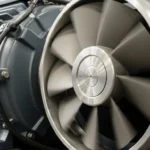

Imagine a ceiling fan rotating smoothly for hours without any physical contact between its internal rotating parts and the stationary body. If these parts touched each other directly, the motor would quickly stop due to friction and damage. The reason the fan works smoothly is because there is a very small space between the rotating and stationary components inside the motor. This space is called the air gap.
In electrical machines such as motors, generators, and transformers, the air gap plays a very important role. Although it is only a small distance, it directly affects the performance, efficiency, torque, and magnetic behavior of the machine.
For electrical students, engineers, and technicians, understanding the air gap working principle is essential when studying electric machines. A properly designed air gap ensures efficient energy conversion, smooth rotation, and stable operation.
In this article, you will learn what an air gap is, how the air gap working principle operates in electrical machines, different air gap types, important components, and practical air gap applications. We will also discuss air gap advantages and disadvantages, common issues, and future technology developments. This explanation is written in simple language so beginners can easily understand this important concept.
2. What is Air Gap?
Definition
An air gap is the small physical space between the stationary part (stator) and the rotating part (rotor) of an electrical machine.
This gap allows the rotor to rotate freely while magnetic fields pass through it to produce motion.
Simple Explanation
In electrical machines, the stator produces a magnetic field. This magnetic field must interact with the rotor to create movement. However, the rotor cannot touch the stator because it needs to rotate freely.
Therefore, a small space is left between them. This space is known as the air gap.
Even though the air gap is very small, it plays a major role in the machine’s performance.
Practical Example
Consider an AC induction motor used in a water pump. Inside the motor:
- The stator produces a rotating magnetic field.
- The rotor interacts with that field.
- The air gap allows the magnetic field to transfer energy without physical contact.
Without the air gap, the motor would not rotate properly.
3. Air Gap Working Principle
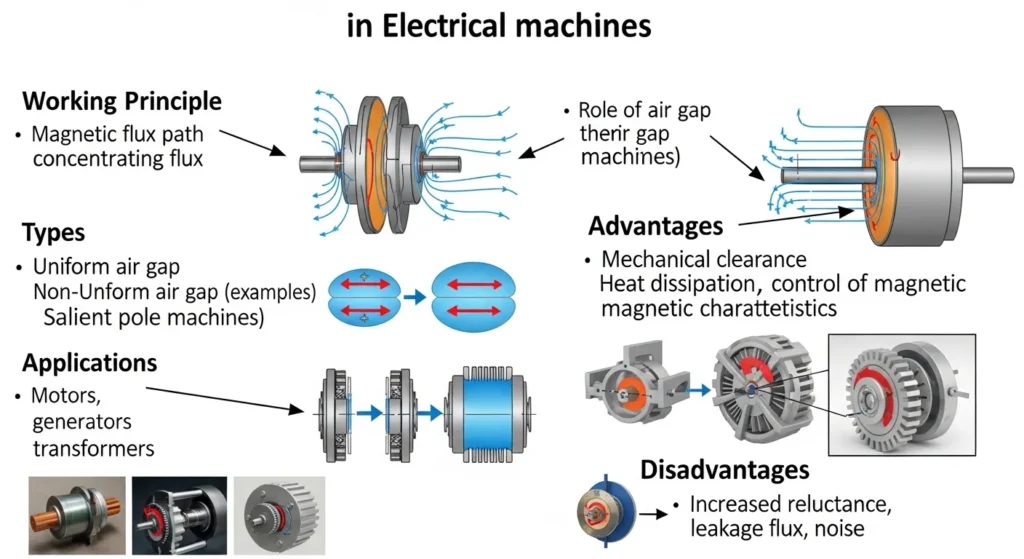
The air gap working principle is based on the transfer of magnetic flux between the stator and rotor through a small air space.
Although air has high magnetic resistance compared to iron, it still allows magnetic fields to pass through.
Step-by-Step Operation
- Magnetic Field Creation
The stator windings receive electrical power and create a magnetic field.
- Magnetic Flux Path
The magnetic field flows through the stator core and crosses the air gap.
- Interaction with Rotor
The magnetic field reaches the rotor and interacts with it.
- Force Generation
This interaction creates electromagnetic force.
- Mechanical Motion
The rotor starts rotating and produces mechanical power.
Simple Analogy
Think of the air gap like a bridge between two magnets.
Even if the magnets are separated by a small space, their magnetic fields can still interact.
Similarly, the stator and rotor exchange magnetic energy through the air gap.
4. Types / Classification of Air Gap
Air gaps are classified depending on the design of electrical machines.
Uniform Air Gap
In this type, the air gap distance between stator and rotor is the same at all points.
Features:
- Balanced magnetic field
- Smooth motor operation
- Common in induction motors
Uniform air gaps improve efficiency and reduce vibration.
Non-Uniform Air Gap
In this design, the air gap distance varies across different parts of the machine.
Features:
- Used in special electrical machines
- Improves starting torque in some motors
However, it can create uneven magnetic forces.
Radial Air Gap
In radial air gap machines, the magnetic field flows radially from the stator to the rotor.
Examples:
- Induction motors
- Synchronous motors
This is the most common air gap configuration.
Axial Air Gap
In axial air gap machines, the magnetic field flows along the axis of the rotor.
Features:
- Compact design
- High power density
Axial air gap machines are used in modern electric vehicles and advanced machines.
5. Main Components Related to Air Gap
Although the air gap itself is simply a space, several components influence its performance.
Stator
The stator is the stationary part of the machine.
Functions:
- Produces magnetic field
- Transfers flux through the air gap
Rotor
The rotor is the rotating part located inside the stator.
Functions:
- Receives magnetic flux
- Converts electromagnetic energy into mechanical motion
Stator Core
The stator core is made of laminated steel.
Functions:
- Reduces energy losses
- Guides magnetic flux
Rotor Core
The rotor core carries rotor windings or conductive bars.
Functions:
- Helps generate torque
- Interacts with stator magnetic field
Magnetic Flux Path
The magnetic path includes:
- Stator core
- Air gap
- Rotor core
This path ensures proper magnetic energy transfer.
6. Air Gap Advantages
The air gap advantages and disadvantages must be understood when designing electrical machines.
Air Gap Advantages
- Prevents mechanical contact between rotor and stator
- Reduces friction and wear
- Allows smooth rotor rotation
- Maintains stable magnetic field distribution
- Improves machine reliability
- Supports efficient energy conversion
A well-designed air gap improves motor performance and lifespan.
7. Air Gap Disadvantages / Limitations
Despite its importance, the air gap also introduces certain limitations.
Air Gap Disadvantages
- Increases magnetic resistance
- Reduces magnetic flux strength
- Can lower machine efficiency
- Requires precise manufacturing accuracy
- Larger air gaps reduce torque production
Therefore, engineers carefully design the air gap to balance performance and efficiency.
8. Air Gap Applications
Air gaps are essential in many electrical machines and technologies.
Home Applications
- Ceiling fans
- Washing machines
- Air conditioners
These appliances use electric motors with air gaps.
Industrial Applications
Air gaps are found in:
- Induction motors
- Synchronous motors
- Generators
- Industrial drives
These machines rely on air gap design for efficient operation.
Modern Technology Applications
Air gap technology is used in advanced systems such as:
- Electric vehicles
- Wind turbines
- Robotics
- Magnetic levitation systems
These air gap applications demonstrate its importance in modern electrical engineering.
9. Comparison Section
Difference Between Air Gap and Magnetic Core
| Feature | Air Gap | Magnetic Core |
|---|---|---|
| Definition | Small space between stator and rotor | Iron path carrying magnetic flux |
| Material | Air or non-magnetic space | Laminated steel |
| Function | Allows rotor rotation | Conducts magnetic flux |
| Magnetic Resistance | High | Low |
Understanding the difference between air gap and magnetic core helps engineers design efficient electrical machines.
10. Selection Guide
Choosing the correct air gap size is critical in motor and generator design.
Important Factors
- Machine size
- Required torque
- Magnetic flux density
- Efficiency requirements
- Mechanical clearance
Tips for Beginners
- Smaller air gaps improve efficiency
- Larger air gaps reduce mechanical risk
- Precision manufacturing is essential
Engineers carefully calculate air gap size to achieve optimal machine performance.
11. Common Problems & Solutions
Q1: What happens if the air gap becomes too large?
A large air gap weakens the magnetic field.
Solution:
- Proper machine design
- Maintain correct rotor alignment
Q2: What happens if the air gap becomes too small?
A small air gap may cause rotor and stator contact.
Solution:
- Maintain proper mechanical tolerances
Q3: Why is air gap uneven?
Uneven air gaps may occur due to:
- Bearing wear
- Rotor misalignment
- Mechanical damage
Solution:
- Inspect bearings
- Align rotor properly
Q4: Can air gap affect motor efficiency?
Yes. An improper air gap reduces magnetic flux and decreases efficiency.
Regular maintenance ensures optimal machine operation.
12. Future Trends
Electrical machine technology is evolving rapidly.
Advanced Motor Designs
New motor designs optimize air gap geometry to improve efficiency.
Electric Vehicles
Modern EV motors use advanced air gap configurations to achieve higher performance.
Magnetic Levitation Systems
Air gap control is important in maglev transport systems.
High-Efficiency Electrical Machines
Future designs will reduce losses and improve magnetic energy transfer.
These innovations will make air gap design even more important in future electrical systems.
13. Conclusion
The air gap is a small but extremely important part of electrical machines. It allows the rotor to rotate freely while enabling magnetic fields to transfer energy between the stator and rotor. Without a properly designed air gap, motors and generators would not operate efficiently or safely.
In this article, we explained what an air gap is, the air gap working principle, different air gap types, and the major components involved in magnetic energy transfer. We also discussed air gap advantages and disadvantages along with real-world air gap applications in motors, generators, and modern electrical systems.
For electrical students, engineers, and technicians, understanding air gap design is essential when studying electric machines. Even though the air gap is physically small, it has a major impact on efficiency, torque, and performance.
By learning how air gaps work and how they are designed, engineers can build electrical machines that operate more efficiently, reliably, and safely in modern technology systems.