
Imagine you are charging your mobile phone at home. You plug the charger into the wall socket, and your phone starts charging. Inside this simple action, two types of electricity are working together: AC and DC current. The electricity coming from your wall socket is AC, but your phone battery needs DC. The charger converts AC into DC for safe charging.
Many electrical students, technicians, and beginners use electrical systems every day but do not fully understand the difference between AC and DC current. This lack of knowledge can lead to wrong equipment selection, safety risks, and poor system performance.
Understanding “AC vs DC Current – Complete Comparison” is very important for anyone working in electrical and electronic fields. In this article, you will learn the basic definition, working principle, types, components, advantages, disadvantages, and applications of AC and DC. You will also see a detailed comparison, selection guide, common problems, and future trends. By the end, you will have clear and practical knowledge to use in real-life work.
2. What is AC vs DC Current?
Definition
AC vs DC current refers to the comparison between Alternating Current (AC) and Direct Current (DC), which are the two main types of electrical current.
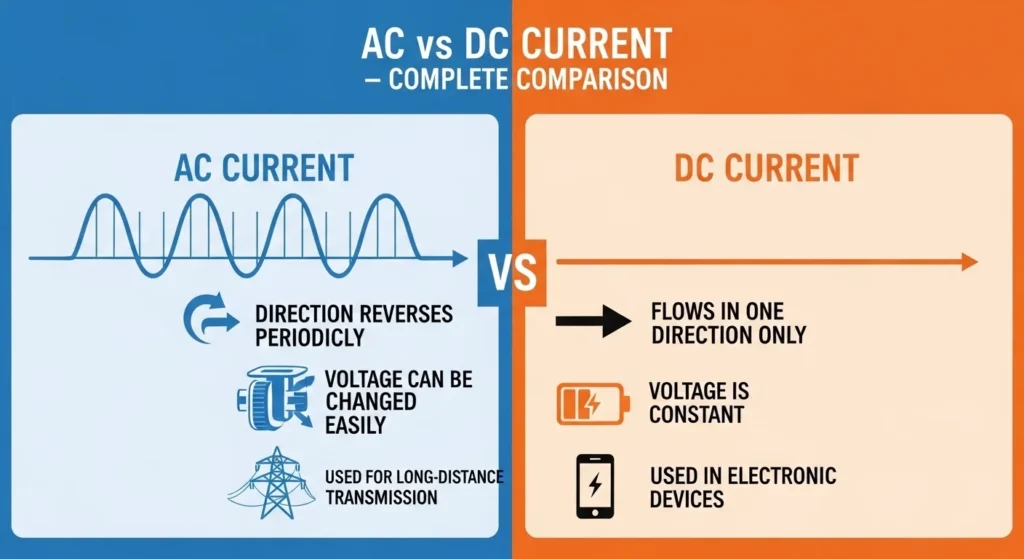
- AC changes its direction again and again.
- DC flows in only one direction.
Simple Explanation
AC is like water that flows forward and backward in a pipe.
DC is like water that flows in only one direction.
In electrical systems, AC is mainly used for power distribution, while DC is used for electronic devices.
Practical Example
- Home socket supply = AC current
- Mobile battery = DC current
When you charge your phone, AC is converted into DC inside the charger.
3. Working Principle of AC vs DC Current
Step-by-Step Explanation
AC Working Principle
- Power station generates AC voltage.
- Direction of current changes many times per second.
- Electricity travels through transmission lines.
- It reaches homes and industries.
- Devices use this power.
DC Working Principle
- Battery or DC source produces voltage.
- Electrons move in one direction.
- Current flows through circuit.
- Device consumes energy.
- Circuit completes and returns.
Easy Analogy
AC is like a swing that moves forward and backward.
DC is like a car moving on a straight road.
Key Points
- AC changes direction.
- DC flows in one direction.
- AC is easy to transmit.
- DC is stable and smooth.
- Both need closed circuits.
This explains the AC vs DC current working principle.
4. Types / Classification of AC and DC Current
Single Phase AC
Single-phase AC is used in homes.
Features:
- Simple system
- Low cost
- Used for small loads
Example: House wiring.
Three Phase AC
Three-phase AC is used in industries.
Features:
- High efficiency
- Smooth power
- Used for heavy machines
Example: Industrial motors.
Pure DC
Pure DC comes from batteries.
Features:
- Stable output
- No fluctuation
- Used in electronics
Example: Mobile battery.
Pulsating DC
Pulsating DC comes from rectifiers.
Features:
- Slight ripple
- Converted from AC
- Used in power supplies
Example: Adapter output.
5. Main Components of AC and DC Systems
1. Power Source
Provides electrical energy.
- AC source: Power station, generator
- DC source: Battery, solar panel
2. Conductors
Carry current.
Examples:
- Copper wires
- Aluminum cables
3. Load
Uses electricity.
Examples:
- Bulb
- Motor
- Laptop
4. Switch and Control Devices
Control current flow.
Examples:
- Switch
- Relay
- Contactor
5. Protection Devices
Protect from damage.
Examples:
- Fuse
- MCB
- Circuit breaker
6. Conversion Devices
Convert AC to DC or DC to AC.
Examples:
- Rectifier
- Inverter
- Charger
Each component plays an important role in system performance.
6. Advantages of AC and DC Current
Advantages of AC Current
- Easy transmission over long distance
- Low power loss
- Voltage can be increased or decreased easily
- Cheaper distribution system
- Suitable for heavy loads
Advantages of DC Current
- Stable voltage
- No frequency problem
- Better for electronics
- High efficiency in batteries
- Good for renewable systems
Real-World Benefits
- AC supports national power grids.
- DC supports smartphones and laptops.
These points explain AC vs DC current advantages and disadvantages clearly.
7. Disadvantages / Limitations of AC and DC Current
Disadvantages of AC
- Not suitable for electronics directly
- Causes power loss in transformers
- More electromagnetic interference
- Needs conversion for batteries
Disadvantages of DC
- Difficult to transmit long distance
- Voltage change is costly
- High transmission loss
- Expensive equipment
Practical Limitations
Wrong selection of AC or DC can damage devices. Proper planning is required.
8. Applications of AC vs DC Current
Home Applications
- Lighting
- Fans
- Refrigerator
- Air conditioner
(Mainly AC)
Industrial Applications
- Motors
- Machines
- Welding systems
- Compressors
(Mainly AC)
Electronic Applications
- Computers
- Mobiles
- Cameras
- Routers
(Mainly DC)
Renewable Energy Applications
- Solar panels (DC)
- Inverters (AC)
- Battery storage (DC)
Modern Technology Uses
- Electric vehicles
- Data centers
- Smart devices
- Robotics
These examples show wide AC vs DC current applications.
9. Comparison Section: AC vs DC Current
Comparison Table
| Feature | AC Current | DC Current |
| Direction | Changes continuously | One direction |
| Source | Power station | Battery |
| Transmission | Easy | Difficult |
| Voltage Change | Easy | Hard |
| Usage | Homes, industries | Electronics |
| Cost | Low | High |
| Stability | Less stable | More stable |
| Storage | Difficult | Easy |
Explanation
AC is best for power distribution.
DC is best for electronic devices.
This explains the difference between AC and DC.
10. Selection Guide for Beginners
How to Choose the Right Current
For Home Wiring
- Choose AC supply
- Use safety devices
- Follow standards
For Electronics
- Choose DC supply
- Use regulated adapter
- Check voltage rating
For Solar Systems
- Use DC panels
- Install inverter
- Use good batteries
For Industries
- Use three-phase AC
- Install protection systems
- Maintain regularly
Tips for Beginners
- Never mix AC and DC without converter.
- Check device rating.
- Use proper insulation.
- Follow safety rules.
- Ask experts when unsure.
11. Common Problems & Solutions (FAQs)
Q1: Why does my charger heat up?
Solution:
Poor quality adapter or overload. Use original charger.
Q2: Why does my inverter trip?
Solution:
Overload or battery problem. Reduce load and check battery.
Q3: Why is my motor vibrating?
Solution:
Voltage imbalance. Check three-phase supply.
Q4: Why is battery not charging?
Solution:
Faulty rectifier or low input voltage.
Q5: Why is power supply unstable?
Solution:
Poor wiring or weak grounding. Improve installation.
12. Future Trends in AC and DC Systems
New Technologies
- Smart grids
- HVDC transmission
- Wireless charging
- Fast chargers
- Energy storage systems
Industry Direction
Future systems will be:
- More digital
- More efficient
- Environment-friendly
- AI controlled
- Cost effective
DC microgrids and renewable systems will grow rapidly. AC systems will become smarter and safer.
13. Conclusion
AC and DC current are the foundation of modern electrical and electronic systems. AC is mainly used for power transmission and industrial work, while DC is essential for electronic devices and energy storage. In this complete comparison, we explained their definition, working principle, types, components, advantages, disadvantages, and applications. We also discussed their differences, selection tips, common problems, and future trends.
For beginners, understanding AC vs DC current is very important. It helps you choose the right system, work safely, and improve technical skills. As a student, technician, or engineer, strong basicknowledge will make you confident and professional.
Keep learning, practicing, and following safety standards. This knowledge will help you build a successful career in the electrical field.