
Imagine a large power plant supplying electricity to thousands of homes, schools, hospitals, and industries. Inside that power plant, powerful machines rotate continuously to generate electricity. These machines are called AC generators. They are one of the most important devices used to produce electrical power in modern power systems.
Almost all electricity used in homes and industries around the world is generated using AC generators. Whether it is a hydroelectric dam, a wind turbine, or a thermal power plant, the electricity produced is usually alternating current (AC).
Understanding AC generator types explained is very important for electrical students, engineers, technicians, and beginners. Different types of AC generators are designed for different purposes, power levels, and operating conditions.
In this article, you will learn the AC generator working principle, AC generator applications, and AC generator advantages and disadvantages. You will also understand different types of AC generators, their main components, common problems, and how to select the right generator for specific applications.
2. What is an AC Generator?
An AC generator is an electrical machine that converts mechanical energy into alternating electrical energy.
It produces electricity in the form of alternating current, where the direction of current changes periodically.
Simple Explanation
When a conductor moves inside a magnetic field, it produces electrical energy. This process is called electromagnetic induction, which is the basic principle behind AC generators.
Practical Example
A hydroelectric power plant uses flowing water to rotate a turbine. The turbine rotates an AC generator, which converts mechanical energy into electrical power that is sent to homes and industries.
AC generators are widely used because AC electricity can be easily transmitted over long distances.
3. AC Generator Working Principle
The AC generator working principle is based on Faraday’s Law of Electromagnetic Induction.
This law states that when a conductor moves in a magnetic field, a voltage is induced in the conductor.
Step-by-Step Working Process
• Mechanical energy rotates the generator rotor.
• The rotor moves inside a magnetic field.
• The rotating conductor cuts magnetic flux lines.
• This motion induces voltage in the conductor.
• The induced voltage produces alternating current in the external circuit.
Simple Analogy
Think of a water pump pushing water through pipes. In the same way, the generator pushes electrons through wires to produce electricity.
The direction of current changes repeatedly, which is why it is called alternating current (AC).
4. Types of AC Generators
There are several AC generator types used in power systems and industrial applications.
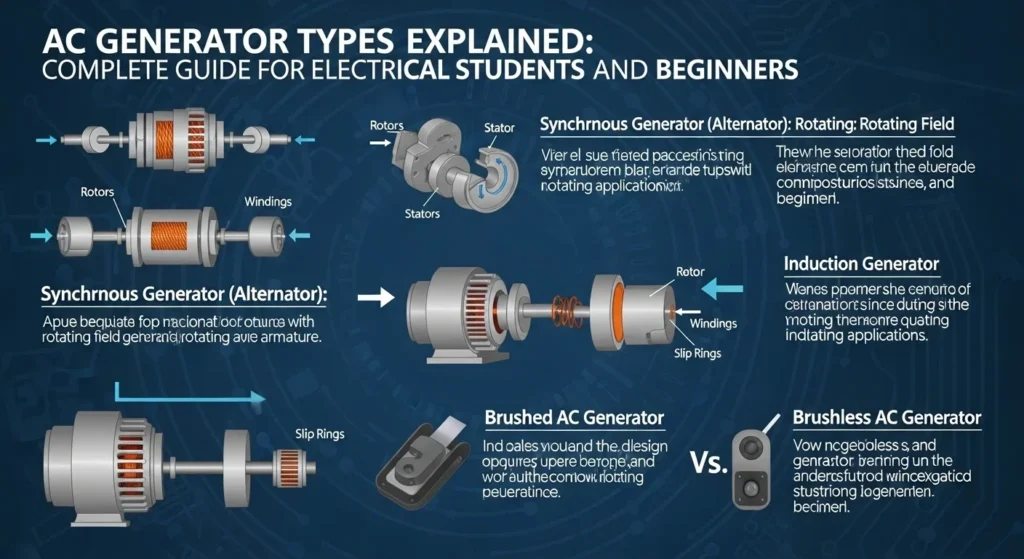
Synchronous Generator
A synchronous generator is the most commonly used AC generator in power plants.
Features
• Rotor rotates at synchronous speed
• Produces constant frequency electricity
• High efficiency
Applications
• Power plants
• Hydroelectric stations
• Thermal power plants
• Nuclear power plants
Most large-scale electricity generation systems use synchronous generators.
Induction Generator
An induction generator works similarly to an induction motor but operates in reverse.
Features
• Simple construction
• Lower maintenance
• Can operate with variable speeds
Applications
• Wind turbines
• Small hydro plants
• Renewable energy systems
Induction generators are popular in renewable energy applications.
Single Phase AC Generator
A single-phase AC generator produces single-phase alternating current.
Features
• Simple design
• Lower power capacity
• Easy operation
Applications
• Small generators
• Portable power systems
• Household backup generators
Three Phase AC Generator
A three-phase AC generator produces three alternating voltages separated by 120 degrees.
Features
• Higher power output
• Smooth power delivery
• Efficient power transmission
Applications
• Industrial power systems
• Large power plants
• Manufacturing industries
Three-phase generators are the backbone of modern electrical power systems.
5. Main Components of an AC Generator
AC generators consist of several important parts that work together to generate electricity.
Stator
The stator is the stationary part of the generator that contains the output windings.
Rotor
The rotor is the rotating part that creates a magnetic field.
Slip Rings
Slip rings transfer electrical energy between rotating and stationary parts.
Brushes
Brushes maintain electrical contact with the slip rings.
Shaft
The shaft connects the generator to the turbine or engine.
Bearings
Bearings allow smooth rotation of the rotor.
Cooling System
Large generators use cooling systems to prevent overheating.
6. AC Generator Advantages
There are many AC generator advantages and disadvantages, but they offer several key benefits.
Advantages
• High efficiency in power generation
• Suitable for large power systems
• Easy voltage transformation using transformers
• Reliable operation
• Long lifespan with proper maintenance
• Ideal for long-distance power transmission
AC generators are widely used because they are highly efficient for producing large amounts of electricity.
7. AC Generator Disadvantages / Limitations
Despite their advantages, AC generators also have certain limitations.
Disadvantages
• Complex design compared to DC generators
• Requires synchronization with the power grid
• High installation cost for large generators
• Maintenance required for moving parts
• Sensitive to mechanical failures
Understanding these limitations helps engineers design better power systems.
8. AC Generator Applications
AC generators have a wide range of applications in modern technology.
Home Applications
• Backup generators
• Small portable generators
• Emergency power systems
Industrial Applications
• Manufacturing plants
• Large industrial motors
• Mining operations
Power Generation Applications
• Hydroelectric power plants
• Thermal power plants
• Nuclear power plants
• Wind power systems
Modern Technology Applications
• Renewable energy systems
• Marine power systems
• Aviation power generation
AC generators are the primary source of electricity in modern societies.
9. Comparison: AC Generator vs DC Generator
Understanding the difference between AC generator and DC generator is important for electrical learners.
| Feature | AC Generator | DC Generator |
|---|---|---|
| Output Current | Alternating Current | Direct Current |
| Maintenance | Lower | Higher |
| Power Capacity | High | Limited |
| Efficiency | Higher for large systems | Lower |
| Applications | Power plants | Battery charging |
AC generators are preferred for large power systems, while DC generators are used in specialized applications.
10. Selection Guide: How to Choose an AC Generator
Selecting the right AC generator depends on several important factors.
Power Requirement
Choose a generator with sufficient power capacity.
Phase Type
Single-phase for small loads and three-phase for industrial loads.
Speed and Frequency
The generator must match the required frequency (50 Hz or 60 Hz).
Efficiency
Higher efficiency generators reduce operating costs.
Environment
Generators must be designed for their operating environment.
Beginners should always follow manufacturer specifications and system requirements.
11. Common Problems & Solutions
Problem 1: Generator Not Producing Voltage
Possible Causes
• Loss of residual magnetism
• Faulty connections
Solution
Re-magnetize the generator or check wiring connections.
Problem 2: Overheating
Possible Causes
• Overload
• Poor cooling
Solution
Reduce load and improve cooling system.
Problem 3: Voltage Fluctuation
Possible Causes
• Speed variations
• Faulty regulator
Solution
Check turbine speed and voltage regulator.
12. Future Trends in AC Generator Technology
The future of AC generators is evolving with new technologies.
Renewable Energy Integration
AC generators will play a key role in wind and hydroelectric systems.
Smart Grid Technology
Modern generators will integrate with smart power grids.
High-Efficiency Materials
New materials will improve generator efficiency and durability.
Compact Generator Designs
Future generators will be smaller but more powerful.
These developments will improve global electricity generation and energy efficiency.
13. Conclusion
AC generators are essential machines that convert mechanical energy into electrical energy in the form of alternating current. They are widely used in power plants, industries, and modern electrical systems.
In this article, we explored AC generator types explained, AC generator working principle, AC generator applications, and AC generator advantages and disadvantages. We also discussed synchronous generators, induction generators, and single-phase and three-phase generators.
Understanding the difference between AC generator and DC generator helps electrical students and engineers choose the right machine for different applications.
As electricity demand continues to grow worldwide, AC generators will remain a critical part of power generation systems. Learning about generator technology is a valuable step for anyone studying electrical engineering or working in the electrical industry.