
Imagine waking up in a remote village where the grid electricity flickers out every few hours. One day, a family installs simple panels on their roof that capture sunlight and turn it into reliable power for lights, fans, and even a small fridge. This is solar power in action—a clean energy source that’s changing lives worldwide.
Solar power is important because it helps reduce our dependence on fossil fuels, cuts down on pollution, and provides energy security in areas without stable grids. As the world faces climate change, understanding solar power becomes key for electrical students, engineers, technicians, and beginners looking to build sustainable systems. It’s not just about saving the planet; it’s about creating efficient, cost-effective solutions for everyday needs.
In this article, you’ll learn the basics of what solar power is, its working principle, types, components, advantages and disadvantages, applications, and more. We’ll cover practical tips, common issues, and future trends to help you grasp how to apply this technology in real projects. By the end, you’ll feel confident discussing or even starting with solar setups.
What is Solar Power?
Solar power is energy harnessed from the sun’s rays and converted into usable electricity or heat. At its core, it’s a renewable resource that uses sunlight, which is abundant and free, to generate power without burning fuels.
In simple terms, solar power works by capturing light particles called photons from the sun. These photons interact with special materials to produce electricity or heat water. It’s like turning free sunlight into something practical, reducing your electric bill and environmental impact.
For a practical example, think of a solar-powered calculator. It has a small panel that absorbs sunlight and powers the device directly, without needing batteries. This shows how solar power can be scaled from tiny gadgets to large farms supplying entire cities.
Solar Power Working Principle
The working principle of solar power revolves around converting sunlight into energy through a process that’s efficient and straightforward. Let’s break it down step by step, using easy analogies to make it clear.
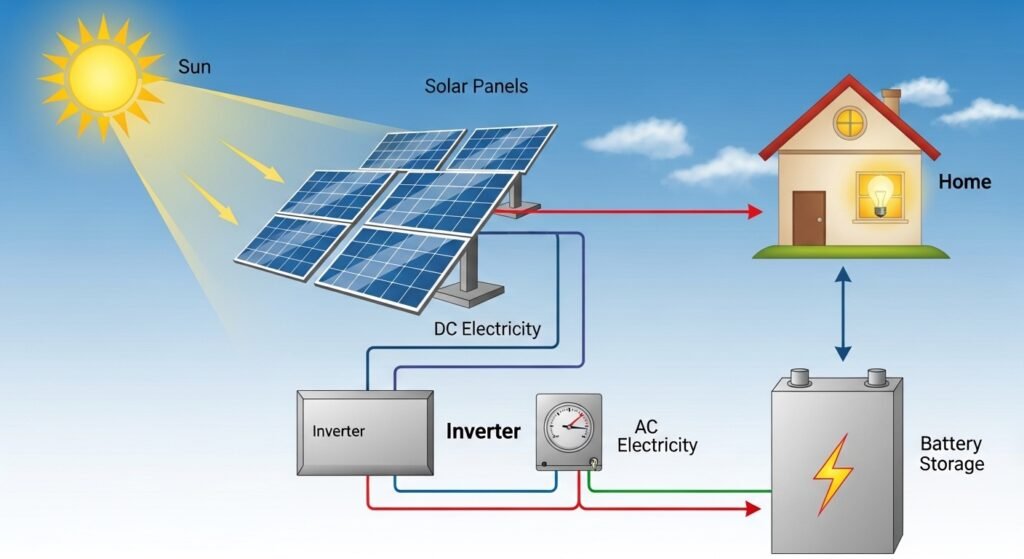
First, sunlight hits solar panels made of photovoltaic cells. These cells are like tiny sandwiches with layers of silicon material. When photons from the sun strike them, they knock electrons loose, creating an electric flow—similar to how a water wheel spins when water pushes it.
Next, this direct current (DC) electricity flows to an inverter, which changes it to alternating current (AC) for home use. It’s like translating a foreign language so your appliances can understand it.
Finally, the power is used immediately, stored in batteries, or sent back to the grid. Excess energy can even earn you credits from utility companies.
- Step 1: Absorption – Panels soak up sunlight like a sponge absorbs water.
- Step 2: Generation – Electrons move, creating current, akin to a ball rolling downhill.
- Step 3: Conversion – Inverter flips DC to AC, ready for outlets.
- Step 4: Distribution – Power reaches lights or devices, with extras stored or shared.
This principle ensures solar power is reliable during daylight, making it a smart choice for sustainable energy.
Types / Classification
Solar power comes in different forms, each suited to specific needs. We’ll explore the main types with clear explanations.
Photovoltaic (PV) Solar Power
This is the most common type, where panels convert sunlight directly into electricity using semiconductor materials. It’s ideal for rooftops and requires no moving parts, making it low-maintenance.
PV systems scale easily, from small home setups to massive solar farms. They work best in sunny areas but can generate power even on cloudy days.
Concentrated Solar Power (CSP)
CSP uses mirrors to focus sunlight onto a small area, heating a fluid that produces steam to drive turbines. Think of it as a giant magnifying glass boiling water for energy.
It’s often used in large-scale plants in deserts, providing power that can be stored for nighttime use. However, it needs lots of space and direct sun.
Solar Thermal Power
This type focuses on heating rather than electricity. Panels absorb sun heat to warm water or air for homes, pools, or industrial processes.
It’s simpler and cheaper for heating needs, like a solar water heater on your roof that cuts hot water costs by up to 70%.
Hybrid Solar Systems
Combining PV with other sources like wind or batteries, hybrids ensure steady power. They switch seamlessly, offering reliability in off-grid areas.
These are growing in popularity for homes wanting backup during outages.
Main Components
Solar power systems have key parts that work together smoothly. Let’s describe the important ones and their functions.
The solar panels are the heart, made of PV cells that capture sunlight and start the energy flow. They come in various sizes and efficiencies, determining how much power you get.
Inverters convert DC from panels to AC for household use. Without them, your system couldn’t power standard appliances safely.
Batteries store excess energy for later, like a savings account for cloudy days or nights. Common types include lithium-ion for longer life.
Mounting structures hold panels securely on roofs or ground, angled for maximum sun exposure. They must withstand weather to last decades.
Charge controllers regulate power flow to batteries, preventing overcharge—like a traffic cop managing energy traffic.
Wiring and connectors link everything, ensuring safe, efficient transfer. Proper sizing avoids losses and hazards.
Advantages
Solar power offers many benefits that make it a top choice for modern energy needs.
- Cost Savings: Reduces electricity bills over time, with payback in 5-10 years through free sun energy.
- Environmental Friendliness: Produces no emissions, helping fight climate change and preserve air quality.
- Energy Independence: Allows off-grid living, especially useful in remote areas without reliable utilities.
- Low Maintenance: Panels last 25+ years with minimal cleaning, saving time and money.
- Scalability: Easy to expand from small setups to large systems as needs grow.
- Job Creation: Boosts economy by creating roles in installation, manufacturing, and research.
- Reliability: Works silently without fuel, providing consistent power in sunny conditions.
These real-world benefits make solar power a smart investment for homes and businesses alike.
Disadvantages / Limitations
While solar power has strong points, it’s honest to note its limitations for balanced decisions.
Initial costs can be high, though incentives like tax credits help offset them. Not everyone has upfront funds.
It depends on sunlight, so output drops on cloudy days or in shaded areas, needing backups.
Space requirements matter; large systems need roomy roofs or land, not ideal for apartments.
Battery storage adds expense and requires replacement every 10 years, increasing long-term costs.
Efficiency is around 15-20%, meaning not all sunlight converts to power, though improving.
In cold climates, snow can cover panels, reducing performance until cleared.
Recycling old panels poses environmental challenges, as materials need proper handling.
Applications
Solar power finds uses in homes, industries, and modern tech, showing its versatility.
In homes, rooftop panels power lights, appliances, and heating, cutting bills and adding value.
Industries use large solar farms for manufacturing, reducing operational costs and carbon footprints.
Modern tech includes solar-powered gadgets like chargers, streetlights, and even electric vehicles with built-in panels.
In agriculture, solar pumps irrigate fields efficiently without grid access.
Space applications power satellites, proving reliability in extreme conditions.
Remote areas benefit from solar micro-grids, bringing electricity to villages for education and health.
Comparison Section
Solar power stands out when compared to other energy sources. Here’s a table showing key differences.
| Aspect | Solar Power | Wind Power | Fossil Fuels (Coal/Oil) |
| Source | Sunlight (renewable) | Wind (renewable) | Non-renewable resources |
| Environmental Impact | Low emissions | Low emissions | High pollution and CO2 |
| Cost Over Time | Low after installation | Moderate | Fluctuating fuel prices |
| Reliability | Daytime, weather-dependent | Variable with wind | Consistent but depleting |
| Maintenance | Minimal | Regular for turbines | High for plants |
| Scalability | High for homes/farms | Best for large areas | Large-scale only |
This comparison highlights why solar often wins for clean, accessible energy.
Selection Guide
Choosing the right solar power system starts with assessing your needs. Calculate daily energy use from bills to size panels correctly.
For beginners, start small with a kit for home basics, avoiding overwhelm.
Consider location—sunny spots need fewer panels than shaded ones. Use online calculators for estimates.
Budget matters; look for quality brands with warranties over cheap options that fail early.
Decide on grid-tied (sells excess power) or off-grid (with batteries) based on reliability needs.
Hire certified installers for safety and efficiency. Check reviews and ask for references.
Tips: Test with portable panels first, and factor in incentives to lower costs.
Common Problems & Solutions
Here are FAQs-style answers to typical issues, with practical fixes.
Why isn’t my solar panel producing enough power?
Dust or shade might block it. Clean panels monthly and trim trees; output should improve.
What if my inverter shows an error?
It could be overload or faulty wiring. Reset it, check connections, or call a technician if persistent.
How do I handle low output in winter?
Shorter days reduce power. Angle panels steeper and add batteries for storage.
Batteries draining too fast—what’s wrong?
Overuse or aging. Monitor usage apps and replace every 8-10 years.
System not connecting to grid?
Utility issues or setup errors. Verify permits and consult your provider.
These solutions keep your setup running smoothly.
Future Trends
Solar power is evolving fast with new tech driving efficiency and accessibility.
Perovskite cells promise higher efficiency at lower costs, potentially doubling current outputs.
Floating solar farms on water bodies save land and cool panels for better performance.
Integration with smart grids uses AI to optimize energy distribution in real-time.
Bifacial panels capture sun from both sides, boosting yield by 20-30%.
Solar skins make panels blend with roofs, appealing for aesthetics-focused users.
Industry heads toward widespread adoption, with costs dropping and policies supporting green energy.
Expect more hybrid systems combining solar with hydrogen storage for 24/7 power.
Conclusion
Solar power is a game-changer, offering clean, renewable energy from the sun through simple yet effective technology. We’ve covered its definition, working principle, types like PV and CSP, key components, advantages like cost savings, and honest disadvantages such as weather dependence. Applications span homes to space, with comparisons showing its edge over fossils.
As a senior electrical engineer, I’ve seen solar transform projects from basic setups to advanced grids. For juniors, start experimenting—it’s rewarding and future-proof. Dive deeper, install a small system, and contribute to a sustainable world. Your knowledge here is a strong foundation.