
Imagine standing near a powerful waterfall. The rushing water crashes down with tremendous force. For thousands of years, people used that same force to turn water wheels and grind grain into flour. Today, we use that exact idea—but on a much larger scale—to light up cities, power factories, and charge your phone. This is hydropower in action.
Hydropower is one of the oldest and most reliable ways to make electricity from a renewable source. It provides about 16-17% of the world’s electricity and forms the backbone of clean energy in many countries. As an electrical engineering student or young technician, you will work with hydropower systems because they teach you core concepts like energy conversion, generators, and grid stability in a practical way.
In this complete guide, you will learn what hydropower really is, how it works step by step, the different types available, main parts of a plant, hydropower advantages and disadvantages, real-world hydropower applications, how it compares with solar and wind, how to choose the right system, common problems with solutions, and what the future holds. Everything is explained in simple, clear English—like a senior electrical engineer sitting with you over coffee, drawing diagrams on a napkin.
By the end, you will feel confident discussing hydropower projects, troubleshooting basic issues, and even suggesting small hydro solutions for remote sites. Let’s dive in.
What is Hydropower?
Hydropower, also called hydroelectric power, is electricity produced from the energy of moving or falling water.
In simple terms: Water has potential energy when it sits high up (like in a reservoir). When it flows down, that potential energy turns into kinetic (moving) energy. We capture this movement to spin a turbine, which drives a generator to create electricity.
Think of it like this: If you hold a heavy ball at the top of stairs, it has stored energy. When you drop it, the moving ball can do work. Water does the same job, but continuously and on a massive scale.
A practical example you can see today is the Hoover Dam in the USA. It holds back the Colorado River, creating a huge reservoir. Water released from the dam spins giant turbines and produces enough electricity for more than 1.3 million homes every year. No fuel is burned, no smoke comes out—just clean power from water that nature keeps refilling through rain and rivers.
Hydropower is renewable because the sun evaporates water, clouds make rain, and rivers keep flowing. It does not run out like coal or oil.
Hydropower Working Principle
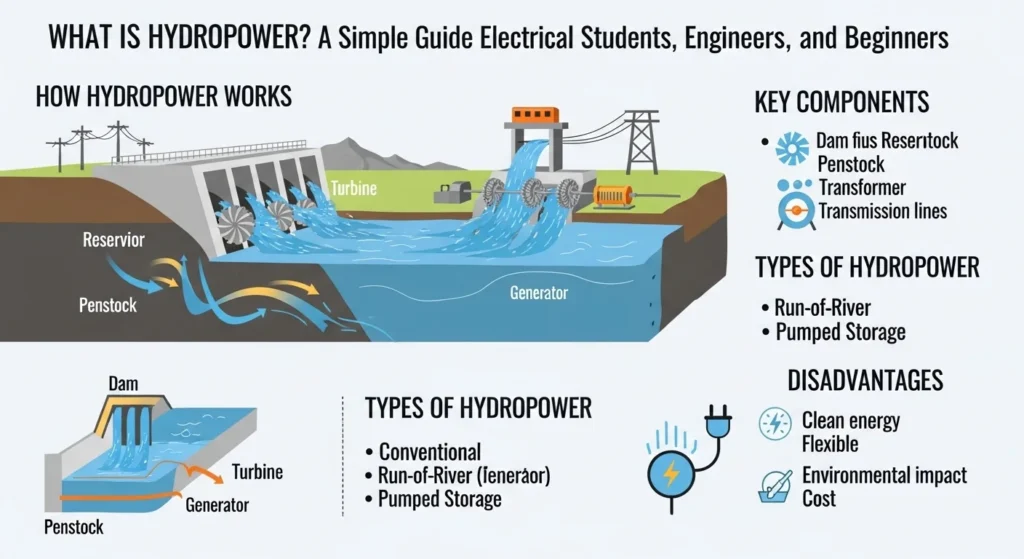
The hydropower working principle is beautifully simple and follows the same steps in almost every plant.
Here is how it works, step by step:
- Water is stored or diverted – A dam or natural drop creates “head” (the vertical height difference between water level and turbine).
- Water flows through a pipe called a penstock. As it falls, it gains speed and pressure.
- Fast-moving water hits the turbine blades, making the turbine spin. (Imagine a pinwheel in strong wind, but with water instead of air.)
- The turbine connects to a generator shaft. The spinning creates a rotating magnetic field inside the generator.
- Electricity is produced through electromagnetic induction (Faraday’s law—you learned this in first-year electrical class).
- Transformers step up the voltage for long-distance transmission.
- Used water flows back into the river through the tailrace.
Easy analogy: Picture a bicycle dynamo. Your legs (water flow) turn the wheel (turbine), which spins a small generator to light the bulb. Hydropower is the same idea, but millions of times bigger and using gravity instead of your legs.
The amount of power depends on two things only:
- Head (height the water falls) – higher head = more power
- Flow rate (how much water passes per second) – more flow = more power
Formula you will use often (in simple terms): Power (kW) ≈ 9.81 × Head (m) × Flow (m³/s) × Efficiency
Most plants run at 85-95% efficiency—much higher than solar or wind.
Working Principle of Hydroelectric Power Plant – Your Electrical Guide
Types / Classification of Hydropower
Hydropower plants come in different designs depending on location, water availability, and purpose. Here are the main types with simple explanations.
Impoundment (Storage) Hydropower
This is the most common type. A large dam stores river water in a reservoir. Engineers control when to release water, so electricity can be produced exactly when needed—perfect for peak evening demand. Example: Three Gorges Dam in China.
Diversion (Run-of-River) Hydropower
No big reservoir here. A small dam or weir diverts part of the river flow through a canal or penstock to the turbine, then returns water to the river. It follows the natural river flow, so power output changes with seasons. Great for areas where big dams are not possible. Smaller environmental footprint.
Pumped Storage Hydropower
This acts like a giant battery. During low-demand times (night), extra electricity from the grid pumps water from a lower reservoir to an upper one. During peak demand, water flows down and generates electricity. It stores energy and helps balance solar and wind power on the grid.
Other classifications you may hear:
- By size: Large (>30 MW), Small (1-30 MW), Mini (100 kW-1 MW), Micro (<100 kW) – perfect for villages or single homes.
- By head: High head (>300 m), Medium, Low head.
Types of Hydropower Plants | Department of Energy
Main Components of a Hydropower Plant
Every hydropower plant has these key parts. Knowing them helps you read drawings and troubleshoot.
- Dam or Weir: Holds back water and creates head. Built strong to handle pressure and floods.
- Reservoir: Stores water. Also used for irrigation and recreation.
- Intake and Trash Rack: Screens out leaves, fish, and debris so they don’t damage the turbine.
- Penstock: Strong steel or concrete pipe that carries high-pressure water to the turbine.
- Turbine: Heart of the plant. Common types: Pelton (high head), Francis (medium), Kaplan (low head, adjustable blades).
- Generator: Converts mechanical rotation into electricity. Usually synchronous generators.
- Transformer and Switchyard: Steps up voltage (e.g., 11 kV to 220 kV) and connects to the national grid.
- Tailrace: Channel that returns water safely to the river.
- Control Systems: Modern plants use PLCs and SCADA for automatic operation.
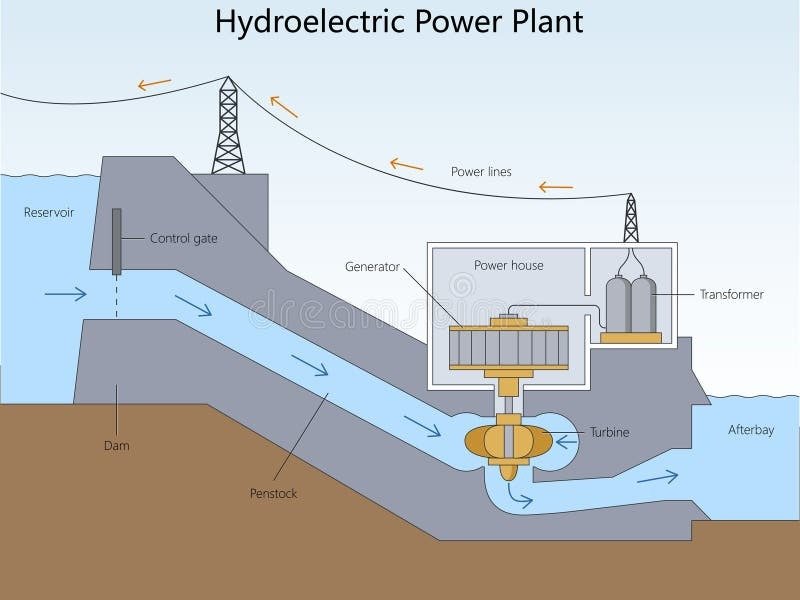
Hydroelectric Power Plant Diagram Labeled Parts Stock Illustration – Illustration of generator, hydropower: 405011491
Hydropower Advantages
Hydropower advantages make it a favorite for utilities worldwide:
- Renewable and endless – water cycle keeps supplying fuel for free.
- Very low operating cost after construction – no fuel bills.
- Reliable and controllable – can start in minutes and adjust output instantly.
- Long life – plants easily run 50-100 years with proper maintenance.
- Multi-purpose – dams provide flood control, irrigation, drinking water, and tourism.
- Clean – almost zero greenhouse gases during operation (much lower than coal or gas).
- High efficiency – up to 95%, best among all power plants.
In real life, countries like Norway get nearly 100% of electricity from hydropower and enjoy stable, cheap power.
Disadvantages / Limitations
Being honest is important. Here are the practical hydropower disadvantages:
- High initial construction cost and long building time (5-10 years).
- Needs specific geography – not every river has good head and flow.
- Environmental impact – dams can block fish migration and change river ecosystems (modern fish ladders help).
- Displacement of people and flooding of land during reservoir creation.
- Affected by drought or climate change – less water means less power.
- Sediment buildup behind dams reduces storage over decades.
These issues are real, but engineers are solving them with better designs.
Hydropower Applications
Hydropower applications go far beyond big dams.
- Large-scale electricity generation: Supplies cities and industries. One big plant can power millions of homes.
- Industry: Aluminum smelting, paper mills, and mining use dedicated hydro power because it is cheap and steady.
- Home and remote areas: Micro and pico hydro systems (5-100 kW) power single houses, farms, or mountain villages without grid connection. A small stream and 10-meter drop can run lights, fridge, and even a small workshop.
- Modern tech uses: Pumped storage balances solar and wind on the grid. Hybrid systems combine hydro with solar panels for 24/7 power. Data centers in cold, rainy regions use hydro for clean, reliable electricity.
You will see micro-hydro kits in rural electrification projects in Pakistan, Nepal, and many developing countries.
Comparison with Similar Technologies
Hydropower often gets compared with solar and wind. Here is a simple table to help you understand the difference between hydropower and other renewable sources:
| Feature | Hydropower | Solar Power | Wind Power |
| Reliability | Very high (dispatchable) | Depends on sunlight | Depends on wind |
| Initial Cost | High | Medium | Medium |
| Operating Cost | Very low | Very low | Low |
| Energy Storage | Built-in (reservoir) | Needs batteries | Needs batteries |
| Environmental Impact | Local (fish, land) | Low (land use) | Low (birds, noise) |
| Lifespan | 50-100 years | 25-30 years | 20-25 years |
| Best For | Base load + peak | Daytime rooftop | Open windy areas |
Hydropower wins on reliability and storage, but solar and wind are easier to install quickly anywhere.
Selection Guide – How to Choose the Right Hydropower System
For beginners and small projects, follow these tips:
- Measure head (use GPS or simple level) and flow (use bucket and stopwatch method).
- Calculate potential power using the simple formula above.
- Check environmental rules and get necessary permissions early.
- For homes: Choose micro-hydro if you have a stream with at least 5 liters/second and 10 m head.
- For larger projects: Hire a consultant for detailed survey and feasibility study.
- Consider run-of-river for lower cost and less impact.
- Always plan for maintenance access and spare parts.
Start small—build a tiny model in your college lab first!
Common Problems & Solutions (FAQs Style)
Q: What happens during drought?
A: Output drops. Solution: Combine with solar/wind or keep small reservoir buffer.
Q: How do we protect fish?
A: Install fish ladders, screens, or use fish-friendly turbines. Modern designs let 95% of fish pass safely.
Q: Sediment blocks the reservoir?
A: Periodic flushing or sediment bypass tunnels. Regular monitoring prevents big problems.
Q: Turbine vibration or low efficiency?
A: Check cavitation (bubbles damaging blades). Solution: Adjust blade angle or repair seals.
Q: Generator overheating?
A: Clean cooling system and check bearings. SCADA systems give early warnings.
Q: High maintenance cost?
A: Preventive schedule and training local technicians keeps costs low.
These are the issues you will face in the field—solve them with basic electrical and mechanical knowledge.
Future Trends
The hydropower industry is changing fast. Here is what you will see in coming years:
- More pumped storage to support massive solar and wind growth.
- Digitalization and AI – sensors predict failures, optimize output, and prevent downtime.
- Fish-friendly and low-impact designs for new and upgraded plants.
- Small and micro hydro boom in remote and developing areas.
- Hybrid plants combining hydro with floating solar on reservoirs.
- Variable-speed turbines for better grid support and efficiency.
- Global capacity is growing—new projects in Asia and Africa plus upgrades in Europe and North America.
By 2030, pumped storage is expected to double, making hydropower the perfect partner for a 100% renewable grid.
Conclusion
Hydropower turns the simple force of falling water into reliable, clean electricity that powers our modern world. You now understand the hydropower working principle, different types, main components, hydropower advantages and disadvantages, wide hydropower applications, and even how to select and troubleshoot systems.
As a future electrical engineer or technician, you have a powerful tool in your hands. Whether you design big dams, install micro-hydro for a village, or maintain existing plants, your work will help fight climate change and bring light to millions.
Keep learning, visit a local hydropower station if you can, and practice calculations. The water is waiting—go harness it responsibly.