
Imagine a hot summer afternoon in a small workshop or home kitchen. The air feels heavy, and the room becomes uncomfortable within minutes. Instead of installing an expensive air-conditioning system, many people simply switch on a wall fan. Within seconds, the moving air creates a cooling effect and improves comfort.
Wall fans are one of the most practical and energy-efficient ventilation solutions used in homes, offices, and industrial environments. They are designed to be mounted on walls, saving floor space while delivering strong airflow across a room.
For electrical students, technicians, and engineers, understanding wall fans is important because they are commonly used in electrical installations and ventilation systems. Even though the device looks simple, it contains several electrical and mechanical components working together.
In this article, you will learn the wall fans working principle, their types, major components, advantages and disadvantages, applications, troubleshooting tips, and how to choose the right wall fan for different environments. The explanation is written from a practical engineering perspective so beginners can easily understand the concept and real-world usage.
2. What is a Wall Fan?
A wall fan is an electric fan that is mounted on a wall and designed to circulate air throughout a room. It uses an electric motor to rotate blades, which push air forward and create airflow.
Unlike table fans or pedestal fans, a wall fan does not occupy floor space. This makes it especially useful in small rooms, workshops, kitchens, classrooms, and commercial areas.
In simple terms, a wall fan works like a mechanical air mover. The rotating blades pull air from the back and push it forward, creating a cooling breeze that improves ventilation.
Practical Example
Consider a classroom with 40 students. Installing multiple wall fans helps distribute air evenly across the room without blocking movement or taking up valuable floor space.
Because of this design advantage, wall fans are widely used in places where both air circulation and space efficiency are important.
3. Wall Fans Working Principle
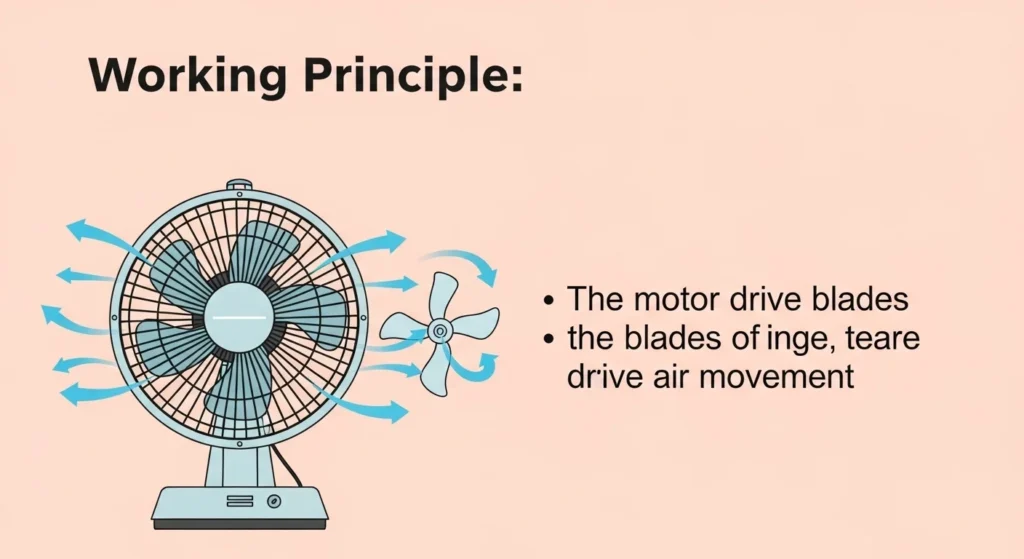
The wall fans working principle is based on the conversion of electrical energy into mechanical rotation through an electric motor.
When electrical current flows through the motor, it produces a rotating magnetic field that turns the motor shaft. The fan blades attached to the shaft rotate and push air forward.
Step-by-Step Operation
- Power Supply Activation
Electricity is supplied to the fan through a wall switch or regulator. - Motor Energization
The electric motor receives power and generates a rotating magnetic field. - Rotor Rotation
The rotor inside the motor begins to spin. - Blade Movement
Fan blades connected to the motor shaft rotate at high speed. - Airflow Creation
The rotating blades push air forward, creating airflow across the room.
Simple Analogy
Think of a wall fan like a paddle moving through water. When the paddle moves, it pushes water forward. Similarly, the fan blades push air forward to create a cooling breeze.
Some modern wall fans also include oscillation mechanisms, allowing the fan to rotate left and right to distribute air evenly across a wider area.
4. Types / Classification of Wall Fans
Wall fans are available in several types depending on their design, control method, and application.
Oscillating Wall Fan
This is the most common type used in homes and offices.
The fan head moves left and right automatically using an oscillation mechanism. This allows airflow to cover a wider area instead of blowing air in one direction only.
Non-Oscillating Wall Fan
These fans remain fixed in one direction.
They are typically used in industrial environments where airflow must be directed toward a specific location such as a workstation or machine.
Remote-Control Wall Fan
Modern wall fans often include remote control operation.
Users can adjust speed, oscillation, and timers without manually touching the fan.
Industrial Wall Fan
Industrial wall fans are designed for factories, warehouses, and large workshops.
They are larger, more powerful, and built with stronger motors to deliver high airflow over long distances.
Smart Wall Fan
Newer smart wall fans can connect to mobile applications or smart home systems. These fans allow users to control speed, schedule operation, and monitor power consumption.
5. Main Components of a Wall Fan
A wall fan may look simple, but it contains several important components that ensure efficient operation.
Electric Motor
The electric motor is the heart of the wall fan.
It converts electrical energy into mechanical motion that rotates the fan blades.
Fan Blades
Blades are responsible for moving air.
Their shape and angle determine the airflow efficiency and cooling performance.
Oscillation Mechanism
This mechanism allows the fan head to rotate left and right.
It helps distribute air evenly across the room.
Protective Grill
The grill is a metal or plastic cover that surrounds the fan blades.
Its purpose is to protect users from accidental contact with rotating blades.
Mounting Bracket
This component attaches the fan securely to the wall.
A strong mounting bracket ensures safety and stability during operation.
Speed Control Regulator
This device controls the speed of the fan motor.
It allows users to adjust airflow according to comfort requirements.
6. Advantages of Wall Fans
Wall fans offer several practical benefits in both residential and industrial environments.
- Space Saving Design – Mounted on walls, leaving floor space free
- Efficient Air Circulation – Improves airflow across the room
- Energy Efficient – Consumes less electricity than air conditioners
- Easy Installation – Can be installed in almost any room
- Affordable Cooling Solution – Low cost compared to HVAC systems
- Wide Air Coverage – Oscillation helps distribute air evenly
- Low Maintenance – Simple design makes servicing easy
Because of these benefits, wall fans remain one of the most widely used ventilation devices.
7. Disadvantages / Limitations
Although useful, wall fans also have certain limitations.
- They do not reduce room temperature like air conditioners
- Airflow may not reach every corner in large spaces
- Noise may occur at high speeds
- Installation requires drilling into the wall
- Dust accumulation on blades requires periodic cleaning
Understanding the wall fans advantages and disadvantages helps technicians recommend the right solution for different environments.
8. Wall Fans Applications
Wall fans are used in many different environments due to their flexibility and efficiency.
Residential Applications
- Bedrooms
- Living rooms
- Kitchens
- Garages
Commercial Applications
- Restaurants
- Shops
- Classrooms
- Offices
Industrial Applications
- Factories
- Warehouses
- Workshops
Special Applications
- Outdoor patios
- Gymnasiums
- Agricultural buildings
These wall fans applications demonstrate how useful they are for improving airflow and comfort in different environments.
9. Comparison Section
Understanding the difference between wall fan and ceiling fan helps engineers choose the right ventilation solution.
| Feature | Wall Fan | Ceiling Fan |
|---|---|---|
| Installation | Mounted on wall | Mounted on ceiling |
| Air Direction | Horizontal airflow | Downward airflow |
| Space Requirement | Saves floor space | Requires ceiling height |
| Air Coverage | Focused airflow | Wide room coverage |
| Typical Use | Small rooms, workshops | Living rooms, bedrooms |
Both fans serve similar purposes, but their installation and airflow patterns are different.
10. Selection Guide
Choosing the correct wall fan depends on several technical and environmental factors.
Consider Room Size
Larger rooms require fans with bigger blade diameters and stronger motors.
Check Motor Power
Higher wattage usually means stronger airflow.
Airflow Rating
Look for fans with high air delivery (CFM) ratings.
Oscillation Feature
Oscillation helps distribute air evenly across the room.
Noise Level
For bedrooms and offices, select low-noise models.
Build Quality
Industrial environments require heavy-duty metal body fans.
Following these tips helps beginners select the most suitable wall fan for their needs.
11. Common Problems & Solutions
Like any electrical device, wall fans may develop problems over time.
Fan Not Starting
Possible Causes
- Faulty switch
- Damaged capacitor
- Motor winding issue
Solution
Check power supply and replace the capacitor if necessary.
Fan Running Slowly
Possible Causes
- Dust on blades
- Weak capacitor
- Low voltage supply
Solution
Clean blades and test the capacitor.
Excessive Noise
Possible Causes
- Loose screws
- Worn bearings
Solution
Tighten mounting hardware and lubricate bearings.
Oscillation Not Working
Possible Cause
Broken oscillation gear.
Solution
Replace the oscillation mechanism.
Regular maintenance significantly increases the lifespan of wall fans.
12. Future Trends
Wall fan technology is evolving with new electrical and electronic innovations.
Brushless DC Motors
Modern wall fans are starting to use BLDC motors, which consume less energy and operate more quietly.
Smart Control Systems
Integration with mobile applications and smart home systems allows remote monitoring and scheduling.
Energy Efficiency Improvements
Manufacturers are focusing on designs that reduce electricity consumption while maintaining strong airflow.
Advanced Aerodynamic Blades
Improved blade designs increase air delivery and reduce noise levels.
These developments will make wall fans more efficient, smarter, and environmentally friendly in the future.
13. Conclusion
Wall fans remain one of the most practical and reliable solutions for air circulation in homes, offices, and industrial spaces. Their simple design, energy efficiency, and affordable cost make them a popular choice for improving comfort and ventilation.
Understanding the wall fans working principle, major components, types, and wall fans applications is important for electrical students, engineers, and technicians. Although wall fans cannot replace air-conditioning systems, they provide effective airflow and cooling comfort when installed and used correctly.
From a professional engineering perspective, selecting the right fan requires evaluating room size, airflow requirements, motor power, and installation location. Proper maintenance such as cleaning blades, checking capacitors, and tightening mounting hardware ensures long-term reliability.
As technology advances, modern wall fans will become more energy-efficient, quieter, and smarter, making them an even more valuable part of everyday electrical systems.