
Imagine a hot afternoon in a workshop or classroom where the air feels heavy and uncomfortable. The room may have windows open, but the air still feels stagnant. When someone turns on a pedestal fan, within seconds the moving air spreads across the room and creates a cooling effect. People immediately feel more comfortable and productive.
Pedestal fans are one of the most common electrical appliances used for air circulation in homes, offices, workshops, and commercial spaces. They are popular because they are portable, easy to operate, and capable of delivering strong airflow. Unlike ceiling fans or wall-mounted fans, pedestal fans can be moved easily and adjusted according to the user’s needs.
For electrical students, technicians, and engineers, understanding pedestal fans is important because they combine basic electrical principles with mechanical design and airflow engineering. Even though the device appears simple, it contains several important components such as an electric motor, blades, oscillation mechanism, and control system.
In this article, you will learn the pedestal fans working principle, types of pedestal fans, their main components, applications, and pedestal fans advantages and disadvantages. The explanation is written in simple language so beginners can easily understand how pedestal fans work and how they are used in real-life situations.
2. What is a Pedestal Fan?
A pedestal fan is a free-standing electric fan designed to provide powerful and flexible air circulation in homes, offices, workshops, classrooms, and commercial spaces. It consists of a high-speed electric motor, aerodynamic fan blades, an adjustable vertical stand, a sturdy base, and an oscillating head that distributes air across a wide area.
Unlike ceiling fans that are permanently mounted overhead, pedestal fans are portable and can be moved wherever additional cooling is required. Most modern models feature adjustable height, multiple speed settings, tilting heads, and automatic oscillation, allowing users to customize airflow according to their comfort.
Pedestal fans do not lower room temperature like air conditioners. Instead, they improve ventilation by continuously moving air, which helps evaporate sweat from the skin and creates a cooling sensation. They are also energy-efficient, easy to install, and require very little maintenance, making them a popular cooling solution in both residential and industrial environments.
Whether used as a primary cooling device in mild weather or as a supplement to an air conditioner, a pedestal fan offers an affordable and effective way to improve indoor comfort while consuming relatively little electricity.
Practical Example
Imagine a meeting room where several people are seated in different locations. Instead of installing multiple fans, a single pedestal fan can be placed in the center of the room. Its adjustable height and oscillating head distribute cool air evenly in multiple directions, ensuring that everyone receives consistent airflow. Similarly, in workshops or garages, pedestal fans help improve ventilation and keep workers comfortable during long hours.
3. Pedestal Fan Working Principle
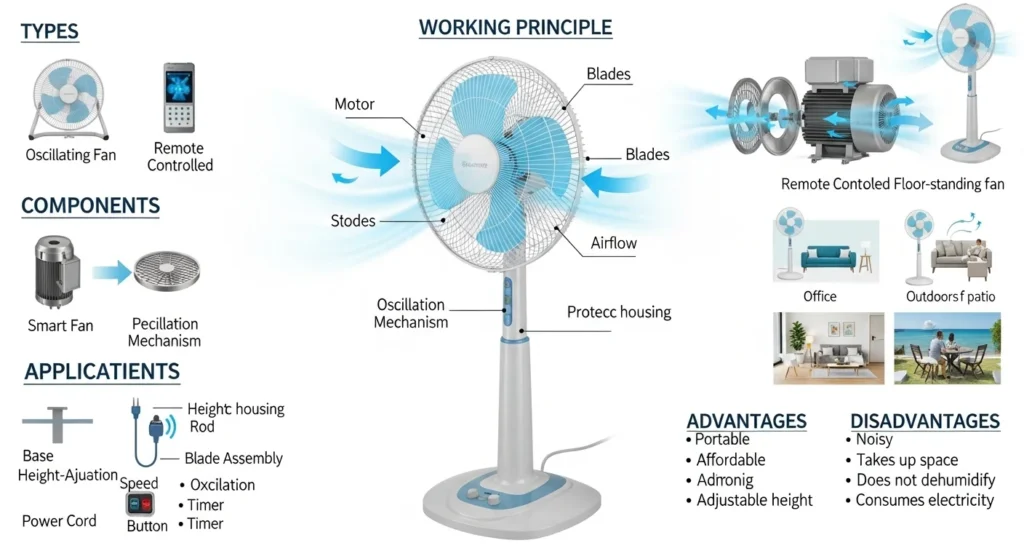
The working principle of a pedestal fan is based on the conversion of electrical energy into mechanical energy through an electric motor. When electrical power is supplied to the fan, the motor generates rotational motion that spins the fan blades at high speed. These rotating blades create a pressure difference between the front and back of the blades, drawing air from behind the fan and pushing it forward in a continuous stream.
The shape and angle of the blades are carefully designed to maximize airflow while minimizing noise and energy consumption. Many modern pedestal fans also include an oscillation mechanism powered by a small gear assembly, allowing the fan head to rotate from side to side and distribute air evenly throughout the room.
Most pedestal fans offer multiple speed settings, enabling users to control airflow according to the room size, weather conditions, and personal comfort. This simple yet efficient mechanism makes pedestal fans one of the most reliable and cost-effective cooling appliances available today.
Step-by-Step Working Process
- Power Supply
The fan receives electrical power from a standard AC outlet through the power cord and switch. - Motor Starts
Electricity energizes the motor windings, creating a rotating magnetic field that causes the motor shaft to spin. - Blade Rotation
The fan blades attached to the shaft rotate rapidly, generating a steady stream of air. - Air Circulation
The specially designed blades pull air from behind the fan and force it forward, improving ventilation and creating a cooling effect. - Oscillation Mechanism
When oscillation is enabled, an internal gear mechanism slowly moves the fan head from left to right, spreading airflow across a larger area. - Speed Control
Users can select different speed levels to increase or decrease airflow based on their cooling needs.
Simple Analogy
Think of a pedestal fan as a boat propeller moving through water. Instead of pushing water, the fan blades push air. As the blades rotate faster, they move a greater volume of air, creating stronger airflow that helps cool people and improve ventilation throughout the room. This continuous movement of air is what makes a pedestal fan an efficient and economical cooling solution for everyday use.
4. Types / Classification of Pedestal Fans
Pedestal fans come in several designs depending on their application and technology.
Standard Pedestal Fan
This is the most common type used in homes and offices.
It usually includes adjustable height, three-speed control, and oscillation movement.
High-Speed Pedestal Fan
High-speed pedestal fans are designed to produce stronger airflow.
They are commonly used in large rooms, halls, and workshops where more air circulation is needed.
Industrial Pedestal Fan
Industrial pedestal fans are larger and more powerful.
They are used in factories, warehouses, and production facilities where heavy-duty ventilation is required.
Remote-Control Pedestal Fan
Modern pedestal fans often include remote control features.
Users can adjust speed, oscillation, and timer settings without manually operating the fan.
Rechargeable Pedestal Fan
These fans include built-in batteries and can operate during power outages.
They are especially useful in areas with unstable electricity supply.
5. Main Components of a Pedestal Fan
A pedestal fan consists of several electrical and mechanical parts.
Electric Motor
The motor is the most important component. It converts electrical energy into rotational motion.
Fan Blades
The blades move air when they rotate. Their shape and angle determine airflow efficiency.
Protective Grill
The grill is a metal or plastic cover that surrounds the blades and protects users from accidental contact.
Oscillation Mechanism
This mechanism moves the fan head from side to side to distribute airflow evenly.
Adjustable Stand
The stand allows the height of the fan to be adjusted according to user preference.
Base
The base supports the entire structure and provides stability.
Speed Control Switch
This control allows the user to adjust fan speed according to cooling needs.
6. Advantages of Pedestal Fans
Pedestal fans offer several practical benefits.
- Portable and easy to move
- Adjustable height and direction
- Strong airflow for better air circulation
- Energy efficient compared to air conditioners
- Affordable cooling solution
- Easy installation and operation
- Wide air distribution with oscillation
Understanding pedestal fans advantages and disadvantages helps technicians recommend the best solution for different environments.
7. Disadvantages / Limitations
Despite their usefulness, pedestal fans also have some limitations.
- They do not reduce room temperature like air conditioners
- They occupy floor space
- High speed operation may create noise
- Airflow may not reach very large areas
- Dust accumulation requires regular cleaning
These limitations should be considered before choosing pedestal fans.
8. Pedestal Fans Applications
Pedestal fans are widely used in many environments because of their flexibility.
Residential Applications
- Living rooms
- Bedrooms
- Kitchens
- Study rooms
Commercial Applications
- Offices
- Restaurants
- Schools and classrooms
- Retail shops
Industrial Applications
- Workshops
- Factories
- Warehouses
Temporary Cooling Applications
- Outdoor events
- Construction sites
- Exhibition halls
These pedestal fans applications show their versatility in different environments.
9. Comparison Section
Understanding the difference between pedestal fan and ceiling fan helps in selecting the right cooling solution.
| Feature | Pedestal Fan | Ceiling Fan |
|---|---|---|
| Installation | Portable | Fixed to ceiling |
| Airflow direction | Adjustable | Downward airflow |
| Mobility | Can be moved | Permanent |
| Coverage area | Focused airflow | Wide room coverage |
| Space requirement | Uses floor space | No floor space needed |
Both fans serve different purposes depending on the room design and ventilation needs.
10. Selection Guide
Choosing the right pedestal fan requires evaluating several factors.
Blade Size
Larger blades move more air. Typical pedestal fan sizes are 16 to 20 inches.
Motor Power
Higher motor power produces stronger airflow.
Speed Settings
Multiple speed settings allow flexible airflow control.
Oscillation Feature
Oscillation improves air distribution across the room.
Noise Level
Low noise models are better for bedrooms and offices.
Build Quality
Strong materials improve durability and long-term performance.
11. Common Problems & Solutions
Fan Not Starting
Possible causes:
- Faulty power connection
- Damaged capacitor
- Motor winding problem
Solution: Check power supply and replace faulty components.
Fan Running Slowly
Possible causes:
- Dust buildup on blades
- Weak capacitor
- Low voltage supply
Solution: Clean blades and inspect the capacitor.
Excessive Noise
Possible causes:
- Loose screws
- Worn bearings
Solution: Tighten screws and lubricate bearings.
Oscillation Not Working
Possible cause: damaged oscillation gear.
Solution: repair or replace the oscillation mechanism.
12. Future Trends
Pedestal fan technology continues to evolve with modern innovations.
Brushless DC Motors
BLDC motors reduce power consumption and increase efficiency.
Smart Control Systems
Some pedestal fans now support remote control and mobile app operation.
Improved Blade Design
Aerodynamic blade designs improve airflow and reduce noise.
Energy Efficient Technology
Manufacturers are developing fans that deliver strong airflow while using less electricity.
These improvements will make pedestal fans more efficient and environmentally friendly.
13. Conclusion
Pedestal fans remain one of the most practical and widely used solutions for indoor air circulation. Their portability, adjustable height, and strong airflow make them suitable for homes, offices, and industrial environments.
Understanding the pedestal fans working principle, components, and pedestal fans applications helps electrical students and technicians gain practical knowledge of how these devices operate. Although pedestal fans cannot replace air-conditioning systems, they provide effective and affordable cooling for many situations.
From an engineering perspective, selecting the correct pedestal fan requires considering blade size, motor power, airflow capacity, and durability. Regular maintenance such as cleaning blades and checking electrical components ensures reliable operation.
With new technologies such as BLDC motors and smart controls, pedestal fans will continue to improve and remain an essential part of modern ventilation systems.