
Imagine a videographer preparing for an important outdoor shoot. The camera battery is ready, the lighting is perfect, and the stabilizer is mounted. But suddenly, the stabilizer stops working because it was not charged properly through its USB control cable. This situation happens more often than many beginners realize, especially when using devices like the Crane M3 gimbal.
The Crane M3 USB control cable charging limitations are an important topic for electrical students, engineers, technicians, and beginners who work with modern electronic devices. Many people assume that any USB cable can charge and control a device at the same time, but this is not always true. USB cables have different functions, power limits, and communication capabilities.
Understanding these limitations helps users avoid equipment damage, slow charging, connection failures, and power inefficiencies. It also improves device reliability during professional work.
In this article, we will explain the Crane M3 USB control cable charging limitations, its working principle, types of USB cables, components involved, advantages and disadvantages, applications, and troubleshooting methods. By the end, you will clearly understand how USB control cables work and how to choose the correct one for stable performance.
2. What is Crane M3 USB Control Cable Charging Limitations?
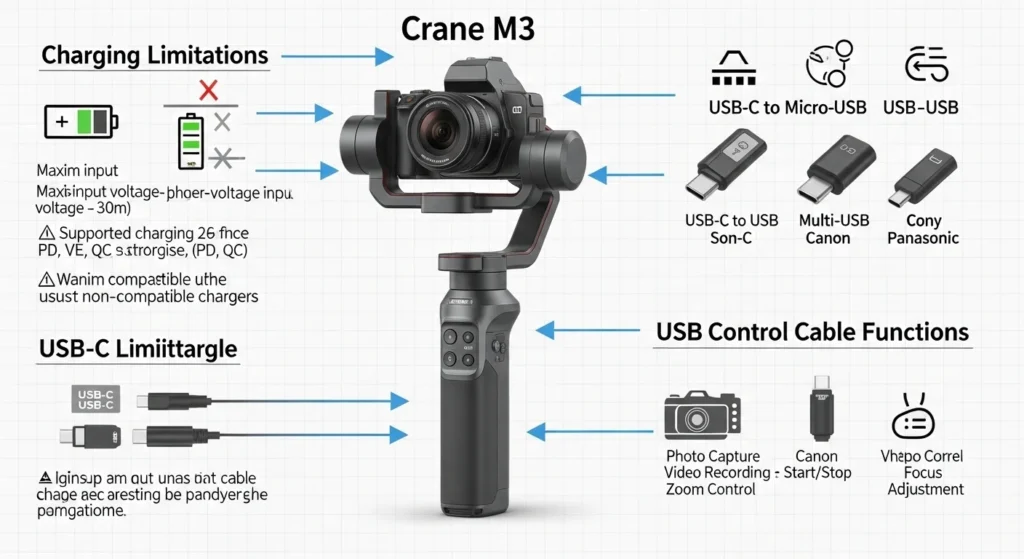
Crane M3 USB control cable charging limitations refer to the technical restrictions related to charging power, data communication, and device compatibility when using a USB cable to control and charge the Crane M3 gimbal.
In simple words, the USB control cable used with the Crane M3 is designed mainly for device communication and control, not always for high-power charging.
Simple Explanation
A USB cable can perform three main functions:
- Transfer electrical power
- Transfer data signals
- Control connected devices
However, some USB control cables are optimized for data communication, which means they may not support high charging current.
Practical Example
When a user connects a Crane M3 gimbal to a camera using a USB control cable:
- The cable allows the camera to communicate with the gimbal.
- The user can start recording using the gimbal buttons.
- But the cable may not provide enough power for charging the gimbal battery.
This is a typical example of USB control cable charging limitations.
3. Crane M3 USB Control Cable Working Principle
The Crane M3 USB control cable working principle is based on both power transmission and data communication.
Think of the USB cable like a two-lane road:
- One lane carries electricity (power).
- The other lane carries information (data signals).
Step-by-Step Working Process
- Power Source Connection
The USB cable connects to a power source or camera. - Voltage Supply
Standard USB cables provide around 5 volts DC. - Current Flow
The cable allows a limited current flow depending on its design. - Data Communication
Internal data wires transmit signals between devices. - Device Control
The gimbal sends commands to the camera, such as recording start or stop. - Charging Attempt
If the cable supports sufficient current, charging occurs. Otherwise, charging becomes slow or impossible.
Important Point
Many USB control cables prioritize stable communication over high charging power, which creates charging limitations.
4. Types / Classification
Different USB cables affect the Crane M3 USB control cable charging limitations.
USB Type-C Control Cable
USB Type-C cables are modern and support:
- Faster charging
- Higher data speed
- Reversible connection
However, some Type-C cables are data-only cables, which limits charging performance.
Micro-USB Control Cable
Older devices use Micro-USB cables.
Characteristics:
- Lower power capacity
- Slower charging speed
- Limited data transfer
These cables commonly show charging limitations.
USB Charging Cable
These cables are designed mainly for:
- High current flow
- Fast charging
- Minimal data communication
They are better for charging but may not support device control.
USB Data Cable
Data cables focus on communication.
Features:
- Stable signal transmission
- Lower power capacity
- Control compatibility
These cables often create charging limitations.
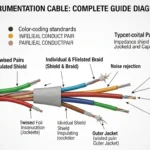
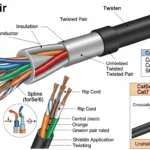
5. Main Components
Understanding the cable structure helps explain the Crane M3 USB control cable charging limitations.
USB Connector
The connector links the cable to the device.
Common types include:
- USB-C
- Micro-USB
- USB-A
Power Wires
These wires carry electrical current from the source to the device.
Thin wires reduce current capacity.
Data Wires
Data wires transmit digital signals for communication.
They enable camera control through the gimbal.
Insulation Layer
The insulation protects wires from electrical interference and damage.
Shielding Layer
Shielding prevents signal disturbance caused by electromagnetic noise.
6. Advantages
Despite charging limitations, USB control cables provide many benefits.
Advantages include:
- Easy device connection
- Allows remote camera control
- Supports compact equipment setup
- Reduces the need for multiple cables
- Enables synchronized device operation
- Portable and lightweight design
- Compatible with modern electronic devices
These advantages make USB control cables essential for gimbal operation.
7. Disadvantages / Limitations
Understanding Crane M3 USB control cable advantages and disadvantages is important for practical use.
Main limitations include:
- Limited charging current capacity
- Slow charging speed
- Some cables support only data transfer
- Compatibility issues with certain cameras
- Cable quality affects performance
- Possible overheating with poor cables
- Power loss over longer cables
These limitations explain why a device may fail to charge properly.
8. Applications
The Crane M3 USB control cable applications extend beyond simple charging.
Photography and Videography
Used to control camera functions through a stabilizer.
Professional Filmmaking
Allows synchronized device operation.
Content Creation
Popular among vloggers and YouTubers.
Electronic Device Testing
Technicians use control cables to test communication between devices.
Consumer Electronics
USB control cables are used in:
- Smartphones
- Cameras
- gimbals
- drones
9. Comparison Section
Understanding the difference between USB charging cable and USB control cable helps users choose the correct cable.
| Feature | USB Charging Cable | USB Control Cable |
|---|---|---|
| Main Purpose | Power supply | Device communication |
| Charging Speed | Fast | Usually limited |
| Data Transfer | Minimal | High |
| Power Capacity | Higher | Lower |
| Device Control | Not supported | Supported |
| Typical Use | Charging devices | Camera and gimbal control |
This comparison highlights why charging limitations occur.
10. Selection Guide
Choosing the correct cable reduces Crane M3 USB control cable charging limitations.
Check Power Rating
Select cables that support higher current capacity.
Verify Device Compatibility
Ensure the cable supports the camera and gimbal models.
Use Certified Cables
High-quality cables provide better performance.
Avoid Very Long Cables
Long cables cause voltage drop.
Choose Dual-Function Cables
Some cables support both fast charging and data communication.
11. Common Problems & Solutions
Why is the Crane M3 not charging through the control cable?
Possible reason:
The cable may support only data communication.
Solution:
Use a dedicated charging cable.
Why is charging very slow?
Possible causes:
- Low current cable
- Weak power adapter
Solution:
Use a high-power USB charger.
Why is the camera not responding?
Possible reason:
Incorrect cable type.
Solution:
Use the recommended control cable.
Why does the cable heat up?
Possible causes:
- Poor cable quality
- High current demand
Solution:
Replace the cable with a certified one.
12. Future Trends
USB technology continues to improve rapidly.
Future developments may include:
Smart Power Management
Devices will automatically adjust power levels.
High-Power USB Standards
New USB versions support 100W or more power delivery.
Improved Cable Design
Future cables will combine fast charging and high-speed data transfer.
Universal Compatibility
Manufacturers are moving toward standardized connectors.
These innovations will reduce charging limitations in future devices.
13. Conclusion
The Crane M3 USB control cable charging limitations highlight an important aspect of modern electronic device connectivity. While USB cables appear simple, their internal design determines how much power they can carry and how effectively they transmit data.
For the Crane M3 gimbal, USB control cables are primarily designed for device communication and camera control. This means charging performance may be limited compared to dedicated charging cables.
Understanding the Crane M3 USB control cable working principle, types of cables, components, and common problems helps users make better technical decisions. Electrical students and technicians especially benefit from learning how cable design affects power delivery and device compatibility.
By choosing high-quality cables, using proper chargers, and understanding cable limitations, users can avoid many common charging problems and ensure reliable operation of their equipment.