
Imagine setting up an internet connection in a home or office. A technician runs a cable from the router to the computer, and within seconds the system connects to the network. This simple cable, often hidden inside walls or ceilings, plays a critical role in modern communication systems. In many cases, that cable is a twisted pair cable.
Twisted pair cables are among the most widely used cables in telecommunications, networking, and electrical communication systems. From telephone lines to Ethernet networks, this cable type helps transmit signals efficiently while reducing electrical interference. Because of its simple design and reliable performance, it has become a standard solution in homes, offices, and industrial environments.
For electrical students, engineers, technicians, and beginners, understanding how twisted pair cables work is very important. Knowledge of cable structure, signal transmission, and interference control helps professionals design better communication systems.
In this article, we will explore the Twisted Pair Cable working principle, types, components, advantages and disadvantages, applications, and practical selection tips. By the end, you will clearly understand why twisted pair cables remain one of the most trusted communication cables in modern electrical and networking systems.
2. What is Twisted Pair Cable?
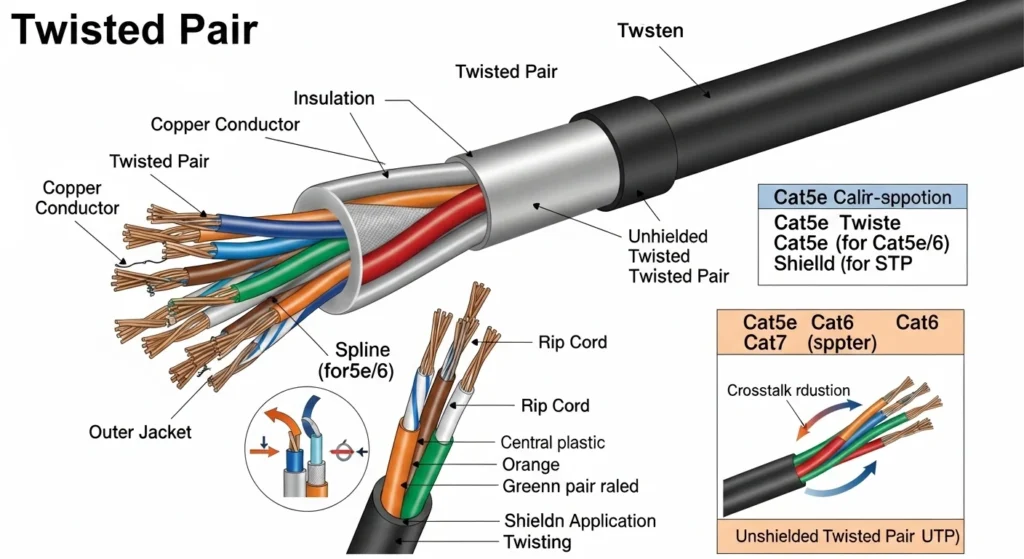
A Twisted Pair Cable is a type of electrical cable made of two insulated copper wires twisted together. These wires carry electrical signals while the twisting pattern helps reduce electromagnetic interference.
Simple Explanation
In simple terms, a twisted pair cable contains two conductors wrapped around each other in a spiral shape. One wire carries the signal, and the other wire carries the return signal.
The twisting pattern helps cancel unwanted noise from external electrical sources.
Practical Example
A common example is the Ethernet cable used to connect computers to a router or switch. Inside that cable are multiple twisted pairs that transmit data between devices.
Another example is the traditional telephone line used in homes and offices.
Because of its low cost and reliable performance, twisted pair cable has become a standard in communication networks.
3. Twisted Pair Cable Working Principle
The Twisted Pair Cable working principle is based on noise reduction through electromagnetic cancellation.
To understand this, imagine two wires carrying electrical signals placed close to each other. External electromagnetic fields from nearby equipment can create noise in the signal.
When the wires are twisted together, the interference affects both wires equally, allowing the system to cancel the noise.
Step-by-Step Working Process
- Signal Transmission
One wire carries the electrical signal. - Return Path
The second wire carries the return current. - Twisting Pattern
The wires are twisted together along the cable length. - Noise Exposure
External electromagnetic noise affects both wires equally. - Noise Cancellation
Because the signals are balanced, the interference cancels out. - Clear Data Transmission
The receiver reads the signal without significant noise.
Easy Analogy
Think of two people walking together while holding opposite sides of a rope. If wind pushes both equally, their balance stays stable. Similarly, twisted wires balance electrical noise.
This simple design greatly improves signal reliability.
4. Types / Classification
Twisted pair cables are classified based on shielding and performance.
Unshielded Twisted Pair (UTP)
Unshielded Twisted Pair is the most common type.
Characteristics include:
- No metallic shielding
- Lightweight design
- Low cost
- Easy installation
UTP cables are widely used in Ethernet networks.
Examples include:
- Cat5
- Cat5e
- Cat6
- Cat6a
These cables are commonly found in homes and office networks.
Shielded Twisted Pair (STP)
Shielded Twisted Pair cables contain an additional protective layer.
Features include:
- Metallic shielding around the wires
- Better protection against interference
- Higher cost than UTP
STP cables are often used in industrial environments where electrical noise is strong.
Foiled Twisted Pair (FTP)
Foiled Twisted Pair cables include a thin foil shield around the wire pairs.
Characteristics include:
- Improved noise protection
- Moderate cost
- Better signal stability than UTP
These cables are used in advanced networking systems.
5. Main Components
A twisted pair cable contains several important components that support signal transmission.
Copper Conductors
The core wires are made of copper because copper is an excellent conductor of electricity.
These conductors carry the electrical signals.
Insulation Layer
Each copper wire is covered with insulation to prevent short circuits and signal leakage.
Twisted Pair Structure
Two insulated wires are twisted together to reduce electromagnetic interference.
Different twist rates improve signal quality.
Cable Jacket
The outer jacket protects the cable from mechanical damage, moisture, and environmental conditions.
Shielding (Optional)
Some cables include metallic shielding to block external electromagnetic noise.
6. Advantages
Understanding Twisted Pair Cable advantages and disadvantages helps technicians choose the right communication cable.
Advantages
- Low cost compared to other communication cables
- Easy installation and maintenance
- Flexible cable design
- Effective noise reduction through twisting
- Widely available worldwide
- Compatible with Ethernet networks
- Lightweight and easy to handle
These advantages make twisted pair cables a preferred choice for network infrastructure.
7. Disadvantages / Limitations
Despite its benefits, twisted pair cable has some limitations.
Disadvantages
- Limited transmission distance compared to fiber optic cables
- Lower bandwidth than optical communication systems
- Susceptible to strong electromagnetic interference
- Signal attenuation over long distances
- Requires proper installation to maintain performance
These limitations must be considered when designing large communication networks.
8. Twisted Pair Cable Applications
The Twisted Pair Cable applications are found in many industries.
Telephone Communication
Traditional telephone networks rely heavily on twisted pair cables.
Computer Networking
Ethernet networks commonly use twisted pair cables for data transmission.
Internet Connections
Home and office internet systems often use twisted pair wiring.
Security Systems
Security cameras and alarm systems use twisted pair cables for signal transmission.
Industrial Communication
Factories and automation systems use shielded twisted pair cables for reliable communication.
Data Centers
Structured cabling systems in data centers frequently include twisted pair cables.
9. Comparison Section
Understanding the difference between twisted pair cable and coaxial cable helps engineers select the appropriate communication cable.
| Feature | Twisted Pair Cable | Coaxial Cable |
|---|---|---|
| Structure | Two twisted copper wires | Single conductor with shielding |
| Cost | Low | Higher |
| Flexibility | High | Moderate |
| Noise Protection | Moderate | Strong |
| Installation | Easy | Slightly complex |
| Bandwidth | Medium | Higher than twisted pair |
Both cable types serve different communication needs depending on system requirements.
10. Selection Guide
Choosing the correct twisted pair cable is important for reliable communication.
Check Cable Category
Higher category cables provide better performance.
Examples include:
- Cat5e for basic networking
- Cat6 for high-speed networks
- Cat6a for advanced data systems
Consider Shielding Requirements
Use shielded cables in environments with strong electrical interference.
Evaluate Transmission Distance
Longer distances may require better cable categories.
Check Installation Environment
Outdoor installations require cables with stronger protective jackets.
Verify Network Speed Requirements
Faster networks need higher-quality cables.
11. Common Problems & Solutions
Why is the network connection slow?
Possible causes:
- Low cable category
- Damaged cable
Solution:
Upgrade to higher category twisted pair cables.
Why does the signal drop frequently?
Possible causes:
- Poor cable connections
- Electrical interference
Solution:
Check connectors and use shielded cables.
Why is there data transmission error?
Possible causes:
- Incorrect cable wiring
- Faulty connectors
Solution:
Follow standard wiring methods such as T568A or T568B.
Why does the cable overheat?
Possible cause:
Excess electrical load.
Solution:
Use proper communication cables designed for data transmission.
12. Future Trends
Communication technology continues to evolve, but twisted pair cables remain important.
Higher Speed Ethernet
New cable categories support faster internet speeds.
Improved Shielding
Advanced shielding techniques improve noise resistance.
Smart Building Networks
Twisted pair cables support smart home and automation systems.
Power Over Ethernet (PoE)
Modern twisted pair cables can deliver both data and electrical power to devices like cameras and wireless access points.
These improvements ensure twisted pair cables remain relevant in modern communication networks.
13. Conclusion
Twisted pair cable is one of the most essential components of modern communication systems. Its simple design, low cost, and reliable performance have made it a standard solution for telephone networks, computer networking, and internet connectivity.
By twisting two insulated copper wires together, the cable effectively reduces electromagnetic interference and maintains signal integrity. This clever design allows stable data transmission even in environments with electrical noise.
Understanding the Twisted Pair Cable working principle, types, components, and applications helps electrical students and technicians design better communication systems. While twisted pair cables have some limitations in terms of distance and bandwidth, they remain highly practical for most networking environments.
For beginners and professionals alike, learning how to select, install, and maintain twisted pair cables is an essential skill in electrical and communication engineering.