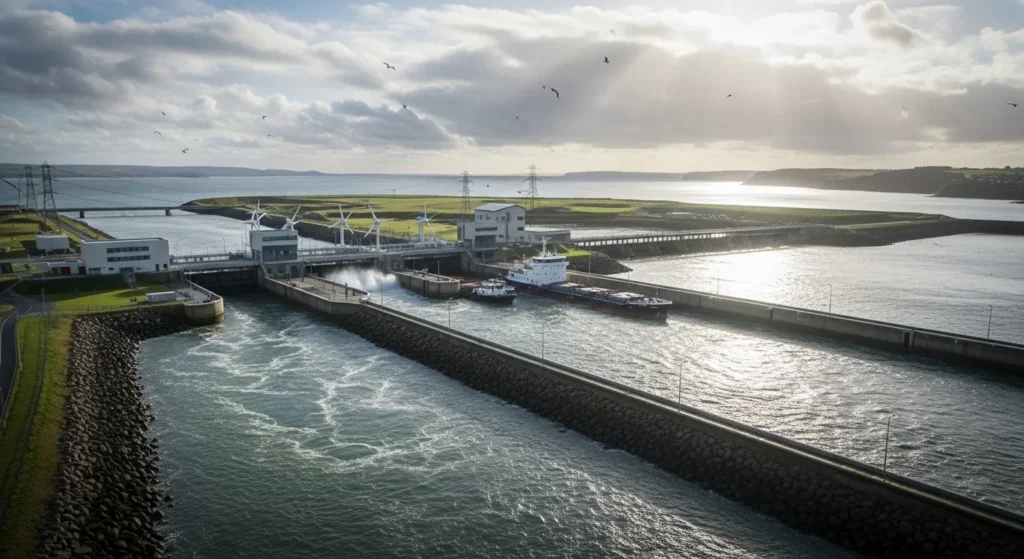

Imagine standing near the sea and watching the ocean water move in and out along the coastline every day. These movements, called tides, are caused mainly by the gravitational pull of the moon and the sun. While most people see tides as a natural ocean phenomenon, engineers see them as a powerful and predictable source of renewable energy.
A Tidal Power Plant uses the natural rise and fall of ocean tides to generate electricity. Unlike fossil fuel power plants, tidal energy does not rely on coal, oil, or gas. Instead, it uses the movement of seawater to rotate turbines and produce electrical power.
With the growing global demand for clean and sustainable energy, tidal power plants are becoming an important renewable energy technology. They produce electricity with very low environmental pollution and provide a reliable energy source because tidal movements are highly predictable.
In this article, you will learn the Tidal Power Plant working principle, its types, main components, and practical Tidal Power Plant applications. We will also discuss the Tidal Power Plant advantages and disadvantages, compare it with other renewable energy systems, and explain future trends in tidal energy technology.
What is a Tidal Power Plant?
Definition
A Tidal Power Plant is a renewable energy power station that generates electricity by using the natural movement of ocean tides.
Simple Explanation
In simple terms, a tidal power plant converts the energy of moving seawater into electrical energy. When tides rise and fall, large amounts of water flow through turbines. These turbines rotate generators that produce electricity.
Practical Example
For example, coastal areas with strong tidal movements can build tidal power stations to generate electricity for nearby cities. When the tide flows in or out, the water passes through turbines installed in dams or underwater systems.
This process transforms the natural movement of the ocean into usable electrical power.
Tidal Power Plant Working Principle
The Tidal Power Plant working principle is based on converting the kinetic and potential energy of tidal water into mechanical energy and then into electrical energy.
Step-by-Step Working Process
- Tidal Movement
Ocean tides rise and fall due to gravitational forces from the moon and sun.
- Water Storage
In some tidal systems, a dam or barrier stores seawater during high tide.
- Water Flow Through Turbines
When the tide level changes, water flows through turbines installed in the plant.
- Turbine Rotation
The flowing water rotates the turbine blades.
- Electricity Generation
The turbine is connected to a generator that converts mechanical energy into electrical energy.
- Power Transmission
The generated electricity is transmitted through power lines to homes, industries, and businesses.
Simple Analogy
Think of a tidal power plant like a water mill. Instead of river water turning the wheel, ocean tides move water through turbines to generate electricity.
Types of Tidal Power Plants
Tidal energy systems are classified based on how they capture the energy of ocean tides.
Tidal Barrage Power Plant
A tidal barrage is similar to a dam built across a coastal bay or river estuary.
Features:
- Water is stored during high tide
- Water flows through turbines during low tide
- Generates electricity when water levels change
This is one of the most common tidal energy systems.
Tidal Stream Generator
Tidal stream systems work like underwater wind turbines.
Features:
- Installed directly in fast-moving tidal currents
- Water flow rotates turbine blades
- No large dams required
These systems are considered environmentally friendly compared to tidal barrages.
Tidal Lagoon Power Plant
A tidal lagoon is a circular or enclosed structure built in coastal areas.
Features:
- Creates a controlled water basin
- Generates electricity during both incoming and outgoing tides
- Can produce power for longer periods
Main Components of a Tidal Power Plant
A tidal power plant consists of several important components.
Tidal Barrage or Structure
This structure controls the flow of seawater and directs it through turbines.
Turbine
The turbine converts the kinetic energy of moving water into mechanical rotation.
Generator
The generator converts the mechanical energy from the turbine into electrical energy.
Sluice Gates
Sluice gates control the flow of water entering and leaving the tidal basin.
Power Transmission System
Transmission lines carry electricity from the power plant to the electrical grid.
Tidal Power Plant Advantages
Understanding the Tidal Power Plant advantages and disadvantages is important for energy planning.
Advantages
- Renewable and sustainable energy source
- Highly predictable energy generation
- Produces no greenhouse gas emissions
- Long lifespan of tidal infrastructure
- Low operating costs after installation
- Reliable power generation in coastal regions
Tidal energy is considered one of the most reliable renewable energy sources because tidal patterns are predictable.
Tidal Power Plant Disadvantages / Limitations
Despite its benefits, tidal energy has several limitations.
Disadvantages
- High initial construction cost
- Limited suitable coastal locations
- Possible environmental impact on marine ecosystems
- Complex engineering requirements
- Maintenance challenges in seawater environments
These limitations make tidal power plants less common compared to solar or wind power systems.
Tidal Power Plant Applications
There are several important Tidal Power Plant applications in modern energy systems.
Electricity Generation
The primary application is producing electricity for coastal cities and towns.
Renewable Energy Systems
Tidal power plants are part of global renewable energy strategies.
Hybrid Power Systems
Tidal energy can be combined with wind or solar power for more reliable energy supply.
Coastal Infrastructure
Some tidal structures also help protect coastal areas from flooding and storm surges.
Comparison: Tidal Power Plant vs Hydroelectric Power Plant
Understanding the difference between tidal power plant and hydroelectric power plant helps students understand renewable energy systems.
| Feature | Tidal Power Plant | Hydroelectric Power Plant |
|---|---|---|
| Energy Source | Ocean tides | River water |
| Location | Coastal areas | Rivers and dams |
| Energy Predictability | Highly predictable | Depends on rainfall |
| Environmental Impact | Affects marine life | Affects river ecosystems |
| Energy Availability | Twice daily | Continuous water flow |
Both systems use moving water to generate electricity, but their sources and locations differ.
Selection Guide: When to Use Tidal Power
Engineers consider several factors before building a tidal power plant.
Coastal Location
The plant must be located in an area with strong tidal movement.
Tidal Range
A large difference between high tide and low tide improves energy production.
Environmental Assessment
Marine life and coastal ecosystems must be carefully protected.
Economic Feasibility
Construction costs and long-term benefits must be evaluated.
For beginners, it is important to understand that tidal power plants are location-specific technologies.
Common Problems & Solutions
Problem 1: Corrosion of Equipment
Cause:
Continuous exposure to seawater causes corrosion.
Solution:
Use corrosion-resistant materials and protective coatings.
Problem 2: Marine Life Disturbance
Cause:
Turbines may affect fish and marine animals.
Solution:
Design turbines that are safer for marine ecosystems.
Problem 3: Sediment Accumulation
Cause:
Sediments may collect around tidal structures.
Solution:
Regular maintenance and dredging operations.
Problem 4: High Installation Cost
Cause:
Complex marine construction.
Solution:
Long-term investment planning and improved engineering technologies.
Future Trends in Tidal Energy
Tidal energy technology continues to develop with new innovations.
Advanced Tidal Turbines
New turbine designs improve efficiency and reduce environmental impact.
Floating Tidal Systems
Floating tidal platforms are being developed for deeper ocean areas.
Smart Energy Grids
Tidal power plants may be integrated with smart grid systems to optimize electricity distribution.
Hybrid Renewable Energy
Future power plants may combine tidal, wind, and solar energy to create stable renewable energy systems.
These developments may increase the role of tidal energy in global electricity production.
Conclusion
A Tidal Power Plant is an innovative renewable energy system that uses the natural movement of ocean tides to generate electricity. By converting tidal water flow into mechanical and electrical energy, these plants provide a clean and reliable power source.
Understanding the Tidal Power Plant working principle, types, and components helps electrical students and engineers learn how ocean energy can be transformed into usable electricity. Tidal power plants offer several advantages such as predictable energy production and low environmental pollution.
However, the Tidal Power Plant advantages and disadvantages must be carefully considered before installation. High construction costs and limited suitable locations remain major challenges.
Despite these challenges, tidal energy has great potential for the future. With advanced turbine technology and improved engineering solutions, tidal power plants may become an important part of the global renewable energy system.