
Imagine your home receiving 11,000 volts directly from a power line. Every light bulb, fan, charger, and refrigerator would burn instantly. This is where a stepdown transformer plays a critical role.
Electric power is generated at high voltage for efficient transmission over long distances. However, our homes and devices require much lower voltage levels. The device that safely reduces high voltage to usable levels is called a stepdown transformer.
Understanding this topic is very important for electrical students, engineers, technicians, and beginners. Transformers are the backbone of power systems, and knowing how they work builds a strong foundation in electrical engineering.
In this article, you will learn the stepdown transformer working principle, its types, components, applications, advantages and disadvantages, comparison with step-up transformers, troubleshooting tips, and future trends. I will explain everything in simple and clear language, just like a senior engineer guiding a junior in the field.
2. What is a Stepdown Transformer?
A stepdown transformer is an electrical device that reduces high AC voltage to a lower AC voltage while keeping the frequency the same.
Simple Definition
A stepdown transformer decreases voltage from the primary side to the secondary side.
Easy Explanation
If the input voltage is 11kV and the output voltage is 230V, the transformer is stepping the voltage down. It makes electricity safe and usable for homes, offices, and industries.
Practical Example
You see a distribution transformer mounted on an electric pole near your house. That transformer converts high distribution voltage into 230V or 120V for domestic use. That is a real-life example of a stepdown transformer.
3. Stepdown Transformer Working Principle
The stepdown transformer working principle is based on electromagnetic induction.
It works only with alternating current (AC).
Step-by-Step Explanation
- AC voltage is applied to the primary winding.
- AC current flows and produces a changing magnetic field in the core.
- This magnetic field links with the secondary winding.
- A voltage is induced in the secondary winding.
- Because the secondary has fewer turns than the primary, the output voltage is lower.
Important Formula
Voltage ratio = Number of turns ratio
V₁ / V₂ = N₁ / N₂
Where:
- V₁ = Primary voltage
- V₂ = Secondary voltage
- N₁ = Primary turns
- N₂ = Secondary turns
If N₂ is less than N₁, the voltage decreases.
Simple Analogy
Think of it like a water pipe system:
- High pressure water enters.
- A control valve reduces pressure.
- Lower pressure water comes out safely.
The transformer reduces electrical “pressure” (voltage) safely.
4. Types / Classification of Stepdown Transformers
1. Single-Phase Stepdown Transformer
Used in homes and small commercial setups.
It supplies 230V or 120V for domestic loads.
2. Three-Phase Stepdown Transformer
Used in industries and large buildings.
It reduces high transmission voltage to industrial level voltage.
3. Power Stepdown Transformer
Used in power stations and substations.
Handles high voltage and high power.
4. Distribution Stepdown Transformer
Installed near residential areas.
Used for final voltage reduction before supply to consumers.
5. Isolation Stepdown Transformer
Reduces voltage and provides electrical isolation for safety in sensitive equipment.
5. Main Components of a Stepdown Transformer
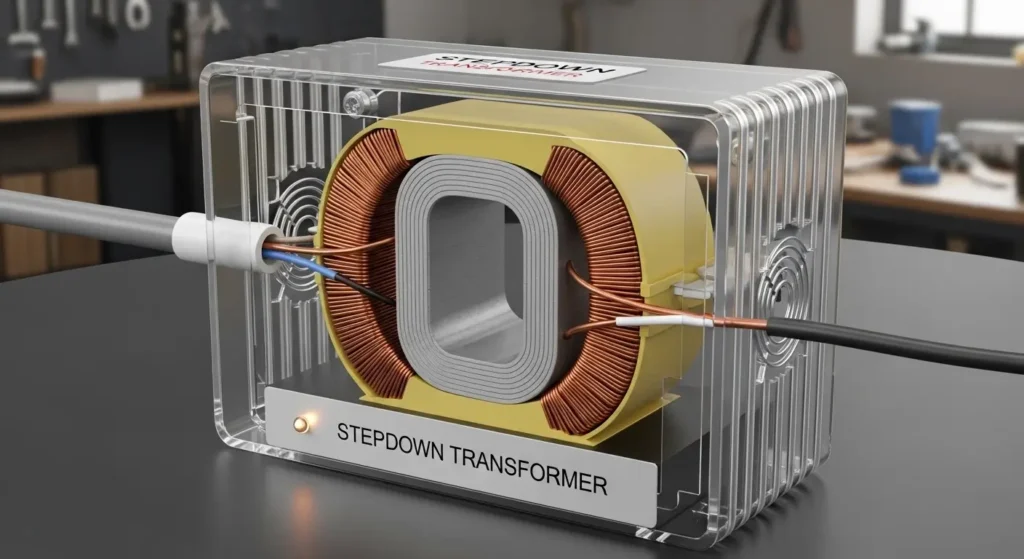
A transformer may look simple outside, but internally it has important parts.
1. Magnetic Core
- Made of laminated silicon steel.
- Provides a path for magnetic flux.
- Reduces energy losses.
2. Primary Winding
- Connected to high voltage supply.
- Has more turns than secondary.
- Creates magnetic field.
3. Secondary Winding
- Connected to load.
- Has fewer turns.
- Provides reduced voltage output.
4. Insulation
- Prevents short circuits.
- Ensures safety between windings.
5. Transformer Tank
- Contains oil (in large transformers).
- Provides cooling and insulation.
6. Cooling System
- Oil cooling or air cooling.
- Prevents overheating.
6. Advantages of Stepdown Transformer
Here are key stepdown transformer advantages and disadvantages (starting with benefits):
Advantages
- Reduces high voltage to safe level
- Essential for domestic power supply
- High efficiency (up to 98%)
- Reliable and long service life
- Requires low maintenance
- Improves safety in electrical systems
- Enables efficient long-distance transmission
Real-world benefit: Without stepdown transformers, modern cities could not function safely.
7. Disadvantages / Limitations
Even though transformers are very useful, they have some limitations.
Disadvantages
- Works only with AC supply
- Large size for high power ratings
- Initial cost can be high
- Energy losses (copper and core losses)
- Requires proper cooling
Understanding these limitations helps in proper system design.
8. Stepdown Transformer Applications
Stepdown transformer applications are found everywhere.
Home Applications
- Supplying 230V to houses
- Mobile chargers
- Doorbell transformers
- LED drivers
Industrial Applications
- Supplying machinery
- Control circuits
- Welding equipment
Modern Technology Uses
- Electronic power supplies
- UPS systems
- Renewable energy systems
- Electric vehicle charging stations
Almost every electrical device depends on a stepdown transformer directly or indirectly.
9. Comparison: Stepdown vs Step-Up Transformer
Understanding the difference between step up and stepdown transformer is very important.
| Feature | Stepdown Transformer | Step-Up Transformer |
|---|---|---|
| Voltage | Decreases voltage | Increases voltage |
| Turns Ratio | N₂ < N₁ | N₂ > N₁ |
| Used In | Distribution | Power generation |
| Example | 11kV to 230V | 11kV to 132kV |
| Safety Role | Makes power usable | Enables long transmission |
Both are based on the same transformer working principle, but their purpose is opposite.
10. Selection Guide: How to Choose the Right Stepdown Transformer
Choosing the correct transformer is very important for safety and performance.
1. Voltage Rating
Check input and required output voltage.
2. Power Rating (kVA)
Calculate total load power.
Always choose 20–25% higher capacity.
3. Cooling Type
- Air-cooled for small systems
- Oil-cooled for large systems
4. Efficiency
Higher efficiency means lower energy loss.
5. Installation Location
Indoor or outdoor use affects design selection.
Tip for Beginners
Never select a transformer based only on price. Always check ratings and safety standards.
11. Common Problems & Solutions (FAQs Style)
Q1: Why is my transformer overheating?
Possible causes:
- Overloading
- Poor ventilation
- Internal short circuit
Solution:
- Reduce load
- Improve cooling
- Check winding resistance
Q2: Why is output voltage low?
Possible reasons:
- Input voltage drop
- Loose connections
- Overload
Solution:
- Check supply voltage
- Tighten terminals
- Reduce load
Q3: Why is there humming noise?
Cause:
- Core vibration
Solution:
- Tighten mounting bolts
- Check core laminations
Proper maintenance increases transformer life significantly.
12. Future Trends in Stepdown Transformers
Technology is improving continuously.
1. Smart Transformers
Integrated sensors for monitoring temperature, voltage, and load in real time.
2. Eco-Friendly Insulation
Replacing mineral oil with biodegradable fluids.
3. Compact High-Efficiency Designs
Better core materials reduce losses.
4. Renewable Energy Integration
Used in solar and wind power systems.
In future smart grids, advanced stepdown transformers will play an even bigger role.
13. Conclusion
A stepdown transformer is one of the most important devices in electrical power systems. It reduces high voltage to safe, usable levels for homes, industries, and modern technology.
We learned the stepdown transformer working principle, types, components, applications, advantages and disadvantages, and the difference between step up and stepdown transformer.
As an electrical engineer, understanding transformers is not optional—it is fundamental. If you master this topic, you build a strong base for power system studies, maintenance work, and industrial applications.
Keep learning, observe real transformers in substations, and always respect electrical safety.