
Imagine installing electrical equipment inside a control panel. When mounting circuit boards, cables, or metal components, it is important to keep a safe distance between different parts. If the components touch each other directly, it may cause electrical short circuits, overheating, or mechanical damage. This is where spacers play a very important role.
Spacers are small mechanical components used to maintain a fixed distance between two parts. They are widely used in electrical systems, mechanical assemblies, electronic devices, and industrial equipment. Although spacers are simple in design, they are extremely important for maintaining structural stability, insulation, and proper alignment in many machines and devices.
For electrical students, engineers, and technicians, understanding the spacers working principle and their applications is useful when designing electrical panels, assembling machines, or installing electronic equipment. Proper use of spacers improves safety, reliability, and performance.
In this article, you will learn what spacers are, how the spacers working principle functions, the different types of spacers, their components, advantages, disadvantages, and real-world spacers applications in home, industrial, and modern technologies.
What are Spacers?
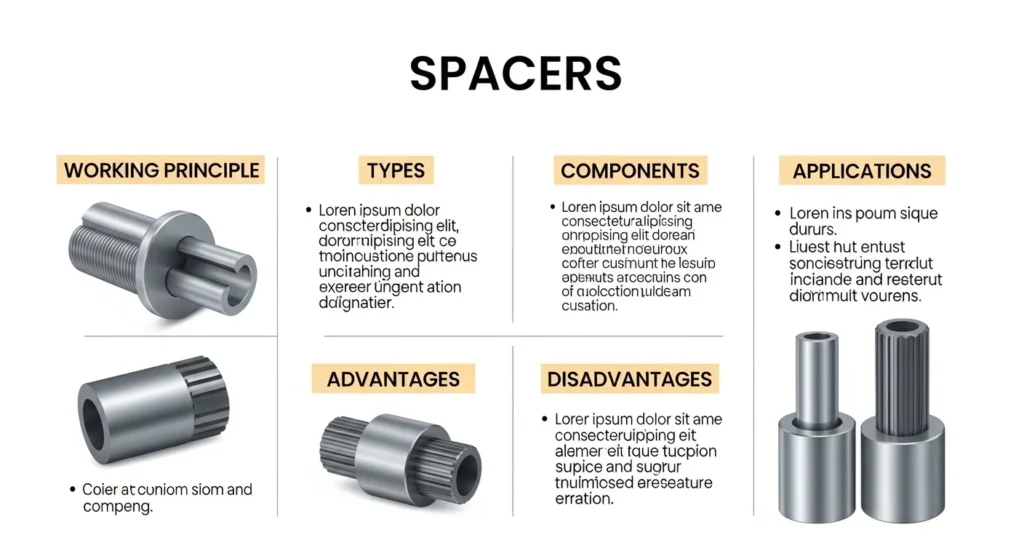
Spacers are mechanical components used to create or maintain a specific gap between two objects. They are placed between parts to prevent direct contact and ensure proper alignment.
Spacers are usually cylindrical or tubular pieces made from materials such as metal, plastic, nylon, or ceramic.
Simple Explanation
In simple terms, spacers act like small supports that keep two components separated at a fixed distance. This helps prevent friction, electrical contact, or mechanical damage.
Practical Example
Inside a computer motherboard, small spacers are used to mount the circuit board onto the metal case. These spacers prevent the board from touching the metal surface, avoiding electrical short circuits.
Spacers Working Principle
The spacers working principle is based on maintaining physical separation between two components while providing structural support.
When spacers are installed between two parts, they maintain a fixed distance that prevents direct contact and allows proper alignment.
Step-by-Step Operation
The operation of spacers can be understood through the following steps:
- A spacer is placed between two components.
- Fasteners such as bolts or screws pass through the spacer.
- The spacer maintains a fixed gap between the components.
- This gap prevents unwanted contact, vibration, or electrical faults.
- The assembly becomes stable and properly aligned.
Simple Analogy
Think of spacers like the legs of a table. The legs keep the tabletop elevated above the ground, maintaining a fixed space. Similarly, spacers keep machine components properly separated.
Types / Classification of Spacers
Spacers are available in different shapes and materials depending on their application.
Metal Spacers
Metal spacers are commonly made from aluminum, stainless steel, or brass.
Features:
- High strength
- Durable construction
- Suitable for heavy mechanical loads
They are widely used in industrial machinery and mechanical assemblies.
Plastic Spacers
Plastic spacers are made from materials such as nylon or PVC.
Features:
- Lightweight
- Electrical insulation
- Corrosion resistance
These spacers are often used in electronic devices.
Threaded Spacers
Threaded spacers contain internal or external threads.
Features:
- Easy installation using screws or bolts
- Strong mechanical connection
- Common in electronic equipment and circuit boards
Unthreaded Spacers
These spacers are simple cylindrical tubes without threads.
Features:
- Used with separate bolts or rods
- Simple and cost-effective design
Insulating Spacers
Insulating spacers are specially designed for electrical applications.
Features:
- Prevent electrical conduction
- Improve safety in electrical systems
Main Components of a Spacer System
Although spacers themselves are simple, they usually work with other mechanical parts.
Spacer Body
The main cylindrical or tubular part of the spacer.
Function:
- Maintains fixed distance between components
- Provides structural support
Fasteners
Fasteners such as bolts, screws, or nuts are used with spacers.
Function:
- Hold the spacer in position
- Secure the components together
Mounting Surface
The surfaces of the components where spacers are installed.
Function:
- Provide contact points for spacer installation
Insulation Material (If Applicable)
Some spacers include insulating materials.
Function:
- Prevent electrical conduction
- Improve safety in electronic systems
Advantages of Spacers
Spacers offer several benefits in mechanical and electrical systems.
Spacers advantages include:
- Maintain proper spacing between components
- Prevent electrical short circuits
- Improve mechanical alignment
- Reduce vibration and friction
- Easy installation and replacement
- Improve system reliability
These benefits make spacers essential in many engineering applications.
Disadvantages / Limitations
Although spacers are useful, they have some limitations.
Spacers advantages and disadvantages should both be considered.
Spacer Limitations
- Incorrect size can cause alignment problems
- Low-quality spacers may deform under heavy load
- Plastic spacers may degrade at high temperatures
- Improper installation may reduce structural stability
Careful selection and installation help minimize these issues.
Spacers Applications
Spacers are used in a wide variety of industries and devices.
Home Applications
Common household applications include:
- Mounting electrical switchboards
- Installing ceiling fans and lighting fixtures
- Assembling furniture and appliances
Industrial Applications
Spacers are widely used in industrial systems such as:
- Electrical control panels
- Heavy machinery assemblies
- Conveyor systems
- Power distribution equipment
These systems require precise spacing and alignment.
Modern Technology Applications
Spacers are also used in advanced technologies including:
- Computer hardware and motherboards
- Telecommunications equipment
- Electric vehicle systems
- Robotics assemblies
These spacers applications demonstrate their importance in modern engineering.
Comparison Section
Difference Between Spacers and Washers
| Feature | Spacers | Washers |
|---|---|---|
| Purpose | Maintain distance between components | Distribute load of fasteners |
| Shape | Cylindrical or tubular | Flat circular disc |
| Function | Create spacing | Protect surface and reduce pressure |
| Application | Mechanical assemblies | Bolted connections |
Understanding the difference between spacers and washers helps engineers choose the correct component for their design.
Selection Guide
Choosing the correct spacer is important for safe and reliable operation.
Important Factors
- Required spacing distance
- Material strength
- Electrical insulation needs
- Temperature resistance
- Load capacity
Tips for Beginners
- Measure the required gap accurately.
- Choose corrosion-resistant materials.
- Use insulating spacers for electrical systems.
- Ensure compatibility with bolts or screws.
Proper selection improves durability and safety.
Common Problems & Solutions
Why do spacers become loose?
Loose fasteners or vibration may cause spacer movement.
Solution:
- Tighten bolts properly
- Use locking fasteners
Why do spacers deform?
Excessive load or poor material quality may cause deformation.
Solution:
- Use stronger metal spacers
- Select correct load capacity
Why do electrical faults occur?
If conductive spacers are used in electrical systems, short circuits may occur.
Solution:
- Use insulating spacers such as nylon
Why does equipment vibrate?
Incorrect spacer size may cause improper alignment.
Solution:
- Replace with correctly sized spacers
Future Trends
Spacer technology is also evolving with modern engineering advancements.
Advanced Materials
High-performance polymers and composites improve durability and insulation.
Lightweight Designs
Modern spacers are designed to reduce weight while maintaining strength.
Precision Manufacturing
Advanced manufacturing techniques improve spacer accuracy and quality.
Smart Engineering Applications
Spacers are being used in compact electronic systems and high-precision equipment.
These innovations will improve reliability and performance in future technologies.
Conclusion
Spacers are small but extremely important components used in mechanical and electrical systems. Their main purpose is to maintain a fixed distance between parts while providing proper alignment and structural support. Even though they are simple in design, spacers play a critical role in preventing electrical short circuits, reducing vibration, and ensuring stable assembly.
In this article, we explored what spacers are, explained the spacers working principle, and discussed different spacer types and components. We also examined various spacers applications, along with the spacers advantages and disadvantages that engineers and technicians should consider.
For electrical students and beginners, understanding spacers is important because they are used in many devices, from small electronic circuits to large industrial machines. Proper selection, installation, and maintenance of spacers can greatly improve system reliability and safety in modern engineering applications.