
Imagine walking through a street at night where the lights automatically turn on after sunset without using electricity from the power grid. These lights charge during the day using sunlight and provide illumination at night. This is a common example of solar LED lights in real life.
In many areas around the world, especially remote locations, providing electrical power through traditional wiring is expensive and difficult. Solar LED lighting systems solve this problem by using renewable energy from the sun. Because of their energy efficiency, low maintenance, and environmentally friendly operation, solar LED lights are becoming increasingly popular in homes, streets, parks, industries, and public infrastructure.
For electrical students, engineers, and technicians, understanding solar LED lighting is very important because it combines solar energy technology, LED lighting, batteries, and electronic control systems.
In this article, you will learn the solar LED lights working principle, types, components, advantages, disadvantages, applications, and how to choose the right system. By the end, you will clearly understand how these systems work and where they are best used in modern electrical installations.
2. What is Solar LED Lights?
Solar LED lights are lighting systems that use solar energy to power LED lamps without relying on the main electrical grid.
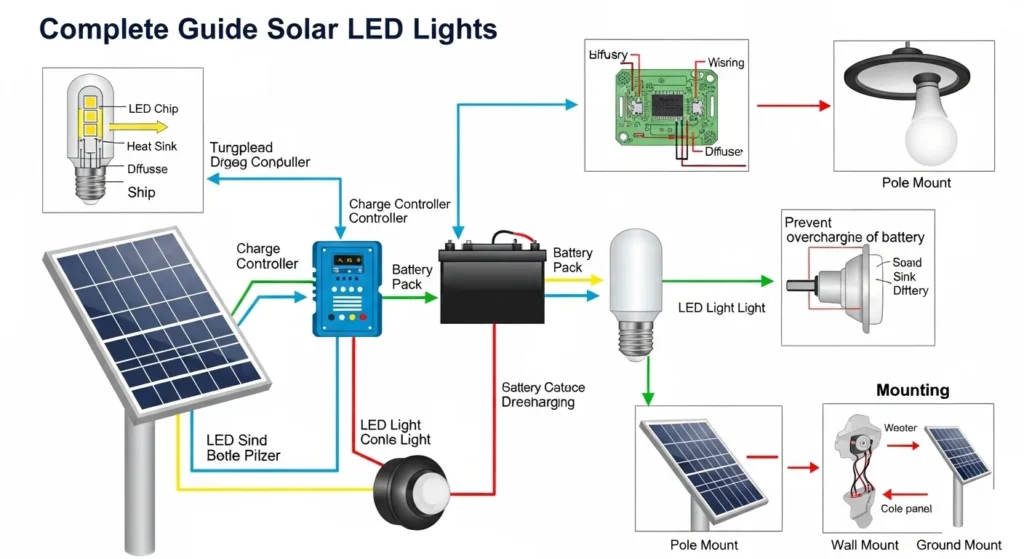
These systems include a solar panel, battery, LED lamp, charge controller, and sometimes sensors. The solar panel converts sunlight into electrical energy during the day, which is stored in a battery. At night, the stored energy powers the LED light.
In simple words, solar LED lights are self-powered lighting systems that run on sunlight.
Practical Example
A common example is solar street lights installed on roads and highways. During the day, the solar panel collects sunlight and stores energy in a battery. At night, the LED lamp automatically turns on using the stored energy.
Because LEDs consume very little power compared to traditional bulbs, they are ideal for solar lighting systems.
3. Solar LED Lights Working Principle
The solar LED lights working principle is based on converting sunlight into electrical energy and storing it for nighttime use.
The process works in several simple steps:
Step-by-Step Working
- Solar Energy Collection
The solar panel receives sunlight during the day. - Energy Conversion
The solar panel converts sunlight into direct current (DC) electricity. - Energy Storage
The DC electricity charges a rechargeable battery through a charge controller. - Automatic Control
A light sensor detects darkness at sunset. - Lighting Operation
The controller allows power from the battery to flow to the LED lamp. - LED Illumination
The LED produces light using very low electrical energy. - Automatic Shutdown
At sunrise, the sensor turns the light off and the charging cycle begins again.
Simple Analogy
Think of solar LED lights like a water tank system:
- Solar panel = water pump collecting water
- Battery = storage tank
- LED lamp = tap that releases water at night
During the day, the system stores energy just like filling a tank. At night, the stored energy powers the light.
4. Types / Classification of Solar LED Lights
Solar LED lights come in many designs depending on their application and installation method.
Solar Street Lights
These are large lighting systems used on roads, highways, and parking areas.
Features:
- High-power LED lamps
- Large solar panels
- Long battery backup
They are widely used in cities and rural areas.
Solar Garden Lights
Solar garden lights are used in parks, lawns, pathways, and landscaping.
Features:
- Decorative design
- Small solar panels
- Automatic night operation
They are easy to install and require no wiring.
Solar Flood Lights
Solar flood lights produce high-intensity illumination for large areas.
Common uses:
- Security lighting
- Building exteriors
- Construction sites
Many models include motion sensors.
Solar Wall Lights
Solar wall lights are mounted on walls, gates, and entrances.
They are used for:
- Outdoor home lighting
- Security lighting
- Corridor illumination
Portable Solar Lights
Portable solar LED lights are mobile lighting systems used during emergencies, camping, or outdoor activities.
They often include:
- USB charging ports
- Rechargeable batteries
- Adjustable brightness levels
5. Main Components of Solar LED Lights
Solar LED lighting systems consist of several key components that work together.
Solar Panel
The solar panel converts sunlight into electrical energy using photovoltaic cells.
Main function:
- Generate DC electricity during daylight.
LED Lamp
The LED lamp produces light using light-emitting diodes.
LEDs are ideal because they:
- Consume less power
- Produce more light
- Have long life
Rechargeable Battery
The battery stores energy generated by the solar panel.
Common battery types include:
- Lithium-ion batteries
- Lithium iron phosphate batteries
- Lead-acid batteries
Charge Controller
The charge controller manages power flow between the solar panel, battery, and LED lamp.
Functions include:
- Prevent battery overcharging
- Prevent deep discharge
- Control lighting operation
Light Sensor
A photocell or light sensor detects day and night conditions.
When it becomes dark, the sensor automatically turns the LED light on.
Mounting Structure
This includes poles, brackets, and frames used to install solar panels and lights securely.
6. Solar LED Lights Advantages
Solar LED lights offer many benefits in modern electrical systems.
- Energy Saving – They use renewable solar energy instead of grid electricity
- Low Operating Cost – No electricity bills
- Environment Friendly – Reduce carbon emissions
- Easy Installation – No wiring required
- Automatic Operation – Turn on and off automatically
- Low Maintenance – LED lamps have long life
- Reliable Lighting – Continue working during power outages
- Ideal for Remote Areas – Perfect where electricity is unavailable
These benefits make solar LED lighting a sustainable and cost-effective solution.
7. Solar LED Lights Disadvantages / Limitations
Despite many advantages, solar LED lighting also has some limitations.
- High Initial Cost compared to traditional lights
- Weather Dependency – Performance depends on sunlight availability
- Battery Replacement required after several years
- Limited Power Output compared to grid-powered lighting
- Performance Reduction during cloudy or rainy days
However, technological improvements are reducing these limitations every year.
8. Solar LED Lights Applications
Solar LED lights are widely used in many sectors.
Residential Applications
- Garden lighting
- Pathway lighting
- Outdoor wall lights
- Security lighting
Public Infrastructure
- Street lighting
- Highway lighting
- Parking areas
- Public parks
Industrial Applications
- Warehouse outdoor lighting
- Construction sites
- Security perimeter lighting
Remote Locations
- Villages without electricity
- Rural roads
- Desert areas
- Agricultural farms
Emergency Lighting
Solar LED lights are also used for:
- Disaster relief areas
- Temporary shelters
- Outdoor events
These solar LED lights applications continue to expand worldwide.
9. Comparison Section
Difference Between Solar LED Lights and Traditional LED Lights
| Feature | Solar LED Lights | Traditional LED Lights |
|---|---|---|
| Power Source | Solar energy | Grid electricity |
| Installation | No wiring required | Requires electrical wiring |
| Operating Cost | Almost zero | Electricity cost |
| Maintenance | Low | Moderate |
| Environmental Impact | Eco-friendly | Depends on power source |
| Backup Power | Battery storage | Needs UPS or generator |
This comparison clearly shows the difference between solar LED lights and traditional lighting systems.
10. Selection Guide
Choosing the right solar LED light requires considering several factors.
Check Solar Panel Capacity
Higher wattage solar panels collect more energy and provide longer lighting time.
Battery Capacity
Choose systems with large battery capacity for longer night operation.
LED Brightness
Brightness is measured in lumens.
Examples:
- Garden lights: 100–300 lumens
- Street lights: 3000+ lumens
Weather Resistance
Outdoor solar lights should have IP65 or higher protection against dust and water.
Installation Location
Ensure the solar panel receives direct sunlight for at least 6–8 hours daily.
Smart Features
Modern systems include:
- Motion sensors
- Remote control
- Adjustable brightness
These features improve efficiency and security.
11. Common Problems & Solutions
Why is my solar LED light not turning on?
Possible reasons:
- Dead battery
- Dirty solar panel
- Faulty light sensor
Solution: Clean the panel and check battery condition.
Why does the light turn off quickly?
This usually happens when the battery is not fully charged.
Solution: Ensure the solar panel receives full sunlight during the day.
Why is the brightness low?
Possible causes include:
- Old battery
- Weak LED driver
- Dust on solar panel
Cleaning the panel often improves performance.
Do solar LED lights work in winter?
Yes, but lighting duration may be shorter due to reduced sunlight.
12. Future Trends
Solar lighting technology continues to evolve rapidly.
Smart Solar Lighting
Future systems will include IoT connectivity, allowing remote monitoring and control.
Higher Efficiency Solar Panels
New photovoltaic materials will increase energy conversion efficiency.
Advanced Batteries
Lithium iron phosphate batteries will provide longer lifespan and better safety.
Integrated Solar Lighting
Modern designs combine solar panel, battery, and LED lamp in one unit.
AI-Based Lighting Control
Smart systems may automatically adjust brightness based on traffic or weather conditions.
These innovations will make solar LED lighting even more efficient and widely used.
13. Conclusion
Solar LED lights are one of the most important developments in modern electrical and renewable energy systems. They combine solar energy technology with efficient LED lighting to provide reliable illumination without depending on traditional power grids.
Understanding the solar LED lights working principle, components, types, applications, and selection methods is essential for electrical students, engineers, and technicians. These systems offer many benefits such as energy savings, low operating cost, environmental protection, and easy installation.
Although solar LED lights have some limitations like weather dependency and battery replacement, ongoing technological improvements are making them more efficient and affordable.
As the world moves toward renewable energy and sustainable infrastructure, solar LED lighting will continue to play a major role in homes, industries, and public infrastructure.
For anyone working in electrical technology, learning about solar LED lighting is an important step toward understanding the future of energy-efficient lighting systems.