
Imagine opening a refrigerator and hearing the soft humming sound of a small fan circulating cold air inside the cooling chamber. That quiet movement of air helps maintain a consistent temperature and keeps food fresh. Behind this simple function is a small but reliable electric motor known as the Shaded Pole Motor.
Shaded pole motors are commonly used in low-power electrical devices where simplicity, low cost, and quiet operation are important. You can find them in household appliances such as exhaust fans, refrigerator fans, small blowers, and electric clocks. Although they are small compared to industrial motors, they play an essential role in many everyday devices.
For electrical students, technicians, and engineers, understanding the Shaded Pole Motor is important because it represents one of the simplest types of single-phase induction motors. Its design is easy to understand and provides a practical introduction to motor starting techniques.
In this article, we will explore the Shaded Pole Motor working principle, its types, main components, advantages and disadvantages, and common applications. By the end, you will have a clear understanding of how this motor works and why it remains useful in many low-power electrical systems.
2. What is a Shaded Pole Motor?
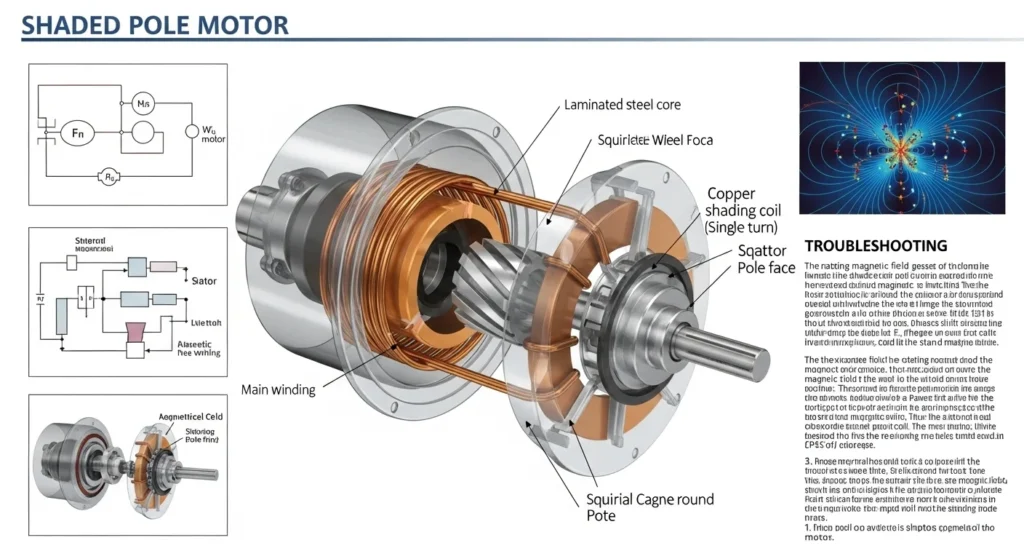
A Shaded Pole Motor is a type of single-phase induction motor that uses a special copper ring called a shading coil to produce a rotating magnetic field and start the motor.
Unlike other single-phase motors that require capacitors or auxiliary windings for starting, shaded pole motors use a simple shading coil placed around a portion of the stator pole.
This shading coil creates a delayed magnetic field, which produces a weak rotating magnetic field that starts the rotor moving.
Simple Practical Example
Consider a small exhaust fan installed in a bathroom. When you switch it on, the fan begins rotating slowly and steadily without any complex starting mechanism. This fan often uses a shaded pole motor because it is inexpensive and reliable for low-power tasks.
Because of their simple construction, shaded pole motors are widely used in small electrical appliances.
3. Shaded Pole Motor Working Principle
The Shaded Pole Motor working principle is based on creating a delayed magnetic field using a shading coil.
When alternating current flows through the stator winding, it produces a magnetic field in the stator pole. A copper ring called the shading coil is placed around part of this pole.
The shading coil causes the magnetic field in the shaded part of the pole to be delayed compared to the unshaded part. This delay produces a weak rotating magnetic field that starts the rotor turning.
Step-by-Step Working Process
• Step 1: AC Supply Applied
Single-phase AC power is supplied to the stator winding.
• Step 2: Magnetic Field Generated
The stator produces a magnetic field in the pole.
• Step 3: Shading Coil Creates Delay
The copper shading ring delays the magnetic field in the shaded portion of the pole.
• Step 4: Weak Rotating Magnetic Field Created
The shifting magnetic field creates a small rotating effect.
• Step 5: Rotor Starts Rotating
The rotor begins to rotate in the direction from the unshaded part toward the shaded part.
Simple Analogy
Imagine pushing a swing slightly on one side first and then on the other side a moment later. This small time difference creates movement. Similarly, the delayed magnetic field in shaded pole motors creates motion.
4. Types / Classification of Shaded Pole Motors
Although shaded pole motors are relatively simple, they can be classified based on their design and application.
Small Appliance Shaded Pole Motor
This is the most common type used in household appliances.
Characteristics
- Low power rating
- Compact size
- Quiet operation
Applications
Used in fans, small blowers, and cooling systems.
Multi-Pole Shaded Pole Motor
This design includes multiple poles to improve performance and smooth operation.
Features
- Better torque distribution
- Smooth rotation
- Used in small machinery
High-Speed Shaded Pole Motor
These motors are designed for applications where higher speed is required.
Uses
- Small ventilation fans
- Cooling fans in electronic devices
- Air circulation systems
5. Main Components
A Shaded Pole Motor consists of several simple components.
Stator
The stator is the stationary part of the motor.
It contains the main winding that produces the magnetic field.
Shading Coil
The shading coil is a copper ring placed around a portion of the stator pole.
Its function is to delay the magnetic field and create the starting torque.
Rotor
The rotor is usually a squirrel cage rotor.
It rotates due to the magnetic field produced by the stator.
Shaft
The shaft connects the rotor to the mechanical load.
Bearings
Bearings support the shaft and allow smooth rotation.
Frame
The frame protects the motor components and provides mechanical support.
6. Advantages
Understanding the Shaded Pole Motor advantages and disadvantages helps determine where the motor should be used.
Advantages
- Very simple construction
- Low manufacturing cost
- Reliable operation
- Compact size
- No capacitor or starting device required
- Quiet operation
- Low maintenance
These advantages make shaded pole motors ideal for small household appliances.
7. Disadvantages / Limitations
Despite its simplicity, the shaded pole motor has some limitations.
- Very low starting torque
- Low efficiency
- Limited power output
- Not suitable for heavy loads
- Poor power factor
Because of these limitations, shaded pole motors are mainly used in low-power applications.
8. Shaded Pole Motor Applications
The Shaded Pole Motor applications are mostly found in small electrical devices.
Home Appliances
- Exhaust fans
- Refrigerator cooling fans
- Hair dryers
- Electric clocks
Commercial Equipment
- Display cabinet fans
- Small ventilation systems
- Office equipment cooling fans
Electronics and Modern Devices
- Computer cooling fans
- Air circulation devices
- Small air pumps
Although these motors are small, they are extremely useful in many daily devices.
9. Comparison Section
Difference Between Shaded Pole Motor and Capacitor Start Motor
| Feature | Shaded Pole Motor | Capacitor Start Motor |
|---|---|---|
| Starting Torque | Very low | High |
| Efficiency | Low | Higher |
| Cost | Low | Higher |
| Complexity | Simple | More complex |
| Applications | Small fans | Pumps and compressors |
Understanding the difference between shaded pole motor and capacitor start motor helps engineers select the correct motor type.
10. Selection Guide
When choosing a Shaded Pole Motor, consider several factors.
Power Requirement
These motors are suitable for low-power devices.
Speed Requirement
Select a motor with the required speed rating.
Application Type
Ensure the motor is appropriate for continuous or intermittent operation.
Cooling Requirements
Proper ventilation improves motor life.
Cost Considerations
Shaded pole motors are chosen when low cost is important.
For beginners, these motors are easy to understand and maintain.
11. Common Problems & Solutions
Why does the motor run slowly?
Possible causes:
- Low voltage supply
- Mechanical load too high
Solution: Check voltage and reduce load.
Why does the motor overheat?
Possible causes:
- Poor ventilation
- Continuous heavy load
Solution: Improve airflow and reduce operating load.
Why does the motor produce noise?
Possible causes:
- Worn bearings
- Loose components
Solution: Inspect and replace damaged parts.
12. Future Trends
Although shaded pole motors are simple, improvements are still being made.
Energy Efficient Designs
Manufacturers are improving motor efficiency to reduce energy consumption.
Improved Materials
Better insulation and magnetic materials increase durability.
Compact Appliances
As devices become smaller, compact shaded pole motors remain useful.
Smart Appliance Integration
These motors are increasingly used in smart home appliances.
Eco-Friendly Manufacturing
Modern production methods aim to reduce environmental impact.
13. Conclusion
The Shaded Pole Motor is one of the simplest and most economical types of single-phase induction motors. Its easy design, low cost, and reliable performance make it ideal for small electrical appliances and low-power devices.
In this article, we explored the Shaded Pole Motor working principle, main components, classification, and real-world applications. We also discussed the Shaded Pole Motor advantages and disadvantages and compared it with other motor types.
Although it cannot handle heavy loads or high efficiency requirements, the shaded pole motor remains extremely valuable for small applications such as fans, blowers, and cooling systems.
For electrical students and technicians, understanding this motor provides a strong foundation in basic motor operation and electrical machine design.