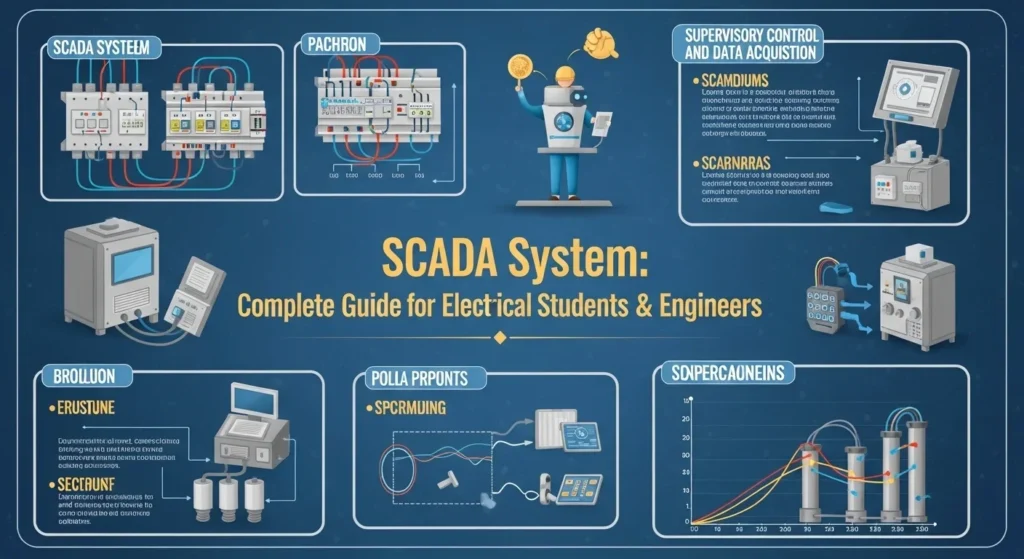

Imagine a large power plant that supplies electricity to thousands of homes. Engineers cannot physically stand near every generator, transformer, and switchgear to check their condition all the time. Instead, they sit in a control room and monitor everything on computer screens. If voltage changes, temperature rises, or a fault occurs, they can see it instantly and take action.
This powerful monitoring and control capability is made possible by a SCADA System.
A SCADA system is widely used in modern electrical power systems, industrial automation, water treatment plants, oil pipelines, and manufacturing facilities. It helps engineers monitor equipment, collect real-time data, and control operations remotely.
For electrical students, technicians, and engineers, understanding the SCADA system working principle is very important because automation is becoming a core part of modern electrical infrastructure.
In this guide, you will learn what a SCADA System is, how it works, its types, components, advantages and disadvantages, applications, and practical troubleshooting tips. By the end of this article, you will clearly understand how SCADA systems help industries run safely and efficiently.
2. What is SCADA System?
A SCADA System stands for Supervisory Control and Data Acquisition.
It is a computer-based system used to monitor, control, and collect data from industrial equipment and electrical systems in real time.
Simple Explanation
A SCADA system works like the brain of an industrial control system. It collects information from machines, displays it on screens, and allows engineers to control equipment remotely.
Practical Example
In a power distribution network:
- Sensors measure voltage and current.
- Data is sent to the control center.
- Engineers monitor system performance on SCADA software.
- If a fault occurs, they can open or close circuit breakers remotely.
This is a basic example of how a SCADA system working principle operates in real-world electrical systems.
3. SCADA System Working Principle
The SCADA system working principle is based on collecting data from field devices, transmitting it to a control center, and allowing operators to monitor and control equipment.
Step-by-Step Operation
- Data Collection
Sensors and instruments measure electrical parameters such as:
- Voltage
- Current
- Temperature
- Pressure
- Flow rate
- Signal Transmission
The collected signals are sent to Remote Terminal Units (RTUs) or Programmable Logic Controllers (PLCs).
- Data Communication
RTUs and PLCs transmit the data to the central SCADA server through communication networks.
- Data Processing
The SCADA software processes and stores the information in a database.
- Visualization
Operators can see real-time data using graphical screens and dashboards.
- Control Commands
Engineers can send commands from the control center, such as:
- Start or stop equipment
- Open or close switches
- Adjust process parameters
Simple Analogy
Think of SCADA like the nervous system of an industrial plant.
- Sensors = Nerves collecting information
- Communication network = Nerve pathways
- Control center = Brain
- Operators = Decision makers
4. Types / Classification of SCADA Systems
SCADA systems have evolved over time. They are generally classified into four main generations.
Monolithic SCADA Systems
These are the earliest SCADA systems developed in the 1960s.
Features
- Standalone systems
- Limited connectivity
- Proprietary hardware
They were reliable but lacked flexibility.
Distributed SCADA Systems
Distributed systems improved reliability by distributing processing tasks across multiple computers.
Features
- Multiple processing units
- Local area network communication
- Improved redundancy
Networked SCADA Systems
These systems use modern networking technologies to connect multiple control systems.
Features
- Internet-based communication
- Data sharing between systems
- Improved scalability
Web-Based SCADA Systems
Modern SCADA systems use web technologies and cloud computing.
Features
- Remote monitoring using web browsers
- Mobile device access
- Cloud data storage
5. Main Components of a SCADA System
A SCADA system consists of several important components.
Sensors and Field Devices
These devices measure physical parameters such as temperature, pressure, voltage, and flow.
They are the first source of system data.
Remote Terminal Units (RTUs)
RTUs collect data from sensors and send it to the SCADA control center.
They are commonly used in large power systems and remote installations.
Programmable Logic Controllers (PLCs)
PLCs are industrial computers used to control machines and processes.
They process signals and execute control instructions.
Communication Network
This network transfers data between field devices and the control center.
Common communication methods include:
- Ethernet
- Fiber optic
- Radio communication
- Cellular networks
SCADA Software
SCADA software runs on servers and provides:
- Data visualization
- Alarm management
- Historical data storage
- System control
Human Machine Interface (HMI)
HMI is the graphical interface used by operators to interact with the SCADA system.
It displays system diagrams, alarms, and real-time measurements.
6. SCADA System Advantages
The SCADA system advantages and disadvantages should be clearly understood before implementation.
Advantages
- Real-time system monitoring
- Remote equipment control
- Improved operational efficiency
- Faster fault detection
- Reduced manpower requirements
- Better data analysis and reporting
- Increased system reliability
SCADA systems greatly improve the management of complex electrical networks.
7. Disadvantages / Limitations
Despite many benefits, SCADA systems have some limitations.
Disadvantages
- High initial installation cost
- Requires skilled operators
- Vulnerable to cyber security threats
- System maintenance required
- Complex configuration
Proper design and security measures can reduce these limitations.
8. SCADA System Applications
There are many SCADA system applications across industries.
Power Generation and Distribution
- Power plant monitoring
- Grid control
- Substation automation
Water Treatment Plants
SCADA systems monitor water levels, pumps, and purification processes.
Oil and Gas Industry
Used for monitoring pipelines, refineries, and storage facilities.
Manufacturing Industry
SCADA systems control production lines and machinery.
Transportation Systems
Used in railways, traffic management, and airport operations.
Smart Cities
SCADA helps manage energy systems, water supply, and infrastructure.
9. Comparison: SCADA vs PLC
Understanding the difference between SCADA and PLC helps beginners understand automation systems better.
| Feature | SCADA System | PLC |
|---|---|---|
| Function | Monitoring and supervisory control | Direct machine control |
| Scope | Large systems | Individual machines |
| Interface | Graphical software interface | Ladder logic programming |
| Data Storage | Large database | Limited storage |
| Control Level | Supervisory control | Real-time control |
Both technologies often work together in industrial automation systems.
10. Selection Guide
Selecting the right SCADA system requires careful planning.
System Size
Small industries may use simple SCADA systems, while power plants require advanced solutions.
Communication Infrastructure
Reliable communication networks are essential for real-time monitoring.
Scalability
Choose a system that can expand as the plant grows.
Security Features
Cybersecurity protection is critical for industrial control systems.
Software Compatibility
Ensure compatibility with existing PLCs and industrial equipment.
11. Common Problems & Solutions
Problem 1: Communication failure
Solution:
Check network cables, routers, and communication modules.
Problem 2: Data not updating
Solution:
Restart SCADA services or verify PLC communication.
Problem 3: Alarm overload
Solution:
Configure alarm thresholds and priority levels properly.
Problem 4: HMI display errors
Solution:
Update SCADA software and verify graphics configuration.
Problem 5: System security risk
Solution:
Install firewalls, update software, and use secure authentication.
12. Future Trends
SCADA technology continues to evolve with modern innovations.
Industrial Internet of Things (IIoT)
IIoT devices allow SCADA systems to collect more detailed data from connected equipment.
Cloud-Based SCADA
Cloud technology allows remote monitoring from anywhere in the world.
Artificial Intelligence Integration
AI helps predict equipment failures and optimize system performance.
Cybersecurity Improvements
Advanced security protocols are being developed to protect industrial control systems.
Smart Grid Integration
SCADA systems will play a key role in future smart electrical grids.
13. Conclusion
The SCADA System is one of the most important technologies used in modern electrical and industrial automation. It allows engineers to monitor, control, and manage large systems from a central location.
By understanding the SCADA system working principle, components, and applications, electrical students and technicians can develop strong knowledge in automation and industrial control systems.
SCADA systems improve efficiency, increase reliability, and help detect problems quickly. Although they require investment and technical expertise, their benefits in safety, monitoring, and system management make them essential for modern industries.
As technology continues to evolve with IoT, cloud computing, and smart grids, SCADA systems will become even more powerful and widely used in future electrical infrastructure.