
Imagine a person touching the metal body of a faulty washing machine. Inside the machine, a damaged wire has come into contact with the metal frame. The frame becomes live, and current starts flowing through the person’s body toward earth. In such situations, milliseconds can mean the difference between safety and serious injury.
This is where protective devices like RCCB and ELCB play a life-saving role. Understanding RCCB vs ELCB is extremely important for anyone working in electrical systems. Although both devices are designed to protect against electric shock and earth leakage faults, their working methods are different.
As a junior engineer or technician, you must clearly understand which device to use, how it operates, and what makes one better than the other in modern installations.
In this detailed guide on RCCB vs ELCB, you will learn:
- The RCCB vs ELCB working principle
- Types and classifications
- RCCB vs ELCB applications
- RCCB vs ELCB advantages and disadvantages
- The difference between RCCB and ELCB in a clear comparison table
- Selection and troubleshooting tips
Let us start from the basics.
2. What is RCCB vs ELCB?
Clear Definition
RCCB (Residual Current Circuit Breaker) and ELCB (Earth Leakage Circuit Breaker) are protective devices used to disconnect power supply when leakage current to earth is detected.
Simple Explanation
Both devices protect people from electric shock caused by earth leakage.
However:
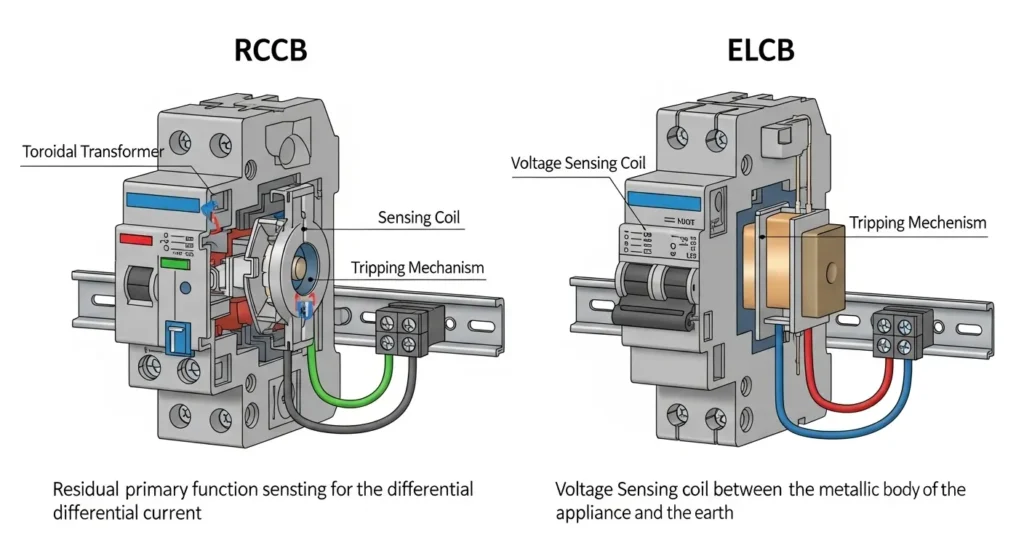
- RCCB detects imbalance between phase and neutral currents.
- ELCB (voltage-operated type) detects voltage between equipment body and earth.
Practical Example
If insulation fails in an appliance and leakage current flows to earth:
- An RCCB senses difference between phase and neutral current and trips.
- An ELCB senses rise in voltage on the equipment body and trips.
Understanding this difference between RCCB and ELCB is crucial for safe installation.
3. RCCB vs ELCB Working Principle
The RCCB vs ELCB working principle differs in detection method.
RCCB Working Principle
- Phase and neutral wires pass through a current transformer.
- Under normal condition, incoming and outgoing currents are equal.
- If leakage occurs, imbalance appears.
- The internal relay detects imbalance.
- The breaker trips instantly.
ELCB Working Principle (Voltage Type)
- ELCB connects between equipment body and earth.
- Under normal conditions, no voltage exists between them.
- If leakage occurs, voltage appears on metal body.
- When voltage exceeds safe limit, device trips.
Easy Analogy
Think of RCCB like checking water entering and leaving a tank. If water leaks, the difference is detected.
ELCB is like measuring pressure at a specific point. If pressure rises, it trips.
4. Types / Classification
Voltage-Operated ELCB
- Old technology
- Detects voltage on earth conductor
- Requires proper earthing
Current-Operated ELCB
- Modern type
- Works similar to RCCB
- Detects current imbalance
RCCB Types Based on Sensitivity
- 30 mA (Human protection)
- 100 mA or 300 mA (Fire protection)
RCCB Types Based on Waveform
- Type AC (AC leakage only)
- Type A (AC + Pulsating DC)
- Type B (AC + DC + High frequency)
Modern installations mainly use RCCB instead of old voltage-operated ELCB.
5. Main Components
RCCB Components
- Current transformer
- Trip coil
- Mechanical switching mechanism
- Test button
- Terminals
ELCB Components
- Voltage sensing coil
- Earth connection terminal
- Trip mechanism
- Switching contacts
Each component ensures proper detection and safe disconnection.
6. RCCB vs ELCB Advantages and Disadvantages
RCCB Advantages
- High sensitivity
- Does not depend on earth resistance
- Fast operation
- Reliable protection
RCCB Disadvantages
- Cannot protect against overload
- Requires proper wiring
ELCB Advantages
- Simple design
- Effective in older systems
ELCB Disadvantages
- Depends on proper earthing
- May not detect all leakage faults
- Less reliable compared to RCCB
Understanding RCCB vs ELCB advantages and disadvantages helps in proper selection.
7. Applications
Home Applications
- Bathroom circuits
- Kitchen outlets
- Water heaters
Industrial Applications
- Motor panels
- Distribution boards
- Generator systems
Modern Technology
- Solar installations
- EV charging systems
- Data centers
Today, RCCB is widely preferred in new RCCB vs ELCB applications.
8. Comparison Section: Difference Between RCCB and ELCB
| Parameter | RCCB | ELCB |
|---|---|---|
| Detection Method | Current imbalance | Voltage rise on body |
| Technology | Modern | Older type |
| Dependence on Earthing | No | Yes |
| Accuracy | High | Moderate |
| Safety Level | Very High | Limited |
| Usage Today | Common | Rare |
This table clearly explains the difference between RCCB and ELCB.
9. Selection Guide
When selecting between RCCB vs ELCB, consider:
1. Installation Type
For modern systems, use RCCB.
2. Earthing Quality
If earthing is weak, avoid voltage-operated ELCB.
3. Sensitivity Requirement
Use 30 mA for human safety.
4. Load Type
Choose correct RCCB type (AC, A, or B).
Tips for Beginners
- Always follow electrical standards.
- Never mix neutral wiring incorrectly.
- Test device using built-in test button monthly.
Proper selection ensures maximum protection.
10. Common Problems & Solutions (FAQs Style)
Q1: RCCB trips frequently. Why?
Possible leakage in appliance or moisture in wiring.
Check insulation resistance.
Q2: Can RCCB replace MCB?
No. RCCB protects against leakage, not overload. Use both.
Q3: Why is ELCB not recommended today?
Because it may fail if earthing is poor.
Q4: How to test RCCB?
Press the test button. It should trip immediately.
11. Future Trends
Electrical protection technology is improving.
Smart RCCB
Remote monitoring and fault data logging.
Integrated RCBO
Combines RCCB and MCB in one device.
IoT-Based Protection
Real-time alerts through smart grids.
Future systems focus on intelligent and faster protection.
12. Conclusion
Understanding RCCB vs ELCB is essential for electrical safety. Both devices protect against earth leakage, but RCCB offers more reliable and advanced protection compared to traditional ELCB.
The RCCB vs ELCB working principle shows that RCCB detects current imbalance, while ELCB depends on voltage detection. Modern electrical installations prefer RCCB due to higher sensitivity and improved safety performance.
As a junior engineer, always select protective devices carefully and ensure correct installation. Electrical safety is not optional—it is mandatory. Mastering RCCB vs ELCB concepts strengthens your knowledge of protection systems and helps you design safer electrical networks.