
Imagine you are working in a small workshop. A motor is running smoothly, lights are on, and everything looks normal. Suddenly, the wires start heating, the breaker trips, and production stops. In another case, a spark flashes inside a panel, followed by a loud sound and immediate power failure.
Both situations are related to electrical faults — but they are not the same. One may be an overload, and the other could be a short circuit.
Understanding Overload vs Short Circuit is very important for electrical students, engineers, and technicians. These faults can damage equipment, cause fires, and risk human safety if not properly controlled.
In this article, you will learn the clear definition of overload and short circuit, their working principles, types, components involved, applications, advantages and disadvantages, and the key difference between overload and short circuit. By the end, you will confidently understand how to identify and protect against these faults in real-world systems.
2. What is Overload vs Short Circuit?
What is an Overload?
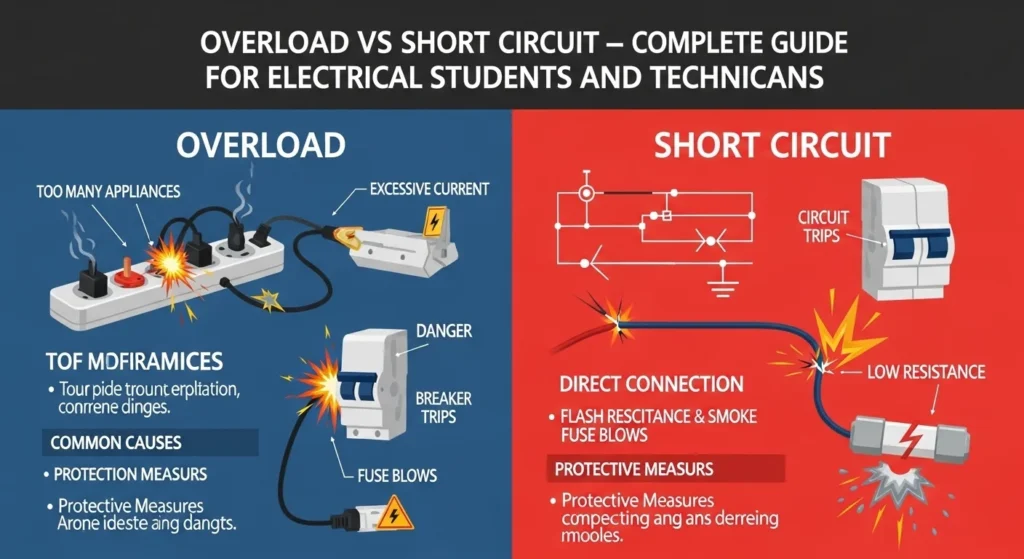
An overload occurs when electrical equipment draws more current than its rated capacity for a certain period.
In simple words, the circuit is healthy, but the load connected is too heavy.
Practical Example:
If you connect too many appliances to one extension board, the current increases beyond the safe limit. The wires heat up slowly. This is an overload condition.
What is a Short Circuit?
A short circuit occurs when the live wire directly touches the neutral or ground wire, creating a very low-resistance path.
In simple words, electricity finds a shortcut path and flows extremely fast.
Practical Example:
If insulation of wires gets damaged and two wires touch each other, a large current flows instantly. You may hear a loud spark. This is a short circuit.
3. Overload vs Short Circuit Working Principle
To understand the Overload vs Short Circuit working principle, we must first understand how current behaves.
Electric current flows according to resistance and load. If resistance decreases or load increases, current changes.
Overload Working Principle (Step-by-Step)
Think of water flowing in a pipe:
- The pipe has a limited capacity.
- If you increase water flow slightly, pressure increases slowly.
- If flow exceeds safe limit, the pipe heats or bursts.
In overload:
- Load increases gradually.
- Current rises above rated value.
- Heat builds up in wires and devices.
- Protection device (like breaker) trips after some time.
Overload current is usually 2 to 6 times the normal current.
Short Circuit Working Principle (Step-by-Step)
Now imagine:
- The pipe suddenly breaks.
- Water flows directly without control.
- Pressure drops instantly but flow becomes violent.
In short circuit:
- Resistance becomes almost zero.
- Current rises instantly to a very high value.
- Sparks and magnetic forces occur.
- Breaker trips immediately.
Short circuit current can be 10 to 100 times normal current.
4. Types / Classification
Types of Overload
1. Thermal Overload
Occurs due to excessive current for a longer time, causing heating.
Common in motors when overloaded mechanically.
2. Mechanical Overload
When motor shaft or machine is jammed, it draws more current.
3. Temporary Overload
Short-term increase in current, like motor starting.
Types of Short Circuit
1. Line-to-Line Short Circuit
Two phase wires touch each other.
2. Line-to-Neutral Short Circuit
Live wire touches neutral.
3. Line-to-Ground Short Circuit
Live wire touches earth or body of equipment.
4. Three-Phase Short Circuit
All three phases short together (most severe in industries).
5. Main Components Involved
To control overload and short circuit, certain protective components are used.
1. Circuit Breaker (MCB/MCCB)
- Detects overcurrent.
- Trips automatically.
- Protects wiring.
2. Fuse
- Thin wire that melts when current exceeds limit.
- Simple but effective protection.
3. Thermal Overload Relay
- Used in motors.
- Works on heating effect.
- Trips during overload but not fast short circuit.
4. Current Transformer (CT)
- Measures high current in industries.
- Sends signal to protection relays.
Each component plays a role in managing Overload vs Short Circuit applications safely.
6. Advantages
Understanding overload and short circuit gives many benefits:
- Prevents fire hazards
- Protects expensive equipment
- Reduces downtime
- Improves system reliability
- Enhances worker safety
- Helps in correct breaker selection
- Improves maintenance planning
Studying Overload vs Short Circuit advantages and disadvantages improves design skills.
7. Disadvantages / Limitations
Despite protection systems, some limitations exist:
- Overload protection may respond slowly
- Short circuit damage can occur in milliseconds
- Incorrect breaker rating causes nuisance tripping
- Poor wiring increases fault risk
- High fault current can damage panel even if breaker trips
No system is 100% safe without proper design and maintenance.
8. Applications
Home Applications
- MCBs in distribution boards
- Protection of air conditioners and heaters
- Overload protection in refrigerators
Industrial Applications
- Motor protection systems
- Generator protection
- Transformer fault protection
- Power distribution panels
Modern Technology Applications
- Solar inverter protection
- Electric vehicle charging systems
- Smart grid systems
- Data center power protection
Proper understanding of Overload vs Short Circuit applications is critical in modern electrical engineering.
9. Difference Between Overload and Short Circuit (Comparison Table)
Many students ask about the difference between overload and short circuit. Here is a simple comparison:
| Feature | Overload | Short Circuit |
|---|---|---|
| Cause | Excess load | Direct wire contact |
| Current Increase | Gradual | Instant and very high |
| Damage Speed | Slow heating | Immediate damage |
| Sound/Spark | Usually none | Loud spark or flash |
| Breaker Response | Delayed trip | Instant trip |
| Risk Level | Moderate | Very high |
This table clearly explains the difference between overload and short circuit in practical terms.
10. Selection Guide – How to Choose Protection
Choosing the right protection device is important.
For Beginners:
- Check rated current of equipment
- Select breaker 20–25% above normal current
- Use thermal overload relay for motors
- Choose proper breaking capacity for short circuit protection
For Engineers:
- Calculate fault current level
- Consider cable size
- Check coordination between relay and breaker
- Follow electrical standards
Never ignore fault level calculation in industrial setups.
11. Common Problems & Solutions (FAQs)
Q1: Why does my breaker trip even when load is normal?
Possible loose connection or weak breaker. Check wiring and rating.
Q2: Can overload cause fire?
Yes. Continuous heating damages insulation and may cause fire.
Q3: Is short circuit more dangerous than overload?
Yes. Short circuit current is extremely high and can explode equipment.
Q4: Why motor trips after some time?
Likely thermal overload condition.
Q5: How to reduce short circuit risk?
- Proper insulation
- Correct cable routing
- Regular inspection
- Tight connections
Regular maintenance prevents most faults.
12. Future Trends
Electrical protection is becoming smarter.
1. Smart Circuit Breakers
They monitor real-time current and send alerts.
2. IoT-Based Protection
Remote monitoring of overload and short circuit conditions.
3. Arc Fault Detection Devices
Detect dangerous sparks before major damage.
4. AI-Based Fault Prediction
Advanced systems predict overload conditions before failure.
Modern industries are moving toward intelligent protection systems.
13. Conclusion
Understanding Overload vs Short Circuit is fundamental for every electrical student and technician. Overload is a gradual increase in current due to excess load, while a short circuit is a sudden, high-current fault caused by direct wire contact. Both can damage equipment and create safety hazards.
We explored the working principle, types, applications, comparison, and selection guide. We also discussed the difference between overload and short circuit in a simple table for clarity.
As a junior engineer, always remember: proper protection design saves lives, equipment, and money. Continue learning, practice calculations, and inspect systems carefully. Electrical safety is not optional — it is a professional responsibility.