
Imagine turning on your smartphone to make a call, watching television at home, or connecting to Wi-Fi. All of these everyday technologies work because of electromagnetic waves. Although we cannot see them with our eyes, they constantly travel around us and carry information, energy, and signals across long distances.
For electrical students, engineers, and technicians, understanding electromagnetic waves is essential. These waves form the foundation of modern communication systems such as radio broadcasting, satellite communication, wireless networks, radar systems, and even medical imaging equipment.
From a technical point of view, electromagnetic waves explain how energy can travel through empty space without needing a physical medium like wires or cables. This concept is one of the most important discoveries in electrical engineering and physics.
In this article, we will explore the Electromagnetic wave working principle, understand how these waves are generated, examine their types, and discuss their real-world applications. We will also look at the Electromagnetic wave advantages and disadvantages, common problems, and future technological developments. By the end, you will clearly understand how electromagnetic waves power many of the technologies used in modern electrical and communication systems.
2. What is Electromagnetic Wave?
An electromagnetic wave is a type of energy wave that travels through space due to the interaction of electric and magnetic fields. These two fields move together in a repeating pattern and propagate through space at the speed of light.
In simple terms, an electromagnetic wave is created when an electric field and a magnetic field oscillate together and move forward through space.
Simple Explanation
When an electric charge moves or vibrates, it creates both electric and magnetic fields. If these fields keep changing continuously, they produce a wave that travels outward. This wave is called an electromagnetic wave.
One unique property of electromagnetic waves is that they do not require a physical medium to travel. Unlike sound waves that require air or water, electromagnetic waves can move through empty space.
Practical Example
A common example is radio communication. When a radio transmitter sends signals, it generates electromagnetic waves. These waves travel through the air and are received by radios, televisions, or mobile phones.
3. Electromagnetic Wave Working Principle
The Electromagnetic wave working principle is based on the interaction between electric fields and magnetic fields.
When a charged particle accelerates or vibrates, it produces a changing electric field. This changing electric field creates a magnetic field. Similarly, a changing magnetic field generates an electric field. This continuous interaction allows the wave to propagate forward.
Step-by-Step Explanation
- An electric charge starts vibrating or accelerating.
- The motion of the charge produces a changing electric field.
- This changing electric field generates a magnetic field.
- The magnetic field also changes and produces another electric field.
- The cycle continues and forms a wave moving through space.
Key Characteristics
- Electric and magnetic fields are perpendicular to each other.
- The wave travels at the speed of light (approximately 3 × 10⁸ m/s).
- Energy is transferred through oscillating fields.
Easy Analogy
Think of dropping a stone in a pond. The disturbance creates ripples that move outward. Similarly, a vibrating electric charge creates disturbances in electric and magnetic fields that travel through space as electromagnetic waves.
4. Types / Classification of Electromagnetic Waves
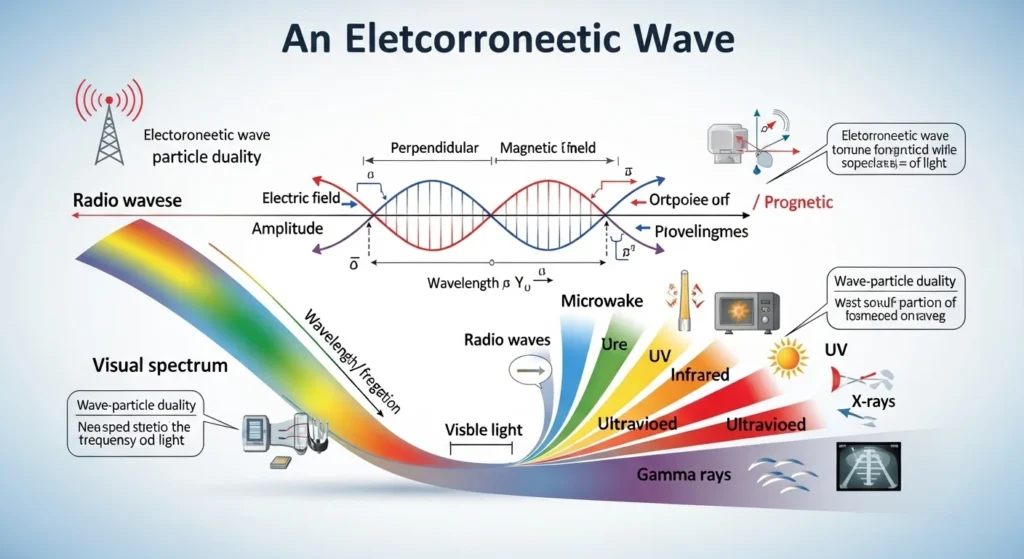
Electromagnetic waves are classified based on their frequency and wavelength. The entire range of these waves is called the electromagnetic spectrum.
Radio Waves
Radio waves have the longest wavelength and lowest frequency. They are widely used in communication systems.
Applications
- Radio broadcasting
- Television signals
- Wireless communication
Microwaves
Microwaves have shorter wavelengths compared to radio waves.
Applications
- Microwave ovens
- Radar systems
- Satellite communication
- Wi-Fi networks
Infrared Waves
Infrared waves are commonly associated with heat radiation.
Applications
- Remote controls
- Thermal imaging
- Night vision cameras
Visible Light
Visible light is the only part of the electromagnetic spectrum that human eyes can see.
Applications
- Lighting systems
- Optical devices
- Cameras
Ultraviolet Waves
Ultraviolet radiation has higher energy and shorter wavelength.
Applications
- Sterilization equipment
- Medical treatments
- Forensic analysis
X-Rays
X-rays have very high energy and can penetrate many materials.
Applications
- Medical imaging
- Airport security scanners
- Industrial inspection
Gamma Rays
Gamma rays are the most powerful electromagnetic waves.
Applications
- Cancer treatment
- Nuclear research
- Sterilization of medical equipment
5. Main Components of Electromagnetic Waves
Although electromagnetic waves are not physical objects, they consist of important elements that define their behavior.
Electric Field
The electric field is created by charged particles. It represents the force exerted on other charges in the surrounding space.
Magnetic Field
The magnetic field is generated by moving electric charges. It interacts with the electric field to form the electromagnetic wave.
Wavelength
Wavelength is the distance between two consecutive peaks of the wave.
Frequency
Frequency is the number of wave cycles passing a point in one second.
Propagation Direction
The direction in which the wave travels is perpendicular to both the electric and magnetic fields.
6. Advantages of Electromagnetic Waves
There are many Electromagnetic wave advantages and disadvantages, and understanding them helps engineers design better systems.
Advantages
- Electromagnetic waves can travel through empty space.
- They enable wireless communication.
- They can carry large amounts of data.
- They support modern technologies such as Wi-Fi, satellite communication, and mobile networks.
- They can travel long distances with minimal loss.
- They enable medical technologies like X-ray imaging.
These benefits make electromagnetic waves extremely important in modern electrical and communication engineering.
7. Disadvantages / Limitations
Despite their advantages, electromagnetic waves also have some limitations.
- High-frequency waves can be harmful to human health.
- Signal interference can affect communication systems.
- Some waves require expensive equipment to generate and detect.
- Environmental conditions can reduce signal strength.
- Certain frequencies require government regulation.
Understanding these limitations helps engineers design safer and more reliable systems.
8. Electromagnetic Wave Applications
The Electromagnetic wave applications are vast and impact almost every modern industry.
Communication Systems
- Radio broadcasting
- Television transmission
- Satellite communication
- Mobile networks
- Wireless internet
Medical Field
- X-ray imaging
- MRI systems
- Cancer radiation therapy
- Sterilization equipment
Industrial Applications
- Radar detection
- Remote sensing
- Quality inspection systems
- Wireless sensors
Home and Consumer Electronics
- Microwave ovens
- Remote controls
- Bluetooth devices
- Smart home technology
These applications show how electromagnetic waves play a critical role in modern technology.
9. Comparison Section
Difference Between Electromagnetic Waves and Mechanical Waves
| Feature | Electromagnetic Waves | Mechanical Waves |
|---|---|---|
| Medium Required | No medium required | Requires medium |
| Speed | Speed of light | Slower than light |
| Examples | Radio waves, X-rays | Sound waves |
| Energy Transfer | Electric and magnetic fields | Particle vibration |
Understanding the difference between electromagnetic wave and mechanical wave helps beginners clearly distinguish these two fundamental wave types.
10. Selection Guide
When designing systems that use electromagnetic waves, engineers must choose the appropriate frequency and wavelength.
Tips for Beginners
- Use radio waves for long-distance communication.
- Use microwaves for wireless networks and radar systems.
- Use infrared for short-range devices such as remote controls.
- Use X-rays for imaging applications.
Factors to consider include:
- Transmission distance
- Signal strength
- Environmental interference
- Safety requirements
- Equipment cost
Selecting the correct wave type ensures efficient system performance.
11. Common Problems & Solutions
Why does signal interference occur?
Electromagnetic signals can overlap with other signals operating at similar frequencies.
Solution:
Use proper frequency allocation and shielding.
Why do wireless signals weaken over distance?
Signal strength decreases as the wave spreads over a larger area.
Solution:
Use signal amplifiers or repeaters.
Why do some devices lose connection indoors?
Walls and obstacles absorb or reflect electromagnetic waves.
Solution:
Place antennas in open areas or use stronger transmitters.
12. Future Trends
Electromagnetic wave technology continues to evolve rapidly with advancements in electrical and communication engineering.
Emerging Developments
- 5G and future 6G networks
- Terahertz communication systems
- Advanced satellite communication
- Smart wireless sensors
- High-resolution radar systems
These innovations will significantly improve communication speed, data capacity, and global connectivity.
For engineers and students, understanding electromagnetic wave technology will remain essential as wireless technologies continue to grow.
13. Conclusion
Electromagnetic waves are one of the most important concepts in electrical engineering and modern technology. They allow energy and information to travel through space without the need for physical wires or cables.
In this article, we explored the Electromagnetic wave working principle, different types of electromagnetic waves, and their main components. We also discussed the Electromagnetic wave advantages and disadvantages, practical applications, and comparisons with mechanical waves.
From radio broadcasting and Wi-Fi networks to medical imaging and satellite communication, electromagnetic waves play a vital role in our daily lives. As technology continues to advance, their importance will only increase.
For electrical students, engineers, and technicians, mastering this topic provides a strong foundation for understanding communication systems, electronics, and modern electrical infrastructure.
Learning about electromagnetic waves not only improves theoretical knowledge but also helps engineers design better and more efficient technologies for the future.