
A few years ago, a young technician in a workshop tried to replace a faulty breaker without turning off the main supply. He believed it would “only take a minute.” The moment his screwdriver touched the terminal, a spark flashed, and he suffered a serious electric shock. The accident could have been avoided by following basic Electrical Safety Rules.
Electricity is powerful and useful, but it can also be dangerous. Every year, electrical accidents cause injuries, equipment damage, and even fires. Most of these incidents happen because safety procedures are ignored or misunderstood.
Understanding Electrical Safety Rules is not just for engineers. It is essential for students, technicians, electricians, and even homeowners. In this article, you will learn the Electrical Safety Rules working principle, types of safety measures, main components of protection systems, Electrical Safety Rules applications, advantages and disadvantages, and practical troubleshooting tips.
As a senior engineer, my advice is simple: safety is not optional. It is a professional responsibility.
2. What is Electrical Safety Rules?
Electrical Safety Rules are a set of guidelines and procedures designed to prevent electrical shock, fire, explosion, and equipment damage.
In simple words, they are instructions that tell us how to work safely around electricity.
These rules include turning off power before work, using proper tools, wearing protective equipment, and following correct wiring standards.
Practical Example:
Before repairing a motor, you isolate the power supply, lock the breaker, test for absence of voltage, and then start work. This process follows Electrical Safety Rules.
The main goal is to protect people, equipment, and property from electrical hazards.
3. Electrical Safety Rules Working Principle
To understand the Electrical Safety Rules working principle, we must first understand how electricity causes harm.
Electricity harms when:
- Current passes through the human body
- Heat builds up in wires
- Sparks ignite flammable materials
- Fault current damages equipment
Think of electricity like water in a pipeline. If controlled properly, it runs smoothly. If the pipe leaks or bursts, it causes damage.
Electrical safety works on three basic principles:
1. Isolation
- Disconnect power source
- Prevent accidental re-energizing
- Use lockout/tagout procedures
2. Protection
- Use insulation
- Install circuit breakers and fuses
- Provide grounding and earthing
3. Prevention
- Regular inspection
- Proper training
- Safe work practices
These steps reduce the risk of shock, overload, and short circuit hazards.
4. Types / Classification of Electrical Safety Rules
Electrical Safety Rules can be classified into different categories.
Personal Safety Rules
These rules focus on protecting the individual worker.
- Wear insulated gloves
- Use safety shoes
- Avoid wet hands
- Remove metal jewelry
- Stand on insulating mats
Equipment Safety Rules
These rules protect machines and devices.
- Proper grounding
- Correct cable sizing
- Use of protective relays
- Proper enclosure of live parts
Workplace Safety Rules
These apply to overall site management.
- Warning signs
- Clear labeling
- Emergency exits
- Fire extinguishers
High-Voltage Safety Rules
Extra precautions are required in high-voltage systems.
- Maintain safe distance
- Use insulated tools
- Follow permit-to-work system
Each category plays an important role in Electrical Safety Rules applications.
5. Main Components of Electrical Safety Systems
Electrical Safety Rules are supported by physical components.
1. Circuit Breaker
Automatically disconnects power during overload or short circuit.
Protects wiring and equipment.
2. Fuse
Melts when excessive current flows.
Simple and reliable protection device.
3. Earthing System
Provides a safe path for fault current.
Reduces shock risk.
4. Residual Current Device (RCD)
Detects leakage current.
Trips quickly to prevent electric shock.
5. Insulated Tools
Prevent accidental contact with live parts.
Each component supports Electrical Safety Rules working principle by reducing electrical hazards.
6. Electrical Safety Rules Advantages and Disadvantages
Advantages
- Prevents electric shock
- Reduces fire risk
- Protects equipment
- Increases workplace safety
- Improves system reliability
- Builds professional discipline
- Reduces downtime and repair cost
Disadvantages / Limitations
- Requires time and discipline
- Sometimes increases installation cost
- Workers may ignore rules due to overconfidence
- Poor maintenance reduces effectiveness
Despite some limitations, Electrical Safety Rules advantages and disadvantages clearly show that safety benefits always outweigh the drawbacks.
7. Applications
Electrical Safety Rules applications are seen everywhere.
Home Applications
- Proper wiring
- MCB installation
- Childproof sockets
- Earthing systems
Industrial Applications
- Lockout/tagout procedures
- Motor protection systems
- Arc flash protection
- Substation safety practices
Modern Technology Applications
- Solar power systems
- Electric vehicle charging stations
- Data centers
- Smart grids
Electrical safety is essential in both small homes and large power plants.
8. Comparison Section
Many students ask about the difference between electrical safety and electrical protection.
Here is a simple comparison:
| Feature | Electrical Safety Rules | Electrical Protection Devices |
| Focus | Human and system safety | Equipment protection |
| Nature | Guidelines and procedures | Physical devices |
| Example | Lockout/tagout | Circuit breaker |
| Control Method | Preventive actions | Automatic tripping |
| Goal | Avoid accidents | Limit damage |
This table explains the difference between electrical safety and electrical protection clearly.
9. Selection Guide – How to Implement Electrical Safety Rules
Choosing and applying safety rules depends on the environment.
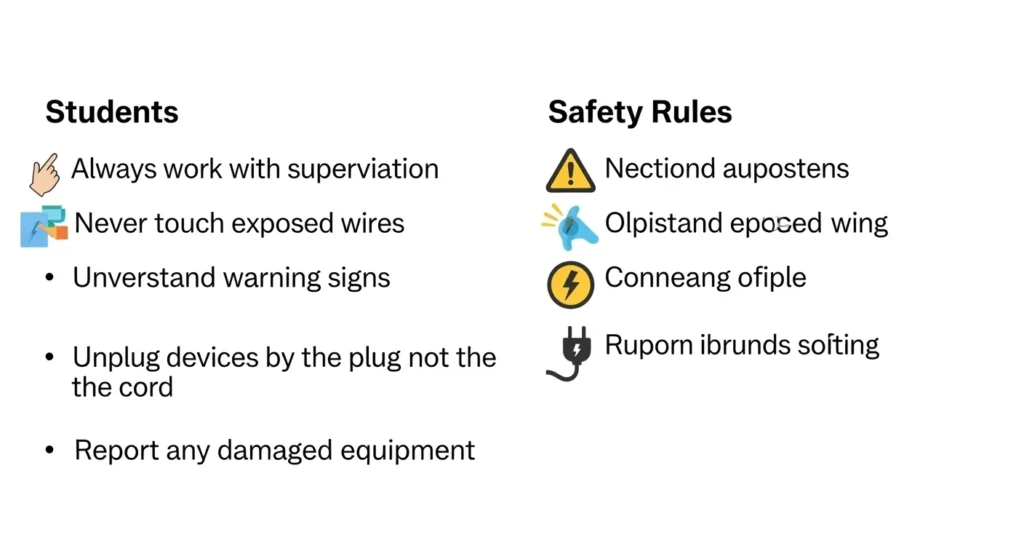
For Students and Beginners
- Always turn off supply before touching wires
- Use basic protective equipment
- Learn proper tool handling
- Never work alone in risky areas
For Technicians
- Follow lockout/tagout procedure
- Use proper rated breakers
- Check insulation regularly
- Keep panels clean and dry
For Engineers
- Perform risk assessment
- Calculate fault levels
- Ensure proper coordination of protective devices
- Follow national and international safety standards
Safety planning should always match the voltage level and system type.
10. Common Problems & Solutions (FAQs Style)
Q1: Why do electrical accidents still happen?
Because safety rules are ignored or workers are not trained properly.
Q2: Can low voltage also be dangerous?
Yes. Even 230V AC can cause fatal shock.
Q3: Why is earthing important?
It provides a safe path for fault current and reduces shock risk.
Q4: What is the most common mistake?
Working on live circuits without proper isolation.
Q5: How to reduce workplace electrical hazards?
- Regular inspection
- Safety training
- Proper labeling
- Use of PPE
Practical troubleshooting always starts with checking safety compliance.
11. Future Trends in Electrical Safety
Electrical safety is becoming smarter and more advanced.
Smart Circuit Breakers
Provide real-time monitoring and remote control.
Arc Flash Detection Systems
Detect dangerous arcs instantly and disconnect power.
IoT-Based Monitoring
Track equipment temperature and current remotely.
AI-Based Predictive Maintenance
Predict faults before accidents happen.
The future of Electrical Safety Rules applications lies in intelligent monitoring and automation.
12. Conclusion
Electrical Safety Rules are the foundation of safe electrical work. They protect human life, prevent fires, and reduce costly equipment damage. From simple home wiring to complex industrial power systems, safety practices must always come first.
We discussed the Electrical Safety Rules working principle, types, components, applications, and the difference between electrical safety and electrical protection. We also explored Electrical Safety Rules advantages and disadvantages to understand their practical impact.
As a junior engineer or technician, never underestimate electricity. Respect it, follow proper procedures, and use protective devices correctly. Safety is not just a rulebook — it is a mindset that defines a true professional.