
Imagine you enter a factory and see hundreds of machines running smoothly. Motors start on time, lights work properly, and safety systems respond instantly. Behind all this reliable operation is one important system — the electrical panel.
Electrical panel design is the backbone of any electrical installation. A poorly designed panel can cause overheating, equipment failure, electrical shock, or even fire. On the other hand, a well-designed panel ensures safety, efficiency, and long equipment life.
For electrical students, technicians, and junior engineers, understanding electrical panel design is essential. Whether you work on residential wiring or industrial automation, panels are everywhere.
In this article, you will learn: Electrical Panel Design ek aisa process hai jisme ek electrical panel ya distribution board ko is tarah design kiya jata hai ke woh surakshit, efficient aur functional ho. Panel ka main kaam electrical power ko distribute karna hai different loads mein, jaise lights, motors, aur machines, aur sath hi short circuit aur overload se protection provide karna. Design process mein sabse pehle load calculation ki jati hai, jisme yeh dekha jata hai ke har load kitna current consume karega aur total system capacity kitni honi chahiye.
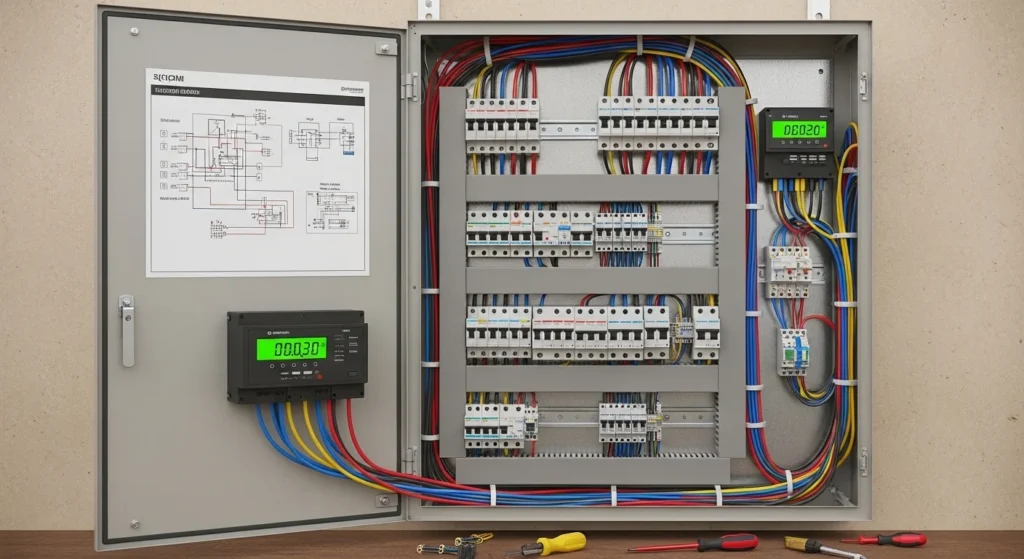
Panel design mein components ki proper selection bahut important hai. Isme MCB (Miniature Circuit Breaker), MCCB (Molded Case Circuit Breaker), fuses, busbars, relays, timers, aur meters shamil hote hain. Har component ka rating, type aur position carefully select kiya jata hai taki panel safe aur durable ho. Layout design mein wiring ka arrangement, phase separation, and easy maintenance ke liye spacing bhi consider ki jati hai. Panel enclosure ki rating bhi environment ke hisab se decide ki jati hai, jaise IP rating dust aur moisture protection ke liye.
Electrical panel design ka ek aur important aspect safety hai. Proper earthing aur insulation ka use karna essential hai. Panel ke andar components ko is tarah arrange kiya jata hai ke heat dissipation proper ho aur overloading se bachav ho. Advanced designs mein automation and control systems bhi integrate kiye jate hain jaise PLC, timers, aur sensors. Yeh modern panels ko efficient aur user-friendly banate hain. Achi panel design se energy efficiency bhi improve hoti hai aur maintenance ka process simple ho jata hai.
- What electrical panel design really means
- Electrical panel design working principle
- Types of electrical panels
- Main components and their functions
- Electrical panel design advantages and disadvantages
- Electrical panel design applications
- Selection tips, troubleshooting, and future trends
Let’s start from the basics and build your understanding step by step.
2. What is Electrical Panel Design?
Electrical Panel Design is the process of planning, arranging, selecting, and assembling electrical components inside a control cabinet or enclosure to safely distribute and control electrical power.
In simple words, it is the “brain and heart” of an electrical system.
Simple Explanation
Think of an electrical panel like a traffic control system. Electricity is like vehicles moving on roads. The panel controls:
- Where electricity goes
- How much current flows
- When to stop power
- How to protect equipment
Practical Example
In a house, the distribution board divides power into lighting, sockets, and AC circuits. In a factory, a motor control panel controls multiple motors with protection devices.
Both are results of proper electrical panel design.
3. Electrical Panel Design Working Principle
The electrical panel design working principle is based on safe power distribution, control, and protection.
Let’s understand it step by step.
Step 1: Power Input
Electricity enters the panel from:
- Utility supply
- Generator
- Transformer
This is connected to a main breaker.
Step 2: Protection
Before power goes further, it passes through protection devices such as:
- Circuit breakers
- Fuses
- Overload relays
These devices protect against:
- Overcurrent
- Short circuit
- Earth fault
Step 3: Distribution
The power is then distributed to different outgoing circuits through busbars and breakers.
Step 4: Control
Control components like:
- Contactors
- Relays
- PLCs
decide when equipment should start or stop.
Step 5: Monitoring
Meters and indicators measure:
- Voltage
- Current
- Power
- Frequency
In simple analogy, electrical panel design is like building a well-organized control room where every device has a proper place and function.
4. Types / Classification of Electrical Panels
Electrical panels can be classified based on application and function.
Distribution Panel (DP)
Used to distribute power to different circuits.
Common in homes and commercial buildings.
Motor Control Center (MCC)
Used in industries to control multiple motors.
Includes starters, overload protection, and contactors.
Power Control Center (PCC)
Handles large power distribution in factories.
Connected directly to transformers or generators.
PLC Control Panel
Used for automation systems.
Includes PLC, SMPS, relays, and communication modules.
Synchronization Panel
Used when two or more generators operate together.
Each type has a specific design requirement depending on load and safety standards.
5. Main Components of Electrical Panel
Understanding components is key to mastering electrical panel design.
1. Enclosure
- Metal cabinet
- Protects internal components
- Prevents dust and moisture entry
2. Circuit Breaker
- Protects against overcurrent
- Acts as main switch
3. Busbars
- Copper or aluminum strips
- Distribute power inside panel
4. Contactors
- Electrically controlled switches
- Used for motor control
5. Overload Relay
- Protects motor from overheating
6. Terminal Blocks
- Connect field wiring to panel
7. Meters and Indicators
- Show voltage and current
Each component must be properly sized and arranged.
6. Electrical Panel Design Advantages and Disadvantages
Advantages
- Improves electrical safety
- Prevents short circuits
- Easy fault detection
- Organized wiring system
- Better load management
- Professional and neat installation
Disadvantages / Limitations
- High initial cost
- Requires skilled design
- Needs proper maintenance
- Design errors can cause serious failures
Proper planning reduces most disadvantages.
7. Electrical Panel Design Applications
Electrical panel design applications are everywhere.
Home Use
- Distribution boards
- Solar control panels
Commercial Buildings
- Lighting control panels
- HVAC control panels
Industrial Applications
- Motor control centers
- Automation panels
- Power distribution panels
Modern Technology
- Renewable energy systems
- Data centers
- Smart building systems
From small houses to large factories, electrical panels are essential.
8. Comparison Section
Let us understand the difference between control panel and distribution panel.
| Feature | Control Panel | Distribution Panel |
|---|---|---|
| Main Function | Control equipment | Distribute power |
| Used For | Motors, automation | Lighting, sockets |
| Includes | PLC, relays, contactors | Breakers, busbars |
| Complexity | High | Medium |
This comparison helps beginners understand the difference between similar systems.
9. Selection Guide
Choosing the right electrical panel design depends on:
1. Load Calculation
- Total connected load
- Future expansion
2. Voltage Level
- Single-phase or three-phase
3. Short Circuit Rating
- Fault level of supply
4. Environment
- Indoor or outdoor
- Dusty or humid location
5. Safety Standards
- Proper earthing
- Correct IP rating
Always select components with 20–25% extra capacity for safety.
10. Common Problems & Solutions
Q1: Why does the panel overheat?
Possible reasons:
- Loose connections
- Overloading
- Poor ventilation
Solution: Tighten terminals and check load rating.
Q2: Why does breaker trip frequently?
- Short circuit
- Overload
- Faulty breaker
Check wiring and test load current.
Q3: Why is there voltage imbalance?
- Uneven load distribution
Balance loads across phases.
Q4: Why is wiring messy inside panel?
- Poor design planning
Always prepare wiring layout before installation.
11. Future Trends in Electrical Panel Design
Electrical panel design is evolving with technology.
Smart Panels
- Remote monitoring
- IoT integration
Energy Monitoring Systems
- Real-time power tracking
- Energy saving reports
Compact Modular Designs
- Space-saving layouts
- Plug-and-play components
Digital Protection Relays
- More accurate fault detection
- Communication with SCADA systems
The future is moving toward automation and intelligent panels.
12. Conclusion
Electrical panel design is not just about placing components inside a box. It is a systematic process of ensuring safety, reliability, and efficient power distribution.
From understanding the electrical panel design working principle to learning about electrical panel design applications, every student and engineer must develop strong fundamentals.
We also discussed electrical panel design advantages and disadvantages and the difference between control panel and distribution panel.
As a junior engineer, focus on load calculation, protection selection, and neat wiring practices. A well-designed panel reflects your professionalism and technical knowledge.
Keep learning, practice reading drawings, and observe real panels in the field. That is how you become confident in electrical panel design.