
Imagine rubbing a plastic comb on dry hair and then bringing it close to small pieces of paper. Suddenly, the tiny paper pieces jump toward the comb and stick to it. This simple everyday experiment demonstrates the power of electric charge, one of the most fundamental concepts in electrical science and engineering.
Electric charge is the basic property responsible for electricity, electric fields, and many modern electrical systems. Every electronic device—from smartphones and computers to power systems and communication equipment—relies on the movement and control of electric charges.
For electrical students, engineers, and technicians, understanding electric charge is essential because it forms the foundation of many electrical principles such as current, voltage, resistance, capacitance, and electromagnetic fields.
In this article, we will explore the Electric charge working principle, types of electric charge, and how charges behave in electrical systems. We will also examine Electric charge applications, discuss the Electric charge advantages and disadvantages, and explain how engineers use this concept in real-world technologies.
By the end of this guide, you will have a clear and practical understanding of electric charge explained in simple language, just as a senior electrical engineer would explain it to a beginner.
2. What is Electric Charge?
Electric charge is a fundamental physical property of matter that causes objects to experience electrical forces when placed in an electric field.
In simple terms, electric charge is the property that allows particles to attract or repel each other through electrical forces.
The unit of electric charge is the Coulomb (C).
Simple Explanation
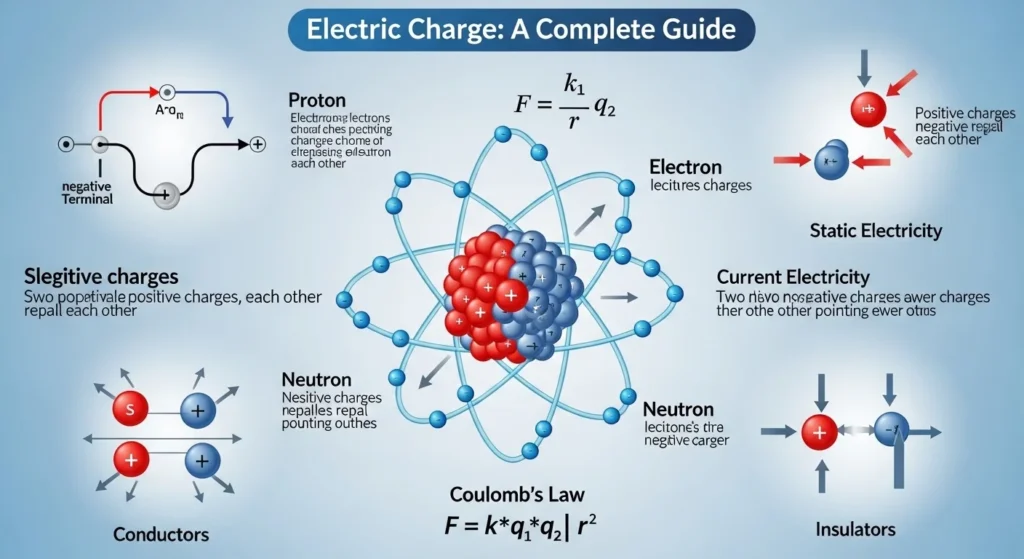
Atoms are made of three main particles:
- Protons (positive charge)
- Electrons (negative charge)
- Neutrons (neutral charge)
When the number of protons and electrons in an object becomes unbalanced, the object gains an electric charge.
Practical Example
If you rub a balloon against dry hair:
- Electrons move from hair to the balloon.
- The balloon becomes negatively charged.
- The hair becomes positively charged.
As a result, the balloon can attract lightweight objects such as paper or dust.
This simple example demonstrates how electric charge works in everyday life.
3. Electric Charge Working Principle
The Electric charge working principle is based on the interaction between charged particles.
Charged particles create electric fields around them. When another charged object enters this field, a force is produced between them.
Basic Rules of Electric Charge
There are two important rules:
- Like charges repel each other
- Opposite charges attract each other
Step-by-Step Explanation
- A material gains or loses electrons.
- This creates a positive or negative electric charge.
- The charged object generates an electric field around it.
- When another charged object enters the field, a force is produced.
- The objects either attract or repel each other depending on their charges.
Easy Analogy
Think of electric charges like magnets.
- Similar poles of magnets push away from each other.
- Opposite poles pull toward each other.
Electric charges behave in a very similar way.
4. Types / Classification of Electric Charge
Electric charge is mainly divided into two types.
Positive Charge
A positive charge occurs when an object loses electrons.
Since electrons carry negative charge, losing them leaves the object with more protons than electrons.
Example
- Glass rubbed with silk
- Human body losing electrons
Negative Charge
A negative charge occurs when an object gains extra electrons.
This means the object now has more electrons than protons.
Example
- Plastic rubbed with wool
- Balloon rubbed on hair
Neutral State
An object is electrically neutral when it has equal numbers of protons and electrons.
Most materials in nature exist in this neutral state.
5. Main Components of Electric Charge
Electric charge is related to several fundamental elements in physics and electrical engineering.
Electrons
Electrons carry negative electric charge and are responsible for electric current in conductors.
Protons
Protons carry positive electric charge and are located in the nucleus of atoms.
Electric Field
An electric field is the region around a charged object where electric force can be experienced.
Electric Force
Electric force is the interaction between charged objects.
Charge Quantity
The amount of electric charge is measured in Coulombs.
These components work together to produce electrical phenomena.
6. Electric Charge Advantages and Disadvantages
Understanding Electric charge advantages and disadvantages helps engineers design better electrical systems.
Advantages
- Enables the flow of electric current in circuits.
- Forms the basis of all electrical and electronic systems.
- Supports wireless communication technologies.
- Enables electrostatic applications in industries.
- Used in advanced technologies such as particle accelerators.
- Allows energy transfer in electrical systems.
These benefits make electric charge one of the most important concepts in electrical engineering.
7. Disadvantages / Limitations
Although electric charge is extremely useful, it also has some limitations.
- Static electric charge can damage sensitive electronic components.
- Electrostatic discharge may cause sparks and equipment damage.
- High electric charge levels can cause electrical hazards.
- Accumulated charge can interfere with electronic signals.
- Requires proper insulation and grounding.
Engineers must carefully control electric charge in electrical systems to avoid these problems.
8. Electric Charge Applications
The Electric charge applications are found in many modern technologies and industries.
Home Applications
- Photocopiers and laser printers
- Static dust removal devices
- Capacitors in electronic circuits
- Television and display technology
Industrial Applications
- Electrostatic painting systems
- Air purification systems
- Electrostatic precipitators in factories
- Material separation processes
Modern Technology Applications
- Semiconductor devices
- Computer processors
- Integrated circuits
- Wireless communication equipment
These technologies rely on the control and movement of electric charge.
9. Comparison Section
Difference Between Electric Charge and Electric Current
| Feature | Electric Charge | Electric Current |
|---|---|---|
| Definition | Property of particles | Flow of electric charge |
| Unit | Coulomb | Ampere |
| Nature | Static or stored | Moving charge |
| Example | Charged balloon | Current in wire |
Understanding the difference between electric charge and electric current helps beginners clearly understand electrical circuits and systems.
10. Selection Guide
In practical engineering applications, controlling electric charge requires proper system design.
Tips for Beginners
When working with electrical systems:
- Use proper grounding to remove excess charge.
- Choose correct insulation materials.
- Use ESD protection devices for sensitive electronics.
- Select appropriate conductors and semiconductors.
Factors to consider include:
- Charge capacity
- Material conductivity
- Environmental conditions
- Safety standards
Proper charge control improves system reliability and safety.
11. Common Problems & Solutions
Why does static electricity occur?
Static electricity occurs when electrons transfer between materials due to friction.
Solution:
Use anti-static materials and grounding systems.
Why do electronic components get damaged by static charge?
Sensitive semiconductor devices can be destroyed by sudden electrostatic discharge.
Solution:
Use ESD protection equipment and grounding straps.
Why do dust particles stick to surfaces?
Charged surfaces attract small particles due to electrostatic forces.
Solution:
Use anti-static cleaning methods.
12. Future Trends
Electric charge research continues to play a major role in modern electrical engineering.
Emerging Technologies
- Nanoelectronics
- Quantum computing
- Advanced semiconductor devices
- High-efficiency energy storage
- Smart electronic sensors
These technologies rely on precise control of electric charge at microscopic and atomic levels.
As electrical engineering evolves, understanding electric charge will remain fundamental for innovation and technological advancement.
13. Conclusion
Electric charge is one of the most fundamental concepts in electrical science and engineering. It explains how electrical forces occur, how current flows, and how many electronic systems operate.
In this guide, we explored the Electric charge working principle, types of electric charge, and the main components involved in electrical interactions. We also discussed Electric charge advantages and disadvantages, real-world applications, and comparisons with electric current.
From simple static electricity experiments to advanced semiconductor devices, electric charge plays a vital role in modern technology. Engineers use this principle to design circuits, communication systems, and electrical equipment used around the world.
For electrical students and beginners, mastering the concept of electric charge provides a strong foundation for understanding more advanced topics in electronics, electromagnetism, and power engineering.