
Imagine driving a car or operating an industrial machine. When the engine or motor produces power, that power must be transferred to another component to perform useful work. For example, in a vehicle, the engine generates rotational energy that must reach the wheels to move the car. The component responsible for transferring this power is called the drive shaft.
A drive shaft is a critical mechanical component used in many machines, including vehicles, electric motors, industrial equipment, and power transmission systems. It plays a vital role in transferring rotational motion and torque from one part of a machine to another.
For electrical students, engineers, technicians, and beginners, understanding the drive shaft working principle is important because many electrical machines rely on rotating shafts to deliver mechanical power. Motors, pumps, compressors, and generators often use drive shafts to connect rotating components.
In this article, you will learn what a drive shaft is, how the drive shaft working principle operates, and the different types used in modern machines. We will also explore drive shaft applications, its advantages and disadvantages, important components, troubleshooting tips, and how to select the right drive shaft for a machine.
What is a Drive Shaft?
A drive shaft is a mechanical component that transmits rotational power and torque from a power source, such as an engine or motor, to another part of a machine.
It is usually a long cylindrical shaft made of strong materials like steel or aluminum. The drive shaft rotates and transfers mechanical energy between components.
Simple Explanation
In simple terms, the drive shaft acts like a power bridge between two machine parts. It connects the power source to the driven equipment and allows rotational energy to move efficiently.
Practical Example
In a car, the engine produces power. That power is transferred through the transmission system and then through the drive shaft to the wheels. Without the drive shaft, the wheels would not receive the power needed to move the vehicle.
Similarly, in industrial machines, drive shafts transfer power from electric motors to pumps, compressors, or conveyors.
Drive Shaft Working Principle
The drive shaft working principle is based on the transmission of rotational motion and torque from one component to another.
When the motor or engine rotates, the drive shaft rotates as well, transferring mechanical power along its length.
Step-by-Step Operation
- The motor or engine generates rotational power.
- The drive shaft is connected to the power source through a coupling or transmission system.
- As the power source rotates, the drive shaft also rotates.
- The shaft transfers torque to the connected machine component.
- The receiving component performs useful work, such as moving wheels or operating machinery.
Simple Analogy
Think of the drive shaft like a rotating stick connecting two wheels. When one wheel turns, the stick rotates and forces the second wheel to turn as well. This is similar to how a drive shaft transfers power.
Types / Classification of Drive Shafts
Drive shafts come in different designs depending on machine requirements.
Single Piece Drive Shaft
A single piece drive shaft is a continuous shaft without joints or separations.
Features:
- Simple design
- High strength
- Used in small machines and short power transmission systems
Two-Piece Drive Shaft
A two-piece drive shaft consists of two sections connected by a center support bearing.
Features:
- Suitable for long transmission systems
- Reduces vibration
- Common in large vehicles
Slip-In-Tube Drive Shaft
This type of shaft allows slight length adjustments during operation.
Features:
- Allows movement during suspension changes
- Common in vehicles
Constant Velocity Drive Shaft
This shaft uses constant velocity joints to maintain smooth power transmission even at different angles.
Features:
- Smooth rotation
- Reduced vibration
- Common in modern vehicles
Main Components of a Drive Shaft
A drive shaft system includes several components that work together to transfer power.
Shaft Tube
The shaft tube is the main cylindrical part of the drive shaft.
Function:
- Transfers rotational torque
- Connects the power source to the driven component
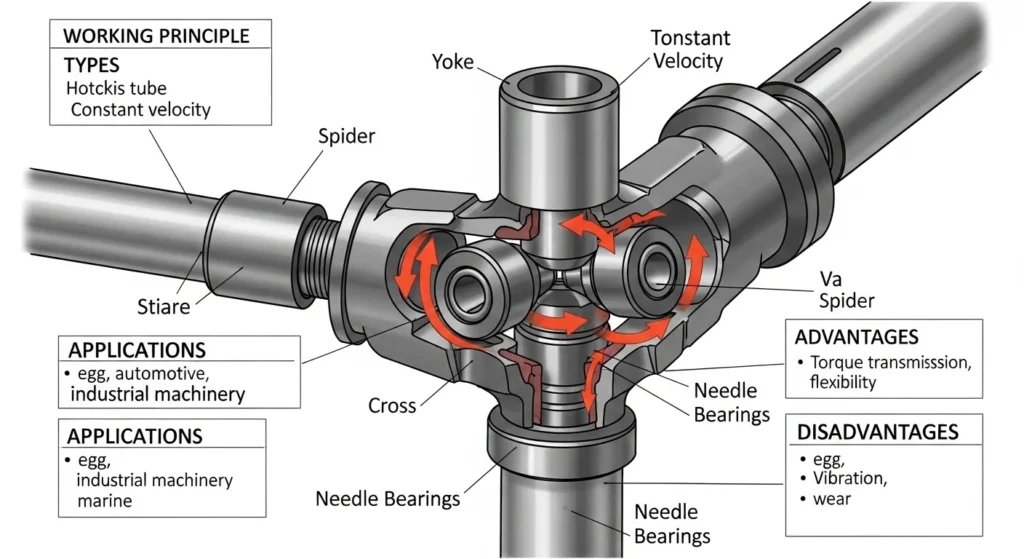
Universal Joints
Universal joints allow the drive shaft to operate at different angles.
Function:
- Maintain rotation even when shafts are misaligned
- Provide flexibility in power transmission
Slip Yoke
The slip yoke allows the drive shaft to adjust its length.
Function:
- Compensates for movement during operation
- Maintains smooth power transfer
Flange Yoke
Flange yokes connect the drive shaft to other components.
Function:
- Securely attach the shaft to the transmission or differential
Center Support Bearing
Used in longer drive shafts.
Function:
- Supports the shaft in the middle
- Reduces vibration and shaft bending
Advantages of Drive Shaft
Drive shafts offer several benefits in mechanical and electrical systems.
Drive shaft advantages include:
- Efficient power transmission
- Simple mechanical design
- High strength and durability
- Capable of transmitting high torque
- Reliable operation in heavy machines
- Suitable for long-distance power transmission
These advantages make drive shafts widely used in vehicles and industrial machines.
Disadvantages / Limitations
Like all mechanical components, drive shafts also have limitations.
Drive shaft advantages and disadvantages must be considered during machine design.
Drive Shaft Disadvantages
- Requires precise alignment
- May produce vibration at high speed
- Needs regular lubrication and maintenance
- Heavy in large applications
- Failure may cause machine damage
Proper installation and maintenance are essential for reliable operation.
Drive Shaft Applications
Drive shafts are used in many machines and industries.
Home Applications
Drive shafts are found in:
- Washing machines
- Power tools
- Lawn equipment
They transfer power from motors to rotating components.
Industrial Applications
In industrial systems, drive shafts are used in:
- Conveyor systems
- Pumps and compressors
- Industrial machinery
- Electric motor-driven equipment
They help deliver power efficiently across machines.
Modern Technology Applications
Modern technology also uses drive shafts in:
- Electric vehicles
- Robotics systems
- Aerospace equipment
- Wind turbine systems
These drive shaft applications demonstrate their importance in modern engineering.
Comparison Section
Difference Between Drive Shaft and Axle
| Feature | Drive Shaft | Axle |
|---|---|---|
| Function | Transfers rotational power | Supports wheels |
| Motion | Rotates continuously | May rotate or remain fixed |
| Application | Power transmission | Wheel support and load carrying |
| Location | Between transmission and machine | Connected to wheels |
Understanding the difference between drive shaft and axle helps engineers design efficient mechanical systems.
Selection Guide
Choosing the correct drive shaft is important for machine performance.
Factors to Consider
- Torque capacity
- Shaft length
- Rotational speed
- Operating environment
- Material strength
Tips for Beginners
- Choose shafts designed for expected loads.
- Ensure proper alignment during installation.
- Select high-quality materials for durability.
- Check vibration and balancing requirements.
Proper selection improves efficiency and reliability.
Common Problems & Solutions
Why does a drive shaft vibrate?
Vibration may occur due to imbalance or misalignment.
Solution:
- Check shaft balance
- Inspect alignment of connected components
Why does the drive shaft make noise?
Noise may occur due to worn universal joints or bearings.
Solution:
- Replace worn components
- Lubricate moving parts
Why does the drive shaft fail?
Failure may occur due to excessive load or material fatigue.
Solution:
- Inspect shaft regularly
- Replace damaged parts immediately
Why does power transmission become inefficient?
This may occur due to worn couplings or damaged joints.
Solution:
- Inspect couplings and joints
- Replace worn components
Future Trends
Drive shaft technology continues to evolve with modern engineering.
Lightweight Materials
New materials such as carbon fiber reduce weight and improve efficiency.
High-Strength Alloys
Advanced alloys increase durability and torque capacity.
Smart Monitoring Systems
Sensors can monitor vibration and temperature to predict failure.
Electric Vehicle Integration
Modern electric vehicles use improved drive shaft designs for efficient power transfer.
These innovations will improve performance and reliability in future machines.
Conclusion
The drive shaft is a vital component in mechanical and electrical systems. It transfers rotational power from a motor or engine to another machine component, allowing useful work to be performed. Without drive shafts, many machines—including vehicles, industrial equipment, and power systems—would not function properly.
In this article, we explored what a drive shaft is, the drive shaft working principle, and the different types used in machines. We also discussed drive shaft advantages and disadvantages, important components, and common drive shaft applications in homes, industries, and advanced technologies.
For electrical students, engineers, and technicians, understanding power transmission systems like drive shafts is essential. Proper selection, installation, and maintenance of drive shafts can significantly improve machine efficiency, reliability, and lifespan.
As technology continues to develop, new materials and smart monitoring systems will further enhance drive shaft performance in modern engineering applications.