
Imagine an electrician repairing a wall switch in a house. Before touching the wires, the electrician must confirm whether electricity is present in the circuit. Even if the breaker appears to be off, there may still be voltage in the wire due to wiring mistakes or shared circuits. In such situations, a Circuit Tester becomes an essential safety tool.
A circuit tester is one of the simplest yet most important electrical tools used by electricians, technicians, and engineers. It helps detect whether electrical voltage is present in a wire, outlet, or electrical device. Without proper testing, working on electrical systems can be extremely dangerous.
For electrical students and beginners, learning how to use a circuit tester is one of the first practical skills in electrical work. It helps prevent electric shocks, equipment damage, and wiring errors.
In this article, you will learn the Circuit Tester working principle, different types of testers, main components, and Circuit Tester applications in homes and industries. We will also discuss the Circuit Tester advantages and disadvantages, comparison with other tools, and tips for choosing the right tester.
What is a Circuit Tester?
A Circuit Tester is a small electrical testing tool used to check whether electrical voltage or current is present in a circuit.
Clear Definition
A circuit tester is a device that detects electrical voltage in wires, sockets, switches, and electrical equipment to determine whether the circuit is live or not.
Simple Explanation
The tester is usually placed in contact with a wire or electrical terminal. If electricity is present, the tester shows an indication using a light, LED, or digital display.
Practical Example
For example, when installing a ceiling fan, an electrician may touch the tester to the wire connected to the switch. If the tester lights up, it indicates that voltage is present in the wire.
This quick check helps ensure safety before working on the circuit.
Circuit Tester Working Principle
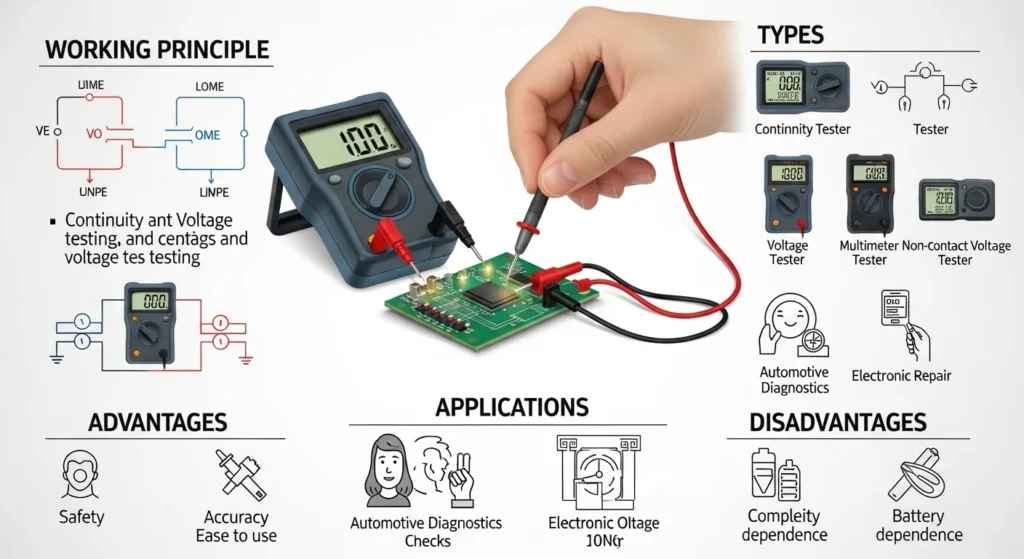
The Circuit Tester working principle is based on detecting electrical voltage or current flowing through a conductor.
When the tester touches a live wire, electricity flows through the tester circuit and activates an indicator such as a light or LED.
Step-by-Step Working Process
- Contact with Electrical Point
- The tester tip touches a wire, socket, or electrical terminal.
- Voltage Detection
- If voltage is present, electrical energy enters the tester.
- Internal Circuit Activation
- The tester’s internal components detect the electrical signal.
- Indicator Activation
- A bulb, LED, or display turns on.
- User Confirmation
- The user knows the circuit is live.
Simple Analogy
Think of a circuit tester like a doorbell. When you press the doorbell button, electricity flows and the bell rings. Similarly, when voltage enters the tester, it activates the indicator.
Types of Circuit Tester
Circuit testers come in different types depending on their design and application.
Neon Circuit Tester
This is one of the most common types used by electricians.
Features:
- Uses a small neon bulb
- Lights up when voltage is present
- Simple and inexpensive
This tester is widely used for household wiring.
Test Lamp Circuit Tester
A test lamp tester uses a small bulb connected to two wires.
Features:
- One wire connects to the live terminal
- The other connects to neutral or ground
- The lamp lights up if voltage exists
It is commonly used in basic electrical testing.
Non-Contact Voltage Tester
This modern tester detects voltage without touching the wire directly.
Features:
- Uses electromagnetic field detection
- Safer than traditional testers
- Quick and easy to use
Electricians often use it for quick safety checks.
Digital Circuit Tester
Digital testers are advanced testing devices.
Features:
- Digital display
- High accuracy
- Multiple testing functions
They are commonly used by engineers and technicians.
Screwdriver-Type Circuit Tester
This is the most widely used tester in homes.
Features:
- Looks like a screwdriver
- Has a neon lamp inside
- Easy to carry
It is commonly used to check sockets and switches.
Main Components of a Circuit Tester
Although circuit testers are simple tools, they contain several important components.
Test Probe Tip
The metal tip that touches the wire or terminal.
Function:
- Detects electrical voltage from the circuit.
Indicator Lamp or LED
The light indicator inside the tester.
Function:
- Shows the presence of electricity.
Internal Resistor
A resistor is placed inside the tester.
Function:
- Limits current flow to protect the user and device.
Transparent Body
Most testers have a transparent plastic body.
Function:
- Allows the user to see the indicator light.
Finger Contact Plate
Located at the top of screwdriver testers.
Function:
- Completes the circuit when the user touches it.
Circuit Tester Advantages
Understanding the Circuit Tester advantages and disadvantages helps users use the tool effectively.
Advantages
- Simple and easy to use
- Very affordable tool
- Portable and lightweight
- Quick voltage detection
- Improves electrical safety
- Requires no complicated setup
Real-World Benefits
Electricians use circuit testers daily because they provide a fast and reliable way to check live wires.
Circuit Tester Disadvantages / Limitations
Despite its usefulness, circuit testers have some limitations.
Limitations
- Basic testers cannot measure voltage levels
- Some testers cannot detect low voltage
- Requires user contact in certain models
- Limited testing capabilities compared to multimeters
These limitations mean that more advanced tools are sometimes required.
Circuit Tester Applications
There are many Circuit Tester applications in electrical work.
Home Electrical Maintenance
Used for checking:
- Wall sockets
- Switchboards
- Extension cords
Electrical Installations
Electricians use circuit testers during wiring installation.
Industrial Electrical Systems
Technicians use testers to check control panels and power circuits.
Appliance Repair
Circuit testers help identify live wires inside appliances.
Safety Testing
Before repairing equipment, technicians use testers to confirm that power is disconnected.
Comparison: Circuit Tester vs Multimeter
Understanding the difference between circuit tester and multimeter is important for beginners.
| Feature | Circuit Tester | Multimeter |
|---|---|---|
| Main Function | Detects voltage presence | Measures voltage, current, resistance |
| Complexity | Very simple | More advanced |
| Cost | Low | Higher |
| Accuracy | Basic detection | High accuracy |
| Applications | Quick safety check | Detailed electrical measurement |
Key Difference
The main difference between circuit tester and multimeter is that a tester only detects voltage presence, while a multimeter measures electrical values.
Selection Guide
Choosing the right circuit tester depends on your work needs.
Important Factors
Safety Rating
Always select testers designed for electrical work.
Type of Tester
Choose between contact or non-contact testers.
Build Quality
Durable testers last longer and provide better reliability.
Application
Select the tester suitable for home, industrial, or electronic work.
Tips for Beginners
- Start with a simple screwdriver tester.
- Always test the tester on a known live circuit first.
- Follow electrical safety practices.
Common Problems and Solutions
Why does the circuit tester not light up?
Possible reasons:
- No voltage present
- Faulty tester
- Loose contact
Solution: Test the tester on another live circuit.
Why does the tester give false readings?
Sometimes electromagnetic interference causes incorrect detection.
Solution: Use a reliable tester and confirm with another device.
Why is the tester bulb not working?
The internal neon bulb may be damaged.
Solution: Replace the tester.
Why does the tester work intermittently?
Poor contact with the electrical terminal can cause inconsistent readings.
Solution: Ensure proper contact with the wire.
Future Trends in Circuit Tester Technology
Electrical testing tools are evolving with modern technology.
Smart Voltage Testers
Advanced testers now include digital displays and smart detection systems.
Wireless Detection Tools
Some modern testers can detect electrical fields without direct contact.
Integrated Safety Features
New testers include insulation protection and overload safety.
Multi-Function Testers
Modern devices combine circuit testing with multimeter functions.
Conclusion
A Circuit Tester is a simple yet extremely important electrical tool used to detect the presence of voltage in electrical circuits. It helps electricians, technicians, and engineers ensure safety before performing electrical work.
Understanding the Circuit Tester working principle, types, and Circuit Tester applications is essential for anyone working with electrical systems. From household wiring checks to industrial maintenance, circuit testers provide quick and reliable voltage detection.
Although circuit testers have limitations compared to advanced measuring instruments, their simplicity, affordability, and portability make them an essential part of every electrician’s toolkit.
For beginners in electrical engineering or technical training, learning to properly use a circuit tester is a fundamental step toward safe and professional electrical practice.