
Imagine entering a large shopping mall on a hot summer afternoon. Outside, the temperature is above 40°C, but inside the building the air feels cool, fresh, and comfortable. This comfort is usually created by a Central Air Conditioner system. Unlike small room air conditioners, a central air conditioning system can cool an entire building through a network of ducts and vents.
Central air conditioning has become essential in homes, offices, hospitals, and commercial buildings. It improves comfort, increases productivity, and maintains controlled indoor environments. For engineers and technicians, understanding how these systems work is very important because central AC systems involve electrical components, refrigeration systems, and airflow control.
In this article, we will explore the Central Air Conditioner working principle, its types, main components, advantages, disadvantages, and real-world applications. The goal is to explain the topic in simple language so that electrical students, engineers, technicians, and beginners can clearly understand how a central air conditioning system operates and how to select the right system.
What is a Central Air Conditioner?
A Central Air Conditioner is a cooling system designed to regulate the temperature of an entire building from a central location. Instead of installing separate air conditioners in each room, a central AC cools the air in one place and distributes it through ducts to multiple rooms.
In simple terms, a central air conditioner removes heat from indoor air and replaces it with cooler air. The system typically consists of an outdoor unit, an indoor unit, ducts, and vents that distribute the cooled air.
Simple Example
Consider a large office building with multiple rooms and floors. Installing separate air conditioners in every room would consume more energy and space. A central air conditioner solves this problem by cooling air in one central system and delivering it to all rooms using ducts.
Because of this design, central air conditioners are commonly used in large houses, malls, hospitals, and office buildings.
Central Air Conditioner Working Principle
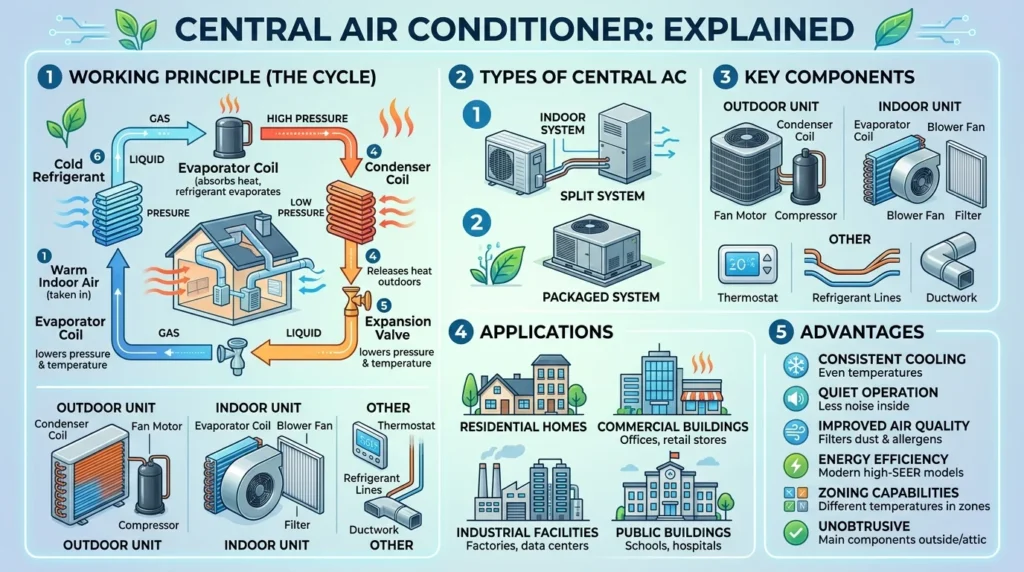
The Central Air Conditioner working principle is based on the refrigeration cycle, which removes heat from indoor air and transfers it outside.
You can think of it like a heat pump that moves heat from inside a building to the outdoor environment.
Step-by-Step Working Process
- Warm Air Intake
- Warm air from the building is drawn into the system through return ducts.
- The air passes through a filter to remove dust and particles.
- Cooling in the Evaporator Coil
- The indoor unit contains an evaporator coil filled with refrigerant.
- The refrigerant absorbs heat from the air, making the air cooler.
- Compressor Operation
- The heated refrigerant moves to the compressor.
- The compressor increases refrigerant pressure and temperature.
- Heat Release in Condenser
- The hot refrigerant moves to the outdoor condenser coil.
- The condenser releases heat into the outside air.
- Expansion Process
- The refrigerant passes through an expansion valve.
- Pressure drops and the refrigerant becomes cold again.
- Air Distribution
- A blower fan pushes the cooled air through ducts.
- The air is distributed to different rooms through vents.
This cycle repeats continuously until the room reaches the desired temperature.
Types / Classification of Central Air Conditioner
Central air conditioning systems are classified based on their design and cooling method.
Split Central Air Conditioner
This system has two main units:
- Indoor unit (evaporator coil and blower)
- Outdoor unit (compressor and condenser)
The two units are connected through refrigerant pipes.
Common Uses
- Residential homes
- Small offices
- Apartments
Packaged Central Air Conditioner
In this type, all components are installed in a single outdoor cabinet. The cooled air is delivered through ducts into the building.
Common Uses
- Hotels
- Small commercial buildings
- Shopping centers
Chilled Water Central AC System
Large buildings often use a chilled water system. Water is cooled in a chiller plant and circulated through pipes to air handling units.
Common Uses
- Airports
- Hospitals
- Large commercial complexes
Main Components of Central Air Conditioner
A central air conditioner contains several important components. Each component performs a specific function.
Compressor
The compressor is the heart of the system. It compresses the refrigerant gas, increasing its pressure and temperature.
Condenser Coil
The condenser releases heat from the refrigerant into the outside environment.
Evaporator Coil
This coil absorbs heat from indoor air. As a result, the air becomes cooler.
Expansion Valve
The expansion valve controls refrigerant flow and reduces its pressure before entering the evaporator.
Blower Fan
The blower circulates air through ducts and distributes cooled air across the building.
Duct System
Ducts carry cooled air from the central system to different rooms.
Thermostat
The thermostat controls the temperature by turning the system on or off automatically.
Central Air Conditioner Advantages and Disadvantages
Understanding the Central Air Conditioner advantages and disadvantages helps engineers and technicians evaluate system performance.
Advantages
- Provides uniform cooling across the entire building
- Quiet operation compared to multiple room AC units
- Improves indoor air quality with filtration
- Higher energy efficiency for large spaces
- Increases comfort and productivity
- Enhances property value
Disadvantages / Limitations
- High installation cost
- Requires duct system installation
- Maintenance can be complex
- Energy consumption can be high in large buildings
- System failure affects the entire building
Central Air Conditioner Applications
Central AC systems are widely used in different environments.
Residential Applications
- Large houses
- Luxury apartments
- Villas
Commercial Applications
- Shopping malls
- Office buildings
- Hotels
Industrial Applications
- Factories
- Data centers
- Manufacturing plants
Modern Technology Uses
- Hospitals and laboratories
- Airports and railway stations
- Smart buildings
These Central Air Conditioner applications show why the system is essential for modern infrastructure.
Comparison Section
Many people ask about the difference between central air conditioner and split air conditioner.
| Feature | Central Air Conditioner | Split Air Conditioner |
|---|---|---|
| Cooling Area | Entire building | Single room |
| Installation Cost | High | Moderate |
| Energy Efficiency | Better for large spaces | Better for small rooms |
| Maintenance | Complex | Easy |
| Noise Level | Quiet indoors | Slight indoor noise |
This comparison helps users choose the right cooling system.
Selection Guide
Choosing the right central air conditioner requires careful consideration.
Cooling Capacity
Measure building size and heat load before selecting the system.
Energy Efficiency
Choose systems with high energy efficiency ratings to reduce electricity costs.
Installation Space
Ensure proper space for outdoor units, ducts, and ventilation.
Maintenance Support
Select systems with easy access to service and spare parts.
Climate Conditions
Consider local temperature and humidity levels.
For beginners, consulting an HVAC engineer before installation is highly recommended.
Common Problems & Solutions
Central air conditioners may face technical issues. Here are some common problems and solutions.
Why is the AC not cooling properly?
Possible causes:
- Dirty air filters
- Low refrigerant level
- Blocked condenser coil
Solution: Clean filters and check refrigerant levels.
Why is airflow weak?
Possible causes:
- Blocked ducts
- Faulty blower fan
Solution: Inspect duct system and repair the fan.
Why is the system making noise?
Possible causes:
- Loose components
- Compressor issues
Solution: Tighten components and inspect compressor.
Why is electricity consumption high?
Possible causes:
- Poor insulation
- Old equipment
- Improper thermostat settings
Solution: Improve insulation and upgrade system efficiency.
Regular maintenance can prevent most problems.
Future Trends
Central air conditioning technology is continuously evolving.
Smart HVAC Systems
Smart thermostats and automation allow remote control and energy optimization.
Inverter Technology
Inverter compressors adjust speed according to cooling demand, improving efficiency.
Eco-Friendly Refrigerants
New refrigerants reduce environmental impact and improve system performance.
Energy Efficient Buildings
Modern buildings integrate central AC with renewable energy systems.
These innovations will shape the future of cooling systems.
Conclusion
A Central Air Conditioner is one of the most effective cooling solutions for large buildings. Instead of cooling individual rooms separately, the system cools air at a central location and distributes it through ducts to multiple areas. This approach ensures consistent temperature control, improved comfort, and efficient cooling performance.
Understanding the Central Air Conditioner working principle, components, and system types is important for electrical students, technicians, and engineers. Knowledge of system advantages, limitations, and maintenance practices helps in designing and operating efficient HVAC systems.
As technology advances, central air conditioning systems are becoming smarter, more energy-efficient, and environmentally friendly. Engineers who understand these systems today will play an important role in designing the sustainable buildings of tomorrow.
Learning the fundamentals of central air conditioning is therefore an important step for anyone interested in electrical engineering, HVAC technology, or building infrastructure.