
Imagine you switch on a ceiling fan and it starts smoothly without jerking. Or think about your mobile charger that provides steady DC output without fluctuation. Behind these smooth operations, there is a small but powerful component working silently — the capacitor.
As an electrical student or technician, understanding what is a capacitor is very important. Capacitors are used in almost every electronic and electrical circuit. From power supplies and motor starters to audio systems and communication equipment, capacitors play a key role.
In this article, I will explain the capacitor working principle in simple language. You will learn about its types, capacitor applications, and capacitor advantages and disadvantages. We will also discuss the difference between capacitor and inductor, selection guidelines, troubleshooting tips, and future trends.
Think of this as a foundation lesson that every electrical professional must clearly understand.
What is a Capacitor?
Clear Definition
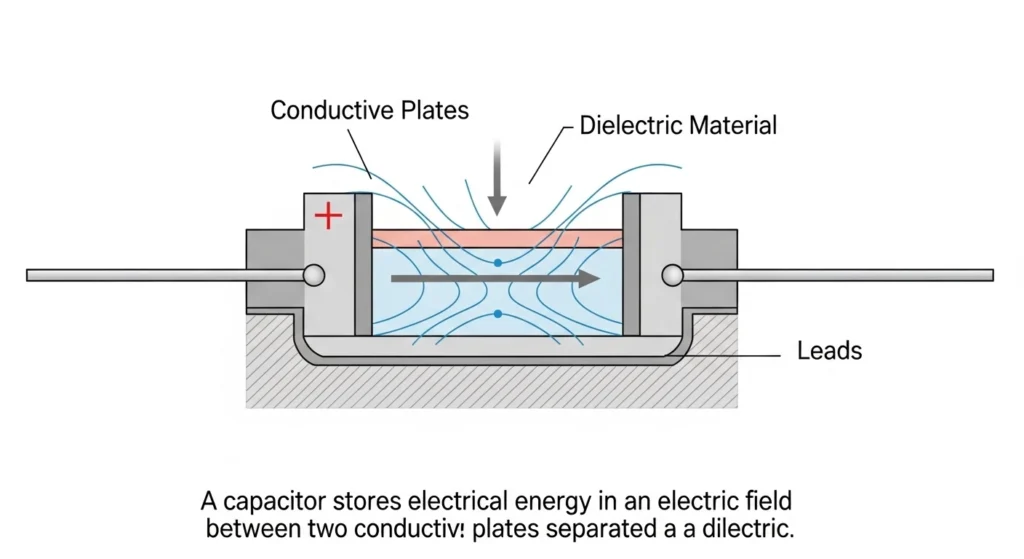
A capacitor is an electrical component that stores electrical energy in the form of an electric field.
In simple words, a capacitor temporarily stores charge and releases it when needed.
Simple Explanation
A capacitor does not generate electricity. It only stores energy for a short time and then gives it back to the circuit.
It consists of:
- Two metal plates
- An insulating material between them (called dielectric)
When voltage is applied, electric charge builds up on the plates.
Practical Example
When you turn on a fan, the capacitor helps create a phase difference that starts the motor.
In mobile chargers, capacitors smooth out voltage fluctuations.
Capacitor Working Principle
Understanding the capacitor working principle is simple if we break it into steps.
Step 1: Apply Voltage
- Connect capacitor to a power source.
- One plate becomes positive.
- The other plate becomes negative.
Step 2: Charge Storage
- Electrons accumulate on the negative plate.
- Positive charge builds on the other plate.
- An electric field forms between the plates.
Energy is stored in this electric field.
Step 3: Fully Charged Condition
- After some time, capacitor becomes fully charged.
- Current flow stops in DC circuit.
- It behaves like an open circuit in steady DC.
Step 4: Discharging
- When connected to a load, stored energy flows back.
- Capacitor releases charge.
- Voltage gradually drops.
Easy Analogy
Imagine a water tank:
- Filling tank = charging capacitor.
- Stored water = stored energy.
- Opening valve = discharging capacitor.
This simple analogy explains the capacitor working principle clearly.
Types / Classification
Capacitors are classified based on construction and application.
Ceramic Capacitor
- Small size.
- Used in high-frequency circuits.
- Non-polarized.
- Common in electronic boards.
Electrolytic Capacitor
- Large capacitance value.
- Polarized (has positive and negative terminal).
- Used in power supplies.
Film Capacitor
- Stable and reliable.
- Used in audio and signal circuits.
- Non-polarized.
Tantalum Capacitor
- Small size with high capacitance.
- Sensitive to overvoltage.
- Used in compact electronics.
Variable Capacitor
- Capacitance can be adjusted.
- Used in tuning circuits like radios.
Each type has specific uses depending on circuit requirements.
Main Components of a Capacitor
A capacitor mainly consists of:
1. Conducting Plates
- Two metal plates.
- Store electric charge.
- Usually made of aluminum or other conductive material.
2. Dielectric Material
- Insulating material between plates.
- Examples: air, ceramic, paper, plastic.
- Determines capacitance value.
3. Terminals
- Provide connection to circuit.
- In polarized capacitors, polarity must be correct.
Each part plays a role in energy storage and performance.
Capacitor Advantages
Let us clearly understand capacitor advantages and disadvantages.
Capacitor Advantages
- Stores electrical energy.
- Smooths voltage fluctuations.
- Improves power factor.
- Supports motor starting.
- Compact and lightweight.
- Low cost.
- High efficiency.
Real-world benefit:
Capacitors help reduce electricity losses in industries by improving power factor.
Capacitor Disadvantages / Limitations
No component is perfect.
Capacitor Disadvantages
- Limited energy storage compared to batteries.
- Can fail due to overvoltage.
- Electrolytic capacitors have limited lifespan.
- Sensitive to temperature.
- Incorrect polarity can cause explosion.
Always check voltage rating before installation.
Capacitor Applications
Capacitor applications are very wide.
Home Applications
- Ceiling fans.
- Refrigerators.
- Air conditioners.
- LED drivers.
- Inverters.
Industrial Applications
- Power factor correction panels.
- Motor starters.
- UPS systems.
- Industrial drives.
Modern Technology
- Smartphones.
- Laptops.
- Solar inverters.
- Electric vehicles.
- Communication systems.
Capacitor applications are essential in both AC and DC circuits.
Comparison Section
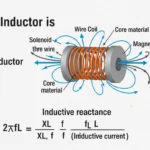
Difference Between Capacitor and Inductor
| Feature | Capacitor | Inductor |
| Stores Energy In | Electric field | Magnetic field |
| Opposes Change In | Voltage | Current |
| Behavior in DC | Blocks after charging | Acts like short circuit |
| Unit | Farad | Henry |
| Common Use | Filtering | Choking |
Understanding the difference between capacitor and inductor helps in circuit design.
Selection Guide – How to Choose the Right Capacitor
When selecting a capacitor, consider:
1. Capacitance Value
Choose according to circuit requirement (microfarad, nanofarad, etc.).
2. Voltage Rating
Always choose voltage rating higher than operating voltage.
3. Type of Capacitor
- Filtering → Electrolytic
- High frequency → Ceramic
- Stable signal → Film
4. Temperature Rating
Check operating temperature range.
5. Application Type
Motor starting requires special motor-run capacitors.
For beginners: Never replace capacitor with lower voltage rating.
Common Problems & Solutions (FAQs Style)
1. Why does capacitor bulge?
Cause:
- Overvoltage
- High temperature
Solution:
- Replace capacitor.
- Check circuit voltage.
2. Why does motor not start?
Possible cause:
- Faulty start capacitor.
Solution:
- Test capacitance using multimeter.
- Replace if weak.
3. Why does power supply output fluctuate?
Cause:
- Weak filter capacitor.
Solution:
- Replace smoothing capacitor.
4. Can capacitor give electric shock?
Yes. Large capacitors store charge even after power is off. Always discharge safely.
12. Future Trends
Capacitor technology is improving rapidly.
New Developments
- Supercapacitors with high energy storage.
- Compact surface-mount capacitors.
- High-voltage DC capacitors for renewable energy.
- Improved power factor correction systems.
- Electric vehicle fast-charging systems.
Supercapacitors are becoming popular for energy backup applications.
Future designs focus on:
- Higher efficiency
- Longer lifespan
- Smaller size
- Better temperature resistance
Conclusion
Now you clearly understand what is a capacitor and why it is essential in electrical and electronic systems. A capacitor stores energy in an electric field and releases it when required.
We discussed the capacitor working principle, types, capacitor applications, and capacitor advantages and disadvantages. You also learned the difference between capacitor and inductor and how to select the right capacitor for your circuit.
As a junior engineer, always check voltage rating, capacitance value, and application before installation. A correct capacitor improves performance and system reliability.
Strong understanding of capacitors will make advanced topics like filters, power electronics, and motor control much easier.
Keep practicing and keep exploring.