
Imagine entering a long staircase in a building at night. You switch on the light from the bottom floor, climb the stairs, and when you reach the top, you turn the same light off using another switch. This simple but very convenient system is made possible by two-way switch wiring. It allows one electrical device, usually a light, to be controlled from two different locations.
Two-way switch wiring is commonly used in homes, offices, hotels, and industrial buildings where lights must be operated from multiple positions. For example, staircases, long corridors, and large rooms often require this type of wiring to improve convenience and safety. Without two-way wiring, a person would have to walk back to the original switch location to turn the light off.
For electrical students, technicians, and engineers, understanding two-way switch wiring working principle is an essential skill. It helps in designing safe and efficient lighting systems in buildings.
In this article, you will learn everything about two-way switch wiring, including its definition, working principle, types, components, applications, advantages and disadvantages, troubleshooting methods, and how to choose the right wiring system. The explanation is written in simple and practical language, just like a senior electrical engineer guiding a junior technician.
What is Two-Way Switch Wiring?
Two-way switch wiring is an electrical wiring method that allows a single light or electrical device to be controlled from two different switch locations.
In simple terms, it is a system where two switches are connected so that either switch can turn the light ON or OFF independently.
Simple Explanation
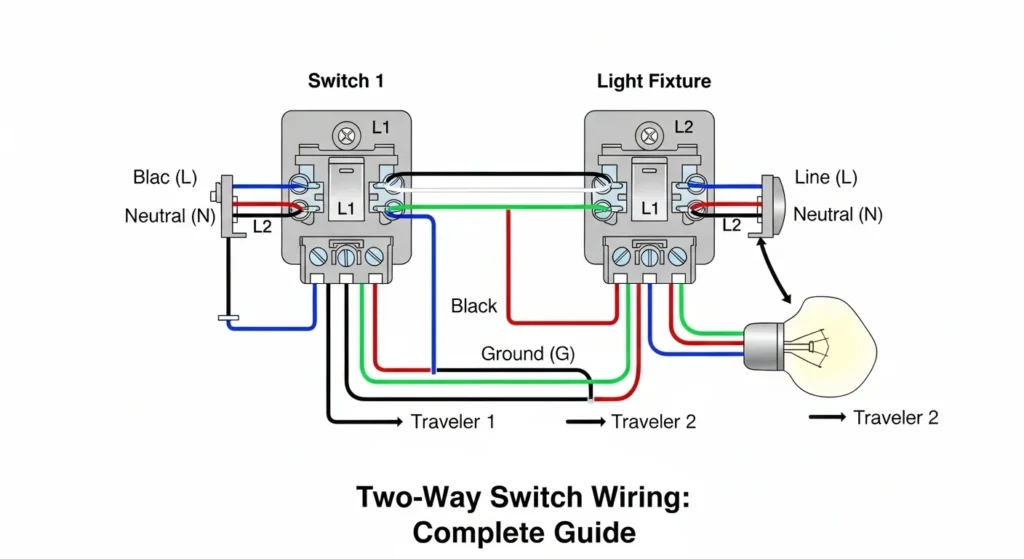
In a standard lighting circuit, a single switch controls the light. However, in two-way switch wiring, two switches are connected using traveler wires, allowing the electrical path to change depending on the switch positions.
Practical Example
Common examples of two-way switch wiring include:
- Staircase lighting systems
- Bedroom lights with switches near the door and bed
- Long hallways or corridors
- Large rooms with multiple entrances
For example, in a bedroom, you may turn on the light from the door and turn it off from a switch near your bed.
Two-Way Switch Wiring Working Principle
The two-way switch wiring working principle is based on changing the path of electrical current between two switches.
Each two-way switch has three terminals:
- Common terminal (COM)
- Traveler terminal 1 (L1)
- Traveler terminal 2 (L2)
Step-by-Step Working Process
- Power Supply Connection
The live wire from the power supply is connected to the common terminal of the first switch.
- Traveler Wires Connection
Two wires connect the traveler terminals of the first switch to the traveler terminals of the second switch.
- Load Connection
The common terminal of the second switch connects to the light or electrical device.
- Circuit Operation
- When both switches connect the same traveler wire, the circuit completes and the light turns ON.
- When switches connect different traveler wires, the circuit breaks and the light turns OFF.
Simple Analogy
Think of two-way switch wiring like two railway track switches controlling the direction of a train. Depending on their position, the train either continues forward or changes track. Similarly, switches change the electrical path.
Types / Classification of Two-Way Switch Wiring
Two-way switch wiring can be implemented using different wiring methods depending on the installation type.
Standard Two-Way Switch Wiring
This is the most common wiring method used in residential buildings.
Features
- Uses two switches
- Requires traveler wires
- Controls one light from two locations
Two-Way Switch Wiring with Intermediate Switch
When lighting needs to be controlled from three or more locations, an intermediate switch is added between the two-way switches.
Features
- Three or more control points
- Used in large staircases or corridors
- Provides greater convenience
Modern Modular Two-Way Switch Wiring
This method uses modern modular switches installed in electrical panels.
Features
- Compact design
- Easy installation
- Modern appearance
Smart Two-Way Switch Wiring
In modern smart homes, digital switches replace traditional switches.
Features
- Remote control via smartphone
- Voice control systems
- Energy monitoring
Main Components of Two-Way Switch Wiring
Two-way switch wiring includes several important electrical components.
Two-Way Switches
These switches contain three terminals and allow current to change direction.
Traveler Wires
These wires connect the two switches and carry current between them.
Electrical Load
The load is usually a light bulb, lamp, or electrical device being controlled.
Power Supply
The live and neutral wires from the electrical supply power the circuit.
Switch Box and Wiring Conduit
These provide safe housing and protection for electrical connections.
Two-Way Switch Wiring Advantages and Disadvantages
Understanding two-way switch wiring advantages and disadvantages helps electricians choose the best wiring system.
Advantages
- Allows control of lights from two locations
- Improves convenience and comfort
- Enhances safety in staircases and hallways
- Reduces unnecessary walking
- Suitable for both residential and commercial buildings
- Compatible with modern modular switches
Disadvantages / Limitations
- Requires additional wiring compared to single switch systems
- Installation may be confusing for beginners
- Slightly higher installation cost
- Incorrect wiring can cause malfunction
Despite these limitations, two-way switch wiring is widely used in modern electrical installations.
Two-Way Switch Wiring Applications
Two-way switch wiring applications are common in many electrical systems.
Home Applications
- Staircase lighting
- Bedroom lighting systems
- Large living rooms
- Hallways and corridors
Commercial Buildings
- Hotels
- Hospitals
- Office buildings
- Shopping malls
Industrial Applications
- Factory corridors
- Warehouse lighting systems
- Control rooms
Public Infrastructure
- Railway stations
- Airports
- Underground parking areas
These applications show how important two-way wiring is for convenient lighting control.
Comparison: Two-Way Switch Wiring vs One-Way Switch Wiring
Understanding the difference between one-way switch and two-way switch wiring is important for beginners.
| Feature | Two-Way Switch Wiring | One-Way Switch Wiring |
|---|---|---|
| Control Locations | Two locations | One location |
| Number of Switches | Two switches | One switch |
| Wiring Complexity | Moderate | Simple |
| Applications | Staircases, corridors | Normal room lighting |
| Convenience | High | Limited |
Two-way wiring offers greater convenience compared to traditional single-switch systems.
Selection Guide: How to Choose the Right Two-Way Switch Wiring
Choosing the correct wiring system ensures safety and efficient operation.
Check Switch Quality
Use reliable switches with proper electrical ratings.
Choose Proper Wire Size
Wires must support the electrical load safely.
Follow Electrical Standards
Ensure installation follows electrical safety codes.
Consider Installation Location
Outdoor systems may require weatherproof switches.
Plan Wiring Layout
Proper planning prevents wiring errors during installation.
Common Problems & Solutions
Problem 1: Light Not Turning On
Cause: Incorrect wiring connections
Solution: Check traveler wires and switch terminals.
Problem 2: Light Works from Only One Switch
Cause: Faulty switch or wiring error
Solution: Inspect switch connections.
Problem 3: Flickering Light
Cause: Loose electrical connections
Solution: Tighten wiring terminals.
Problem 4: Switch Not Responding
Cause: Internal switch damage
Solution: Replace the switch.
Future Trends
Electrical wiring technology continues to evolve with modern innovations.
Future developments may include:
- Smart lighting control systems
- Wireless switch technology
- Touch-sensitive switches
- Energy-efficient automation systems
- Integration with smart home platforms
These technologies will make lighting control even more convenient and energy efficient.
Conclusion
Two-way switch wiring is an essential electrical wiring system that allows a single light or device to be controlled from two different locations. It is widely used in staircases, hallways, large rooms, and commercial buildings where convenience and safety are important.
Understanding the two-way switch wiring working principle, components, types, applications, advantages and disadvantages is very important for electrical students, engineers, and technicians. Proper installation ensures safe operation and efficient lighting control.
As modern buildings continue to evolve with smart technologies, two-way wiring systems will remain a fundamental concept in electrical installations and building automation.