
Imagine sitting in a small apartment during a hot summer evening. The room feels warm, and there is very little air circulation. A traditional ceiling fan may not provide enough airflow, and installing an air conditioner may not be practical or affordable. In such situations, many people choose a tower fan because it is compact, energy-efficient, and capable of circulating air effectively within a room.
Tower fans have become very popular in modern homes, offices, and small workspaces. Their slim vertical design allows them to fit easily in corners or narrow spaces while still providing strong airflow. Unlike traditional fans with visible blades, tower fans often use internal blade systems and oscillation mechanisms to distribute air evenly.
For electrical students, engineers, and technicians, understanding tower fans is useful because they combine electric motors, airflow systems, electronic controls, and mechanical design. These fans demonstrate how simple electrical devices can improve comfort and energy efficiency in everyday environments.
In this article, we will explain the tower fans working principle, types, main components, advantages, disadvantages, and tower fans applications. We will also discuss the difference between tower fan and pedestal fan, helping beginners understand how different fan designs operate and when to use each one.
What are Tower Fans?
Tower fans are vertical, slim-designed electric fans that circulate air through a tall cylindrical or rectangular housing. They are designed to provide consistent airflow while occupying minimal floor space.
Unlike traditional fans with large external blades, tower fans use internal rotating blades or airflow systems to move air through vents along the height of the fan.
Simple Explanation
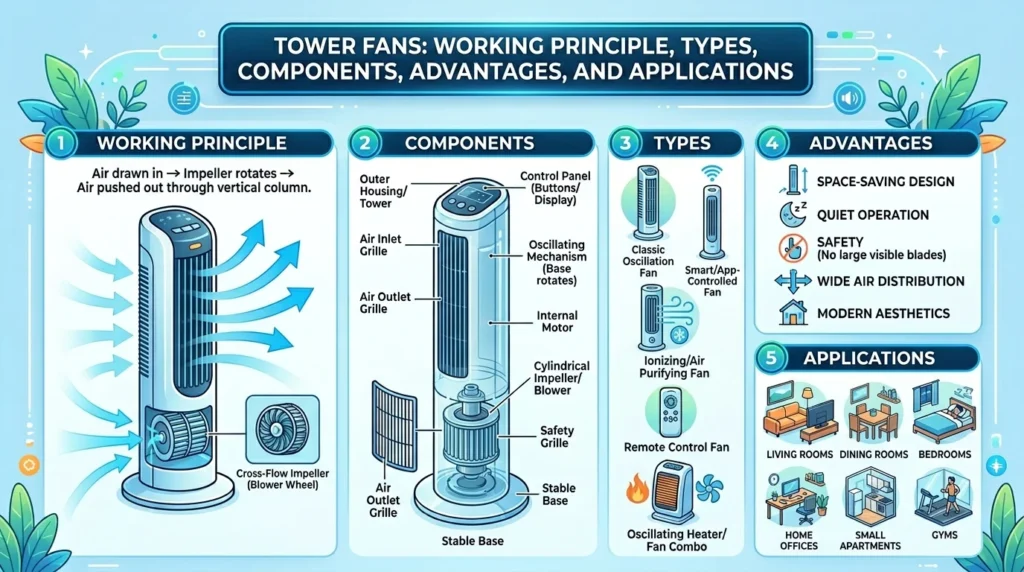
A tower fan pulls air into the base or rear of the unit and pushes it upward through internal blades. The air then exits through narrow vents across the front of the fan, creating a smooth and continuous airflow.
Practical Example
For example, in a small bedroom or office space, a tower fan can be placed in the corner. When it operates, it circulates air throughout the room and improves comfort without occupying much space.
Because of their modern design and quiet operation, tower fans are widely used in homes and apartments.
Tower Fans Working Principle
The tower fans working principle is based on airflow generation using a vertical rotating blade system powered by an electric motor.
Instead of large visible blades, tower fans use a cylindrical fan assembly inside the tower structure.
Step-by-Step Working Process
- Electric motor starts
The electric motor receives electrical power and begins rotating.
- Internal fan blades rotate
Inside the tower, a long cylindrical fan rotates at high speed.
- Air is drawn into the fan
Air enters the tower through intake vents located at the back or bottom.
- Air is accelerated upward
The rotating blades push air upward through the tower.
- Air exits through front vents
Cool moving air exits through the narrow vertical vents.
- Oscillation spreads airflow
Many tower fans rotate left and right to distribute air across the room.
Simple Analogy
Think of a tower fan like a vertical wind tunnel. Air enters from one side, moves upward through spinning blades, and exits evenly along the tower.
Types of Tower Fans
Tower fans are available in several variations depending on features and design.
Standard Tower Fans
Standard tower fans provide basic airflow and oscillation features.
Key characteristics:
- Simple control panel
- Multiple speed settings
- Oscillation function
These fans are commonly used in bedrooms and living rooms.
Bladeless Tower Fans
Bladeless tower fans use advanced airflow technology instead of traditional fan blades.
Features include:
- Smooth airflow
- Safer design without exposed blades
- Modern aesthetic appearance
They are often used in modern homes and offices.
Remote-Control Tower Fans
These tower fans include remote control functionality.
Benefits include:
- Easy operation from a distance
- Timer settings
- Adjustable fan speeds
Smart Tower Fans
Smart tower fans integrate advanced technology such as:
- Wi-Fi connectivity
- Mobile app control
- Smart home integration
These fans are part of modern smart home systems.
Main Components of Tower Fans
Tower fans consist of several electrical and mechanical components that work together to generate airflow.
Electric Motor
The electric motor is the main power source of the fan.
It rotates the internal blade assembly and drives airflow.
Cylindrical Fan Blade Assembly
This long rotating structure moves air vertically inside the tower.
It replaces the traditional large fan blades.
Air Intake Vents
These vents allow air to enter the fan system.
They are usually located at the back or bottom of the fan.
Air Outlet Vents
Air exits through narrow vertical vents along the front of the fan.
These vents help distribute airflow evenly.
Oscillation Mechanism
This mechanism allows the fan to rotate from side to side.
Oscillation helps spread airflow across a wider area.
Control Panel
The control panel allows users to adjust settings such as:
- Fan speed
- Oscillation
- Timer function
Some models include digital displays.
Base and Housing
The base provides stability, while the housing protects internal components.
The tall vertical design is what gives tower fans their name.
Tower Fans Advantages
Understanding tower fans advantages and disadvantages helps users evaluate whether this fan type is suitable for their needs.
Key Advantages
- Space-saving slim design
- Quiet operation compared to traditional fans
- Modern appearance suitable for home décor
- Energy-efficient airflow system
- Even air distribution through vertical vents
- Oscillation improves room circulation
- Safe design with hidden blades
Real-World Benefits
Tower fans are ideal for apartments, offices, and bedrooms where space and noise reduction are important factors.
Disadvantages / Limitations
Although tower fans offer many benefits, they also have some limitations.
Common Limitations
- Airflow is weaker than large pedestal fans
- Cleaning internal components can be difficult
- Higher cost compared to basic fans
- Limited cooling capability in large spaces
- Some models may require regular maintenance
Understanding these limitations helps users select the right fan for their environment.
Tower Fans Applications
The tower fans applications extend across residential and commercial environments.
Home Applications
Tower fans are widely used in:
- Bedrooms
- Living rooms
- Apartments
- Study rooms
They improve air circulation and comfort.
Office Applications
Many offices use tower fans because they are:
- Quiet
- Compact
- Energy efficient
They help maintain comfortable working conditions.
Commercial Spaces
Tower fans can also be used in:
- Small retail stores
- Reception areas
- Waiting rooms
They provide air circulation without occupying much space.
Personal Cooling
Some people place tower fans near desks or beds to provide direct airflow.
Difference Between Tower Fan and Pedestal Fan
Understanding the difference between tower fan and pedestal fan helps users choose the correct fan type.
| Feature | Tower Fan | Pedestal Fan |
|---|---|---|
| Design | Vertical slim tower | Large fan with stand |
| Blade Visibility | Hidden internal blades | Visible rotating blades |
| Space Requirement | Small footprint | Requires more floor space |
| Airflow Strength | Moderate airflow | Strong airflow |
| Noise Level | Generally quieter | Can be louder |
| Appearance | Modern design | Traditional design |
Tower fans are best for compact spaces, while pedestal fans provide stronger airflow.
Selection Guide
Choosing the right tower fan depends on several factors.
Room Size
Larger rooms require tower fans with stronger airflow capacity.
Oscillation Range
Wide oscillation improves air circulation across the room.
Noise Level
Quiet fans are better for bedrooms or offices.
Control Features
Look for features such as:
- Remote control
- Timer settings
- Multiple speed modes
Energy Efficiency
Energy-efficient models reduce electricity consumption.
Common Problems and Solutions
Tower fans may experience common operational issues.
Why is the tower fan not turning on?
Possible causes:
- Power supply issue
- Faulty switch
- Damaged power cord
Solution: Check electrical connections and inspect the power cable.
Why is airflow weak?
Possible cause:
Dust accumulation inside air vents.
Solution:
Clean intake and outlet vents regularly.
Why is the fan making unusual noise?
Cause:
Loose internal components or worn motor bearings.
Solution:
Inspect internal components and perform maintenance.
Why is the oscillation not working?
Cause:
Faulty oscillation motor or mechanical linkage.
Solution:
Repair or replace the oscillation mechanism.
Future Trends
Tower fan technology continues to evolve with new innovations.
Smart Fan Technology
Modern tower fans now include:
- Smart sensors
- Wi-Fi connectivity
- Voice control integration
Energy-Efficient Motors
Advanced motors improve airflow while reducing electricity consumption.
Improved Airflow Design
New aerodynamic designs improve airflow distribution and reduce noise.
Integrated Air Purification
Some advanced tower fans combine fan and air purifier systems to improve indoor air quality.
These innovations will make tower fans more efficient and useful in the future.
Conclusion
Tower fans are modern air circulation devices designed to provide efficient airflow while saving space. Their slim design, quiet operation, and energy efficiency make them a popular choice for homes, offices, and small commercial spaces.
In this article, we discussed the tower fans working principle, types, components, advantages, disadvantages, and tower fans applications. We also explained the difference between tower fan and pedestal fan, helping beginners understand how different fan designs work.
For electrical students, engineers, and technicians, studying tower fans provides insight into airflow mechanics, electric motors, and modern cooling devices.
As technology advances, tower fans will continue to improve with smart features, better efficiency, and advanced airflow systems, making them even more useful in modern environments.