
Imagine a ceiling fan struggling to start on a hot day or an electric vehicle accelerating smoothly on a highway. In both cases, the hidden force behind motion is torque. In electrical motors, torque is the key factor that converts electrical energy into mechanical rotation. Without proper torque, motors cannot perform useful work efficiently.
Understanding the Torque Formula (Motor) is essential for electrical students, engineers, and technicians because it helps in designing, selecting, and troubleshooting electric motors. Whether you are working with industrial machines, home appliances, or electric vehicles, torque plays a major role in performance and efficiency.
In this article, you will learn what motor torque is, how it works, its formula, types, applications, advantages, limitations, and real-world uses. By the end, you will have a clear and practical understanding of how torque controls motor behavior in electrical systems.
What is Torque in a Motor?
Definition
Torque in an electric motor is the turning force that causes the motor shaft to rotate. It is the measure of how much rotational force the motor can produce.
Simple Explanation
Torque is like the “twisting power” of a motor. The higher the torque, the stronger the motor can rotate a load.
Practical Example
- A small fan motor produces low torque
- A crane motor produces very high torque to lift heavy loads
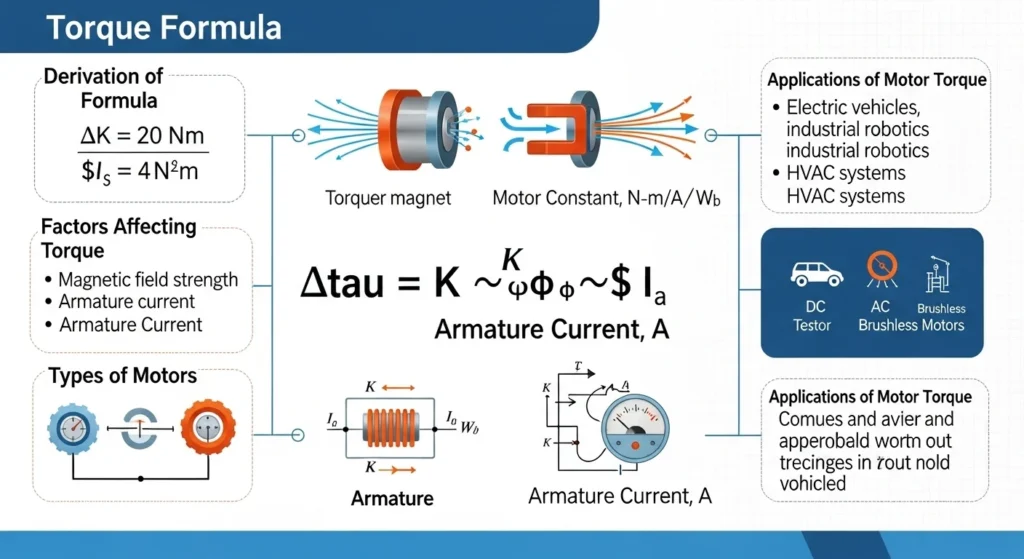
Torque Formula
1. Basic Torque Equation (Most Important)
τ=F×r×sin(θ)
Where:
- τ (Tau) = Torque (Nm)
- F = Force (Newton)
- r = Distance from pivot (meter)
- θ (theta) = Angle between force and lever arm
Special Case:
If force is perpendicular (θ = 90°):
τ=F×r
2. Torque Formula for Electric Motor
T=ωP
Where:
- T = Torque (Nm)
- P = Power (Watts)
- ω (omega) = Angular velocity (rad/s)
3. Motor Torque Formula (RPM Form)
T=2πNP×60
Where:
- N = Speed (RPM)
Conclusion
The most proper torque equations are:
- τ = F × r × sin(θ) (physics basis)
- T = P / ω (engineering basis)
- T = (P × 60) / (2πN) (motor practical formula)
These equations are used in mechanics, electrical machines, and industrial applications.
Basic Formula
T = \frac{P \times 60}{2\pi N}
Where:
- T = Torque (Newton-meter, Nm)
- P = Power (Watts)
- N = Speed (RPM)
Simple Meaning
This formula shows that:
- Higher power increases torque
- Higher speed reduces torque
Working Principle of Torque in Motors
Torque is produced when a current-carrying conductor interacts with a magnetic field.
Step-by-Step Process
- Electric current flows into motor windings
- Magnetic field is created
- Interaction between fields produces force
- Force causes rotation of the rotor
- Rotation generates torque at the shaft
Easy Analogy
Think of torque like pushing a door:
- The stronger you push, the more force (torque) you apply
- The farther from the hinge, the easier it is to rotate
Types of Motor Torque
1. Starting Torque
- Torque produced at the time of starting
- Important for heavy-load machines
2. Running Torque
- Torque during normal operation
- Keeps motor running smoothly
3. Full-Load Torque
- Torque required when motor is fully loaded
- Used for design and rating
4. Pull-Out Torque
- Maximum torque motor can handle before stopping
- Also called breakdown torque
Main Components Affecting Torque
1. Rotor
- Rotating part of motor
- Directly produces mechanical torque
2. Stator
- Creates magnetic field
- Helps induce rotation
3. Air Gap
- Space between rotor and stator
- Affects magnetic strength
4. Windings
- Carry current
- Generate magnetic force
Advantages of Torque in Motors
- Enables mechanical movement
- Controls load handling capacity
- Improves machine performance
- Essential for industrial operations
- Supports variable speed control
Disadvantages / Limitations
- High torque motors consume more power
- Heat generation increases with load
- Requires proper cooling system
- Incorrect torque selection can damage equipment
Applications of Torque in Motors
Home Applications
- Fans
- Washing machines
- Mixers
Industrial Applications
- Conveyor belts
- Lifting cranes
- Pumps
Modern Technology
- Electric vehicles
- Robotics
- CNC machines
Comparison: Torque vs Speed
| Feature | Torque | Speed |
|---|---|---|
| Definition | Rotational force | Rotational motion rate |
| Unit | Nm | RPM |
| Effect | Strength of rotation | How fast it rotates |
| Relationship | Inversely related to speed | Increases when torque decreases |
Selection Guide for Motors Based on Torque
For Beginners
- Identify load type
- Check required starting torque
- Match motor rating with application
Key Tips
- Heavy loads → high torque motors
- Light loads → low torque motors
- Always consider efficiency
Common Problems and Solutions
Problem 1: Motor Not Starting
Cause: Low starting torque
Solution: Use higher torque rated motor
Problem 2: Overheating
Cause: Excess load on motor
Solution: Reduce load or improve cooling
Problem 3: Low Performance
Cause: Incorrect torque-speed balance
Solution: Recalculate torque requirements
Problem 4: Mechanical Vibration
Cause: Uneven torque distribution
Solution: Check rotor alignment
Future Trends in Motor Torque Technology
1. Smart Motors
- AI-based torque control systems
- Real-time adjustment
2. Electric Vehicles
- High torque brushless motors
- Better acceleration performance
3. Energy Efficient Motors
- Reduced power loss
- Optimized torque output
4. Industrial Automation
- Precise torque control in robotics
- High accuracy systems
Conclusion
Torque is one of the most important concepts in electrical motors because it defines the ability of a motor to perform mechanical work. The Torque Formula (Motor) helps engineers understand the relationship between power, speed, and rotational force.
From simple household appliances to advanced industrial machines and electric vehicles, torque plays a critical role in performance and efficiency. Understanding its working principle, types, and applications allows engineers to design better systems and choose the right motors for specific tasks.
For students and beginners, mastering torque is a strong foundation in electrical engineering. It connects theory with real-world applications and helps build practical skills for future technical careers.