
Imagine walking into a large manufacturing plant where machines are cutting metal, conveyor belts are transporting materials, pumps are circulating liquids, and compressors are generating air pressure. Almost all these systems depend on a powerful and reliable machine — the Three Phase Induction Motor.
This motor is considered the backbone of modern industry. From factories and power plants to water treatment facilities and large commercial buildings, three phase induction motors perform most of the heavy mechanical work. Engineers prefer these motors because they are efficient, durable, and capable of operating continuously for long hours.
For electrical students, engineers, and technicians, understanding the Three Phase Induction Motor is essential. It is one of the most commonly used electrical machines in industrial environments, and knowledge of its operation is fundamental in electrical engineering.
In this article, you will learn the Three Phase Induction Motor working principle, types, components, advantages and disadvantages, and real-world applications. We will also discuss how to select the right motor, common troubleshooting techniques, and the future of motor technology. By the end, you will clearly understand why this motor plays such a critical role in modern electrical systems.
2. What is a Three Phase Induction Motor?
A Three Phase Induction Motor is an electrical machine that converts three-phase alternating current (AC) electrical energy into mechanical energy using the principle of electromagnetic induction.
In this motor, the stator receives three-phase AC supply which creates a rotating magnetic field. This magnetic field induces current in the rotor, causing it to rotate and produce mechanical motion.
Unlike some other motors, the rotor in an induction motor does not require a direct electrical connection. Instead, current is induced in the rotor by the stator’s magnetic field.
Simple Practical Example
Consider a large water pumping station supplying water to a city. A three phase induction motor drives the pump that moves thousands of liters of water every minute. Because of its high power and efficiency, this motor is ideal for such heavy-duty applications.
This is why three phase induction motors are widely used in industries where continuous and reliable operation is required.
3. Three Phase Induction Motor Working Principle
The Three Phase Induction Motor working principle is based on Faraday’s law of electromagnetic induction and the concept of a rotating magnetic field.
When three-phase AC power is supplied to the stator windings, it produces a magnetic field that rotates at a constant speed known as synchronous speed.
This rotating magnetic field cuts across the rotor conductors and induces current in them. The interaction between the rotor current and the magnetic field produces torque that causes the rotor to rotate.
Step-by-Step Working Process
• Step 1: Three Phase Supply Applied
Three-phase AC power is applied to the stator windings.
• Step 2: Rotating Magnetic Field Generated
The stator windings create a rotating magnetic field.
• Step 3: Induced Current in Rotor
The rotating magnetic field cuts the rotor conductors and induces current.
• Step 4: Electromagnetic Force Produced
The magnetic interaction between stator and rotor produces torque.
• Step 5: Rotor Rotation Begins
The rotor starts rotating in the same direction as the rotating magnetic field.
Simple Analogy
Imagine chasing a moving carousel. You try to match its speed but never exactly reach it. Similarly, the rotor follows the rotating magnetic field but always runs slightly slower. This difference is called slip.
4. Types / Classification of Three Phase Induction Motors
The classification of Three Phase Induction Motors is mainly based on rotor construction.
Squirrel Cage Induction Motor
This is the most common type of induction motor.
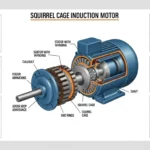
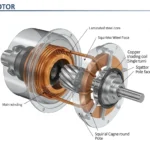
The rotor consists of metal bars connected by end rings, forming a structure similar to a squirrel cage.
Characteristics
- Simple construction
- High reliability
- Low maintenance
- Low cost
Applications
Fans, pumps, compressors, conveyors, and machine tools.
Slip Ring Induction Motor (Wound Rotor Motor)
In this type, the rotor contains windings connected to slip rings.
External resistors can be connected to control starting current and torque.
Features
- High starting torque
- Better speed control
- Suitable for heavy loads
Applications
Cranes, elevators, hoists, and large industrial machines.
5. Main Components
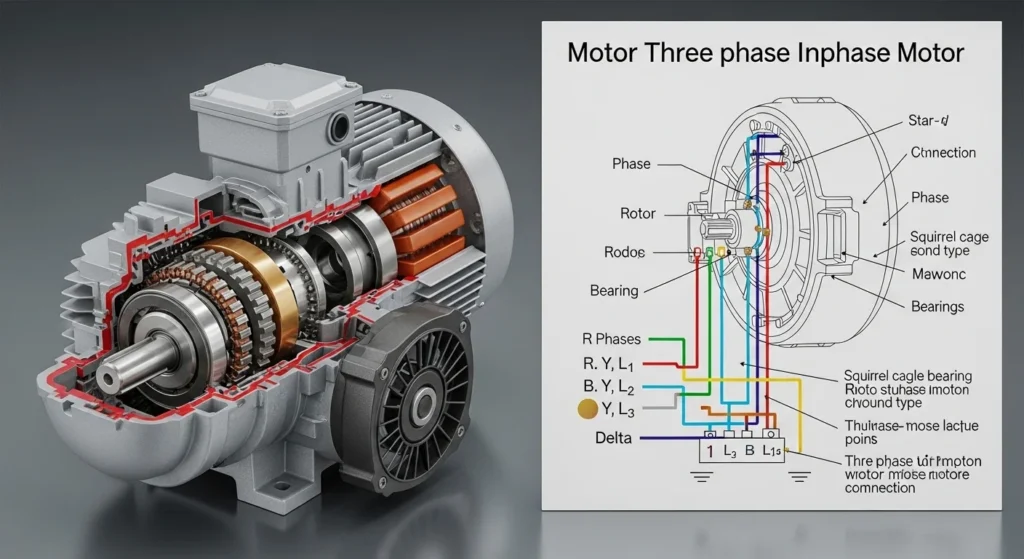
A Three Phase Induction Motor contains several important parts.
Stator
The stator is the stationary outer part of the motor.
It contains three-phase windings that produce the rotating magnetic field.
Rotor
The rotor is the rotating component placed inside the stator.
It receives induced current and produces mechanical rotation.
Air Gap
The air gap is the small space between the stator and rotor.
It allows magnetic interaction while enabling free rotation.
Shaft
The shaft transmits mechanical power from the rotor to the external load.
Bearings
Bearings support the shaft and reduce friction during rotation.
Frame
The frame protects internal parts and provides structural support.
6. Advantages
Understanding the Three Phase Induction Motor advantages and disadvantages helps engineers choose the right motor.
Advantages
- Simple and rugged construction
- Low maintenance requirements
- High efficiency
- Long service life
- Self-starting capability
- Reliable operation
- Suitable for heavy loads
- Cost-effective for industrial use
These advantages make the three phase induction motor the most widely used motor in industrial systems.
7. Disadvantages / Limitations
Despite its many benefits, this motor has some limitations.
- Speed control is difficult without electronic controllers
- High starting current
- Power factor can be low at light loads
- Slip causes slight speed variation
Modern technologies such as variable frequency drives help overcome many of these limitations.
8. Three Phase Induction Motor Applications
The Three Phase Induction Motor applications are found in almost every industrial sector.
Industrial Applications
- Pumps
- Compressors
- Conveyor belts
- Crushers
- Machine tools
Commercial Applications
- HVAC systems
- Elevators
- Escalators
- Cooling towers
Infrastructure Applications
- Water treatment plants
- Oil refineries
- Power stations
- Mining equipment
Modern Technology Applications
- Robotics
- Automated factories
- Electric vehicle components
- Renewable energy systems
Because of their durability and efficiency, these motors are the driving force behind modern industrial operations.
9. Comparison Section
Difference Between Three Phase Induction Motor and Single Phase Motor
| Feature | Three Phase Induction Motor | Single Phase Motor |
|---|---|---|
| Power Supply | Three-phase AC | Single-phase AC |
| Starting | Self-starting | Requires starting mechanism |
| Efficiency | Higher | Lower |
| Power Output | Suitable for heavy loads | Suitable for light loads |
| Industrial Use | Very common | Limited |
Understanding the difference between single phase and three phase motors helps engineers choose the correct motor for different electrical systems.
10. Selection Guide
Selecting the correct Three Phase Induction Motor depends on several factors.
Power Rating
Choose a motor with appropriate power capacity for the load.
Speed Requirements
Determine the required operating speed.
Operating Environment
Consider temperature, dust, moisture, and vibration.
Efficiency Rating
Select energy-efficient motors for long-term cost savings.
Starting Method
Choose the appropriate starting method such as direct-on-line, star-delta, or soft starter.
For beginners, squirrel cage motors are usually the best choice because of their simplicity and reliability.
11. Common Problems & Solutions
Why does the motor overheat?
Possible causes:
- Overloading
- Poor ventilation
- Voltage imbalance
Solution: Reduce load and improve cooling.
Why does the motor vibrate excessively?
Possible causes:
- Shaft misalignment
- Worn bearings
- Rotor imbalance
Solution: Inspect mechanical parts and replace damaged components.
Why does the motor fail to start?
Possible reasons:
- Power supply failure
- Faulty starter
- Overloaded system
Solution: Check electrical connections and reduce load.
12. Future Trends
Motor technology is continuously evolving.
Energy Efficient Motors
New motors are designed to reduce energy consumption.
Smart Motor Monitoring
Sensors and digital monitoring systems detect faults early.
Variable Frequency Drives (VFD)
VFDs allow precise speed control and energy savings.
Industry 4.0 Integration
Smart factories integrate motors with automated control systems.
Electric Transportation
Advanced induction motors are increasingly used in electric vehicles.
These developments will improve efficiency, reliability, and automation in industrial systems.
13. Conclusion
The Three Phase Induction Motor is one of the most important electrical machines used in industry today. Its simple design, high efficiency, and reliable operation make it ideal for powering a wide range of industrial equipment.
In this article, we discussed the Three Phase Induction Motor working principle, types, components, advantages and disadvantages, and practical applications. We also explored the difference between single phase and three phase motors, which helps engineers choose the right machine for different systems.
For electrical students, technicians, and engineers, understanding this motor is essential because it forms the foundation of many industrial drive systems.
As technology continues to advance with smart controls, energy-efficient designs, and automation, three phase induction motors will remain a vital part of modern electrical engineering and industrial infrastructure.