
Imagine installing electrical wiring in a modern building where multiple circuits must run from the main distribution board to different rooms. Instead of using several individual wires separately, electricians often use a single cable that contains multiple insulated conductors inside one protective jacket. This type of cable is known as a Multi Core Cable.
In electrical installations, safety, organization, and efficiency are very important. Multi core cables help simplify complex wiring systems by combining several conductors in a single cable structure. They are widely used in homes, industries, control panels, machines, and power distribution systems.
For electrical students, engineers, and technicians, understanding multi core cables is essential because they are used in almost every electrical project. These cables reduce installation time, improve safety, and protect wires from mechanical damage.
In this article, you will learn everything about Multi Core Cable, including its definition, multi core cable working principle, types, components, advantages, disadvantages, applications, and selection tips. By the end, you will have a clear understanding of how these cables work and where they are used in modern electrical systems.
2. What is Multi Core Cable?
A Multi Core Cable is an electrical cable that contains two or more insulated conductors (cores) inside a single outer protective sheath.
Each core carries electrical current independently, but all the conductors are protected within the same cable jacket.
In simple words, a multi core cable is a bundle of multiple wires enclosed inside one cable covering.
Simple Explanation
Instead of running several single wires separately, engineers combine them into one cable to make installation easier and safer.
Practical Example
In a three-phase power system, a cable may contain:
- One core for Phase R
- One core for Phase Y
- One core for Phase B
- One core for Neutral
- One core for Earth
This type of cable is commonly used in industrial power distribution and motor connections.
3. Multi Core Cable Working Principle
The multi core cable working principle is based on the transmission of electrical current through multiple insulated conductors that are grouped together within a protective outer sheath.
Each conductor inside the cable carries electrical current separately but remains electrically isolated from the others through insulation.
Step-by-Step Working
- Power Source Connection
Electrical power enters the cable through the conductor terminals. - Current Flow Through Individual Cores
Each conductor carries current to different electrical devices or circuits. - Insulation Protection
The insulation around each conductor prevents electrical contact between cores. - Outer Sheath Protection
The outer jacket protects the cable from moisture, heat, and mechanical damage. - Safe Power Distribution
Electricity reaches its destination safely without interference between conductors.
Easy Analogy
Think of a multi core cable like a bundle of water pipes inside a large protective pipe.
- Each small pipe carries water separately.
- The large outer pipe protects all of them together.
Similarly, each conductor inside the cable carries electricity independently while the outer sheath provides protection.
4. Types / Classification of Multi Core Cables
Multi core cables are classified based on the number of conductors and their applications.
Two Core Cable
Two core cables contain two insulated conductors.
Typical use:
- Single-phase electrical circuits
- Small appliances
- Lighting circuits
One conductor usually carries phase, and the other carries neutral.
Three Core Cable
Three core cables contain three conductors.
Common applications:
- Single-phase power with earth
- Small motors
- Household electrical wiring
Example:
- Phase
- Neutral
- Earth
Four Core Cable
Four core cables are commonly used in three-phase electrical systems.
Typical conductors include:
- Three phases
- One neutral conductor
They are often used in industrial power distribution.
Five Core Cable
Five core cables include:
- Three phases
- One neutral
- One earth conductor
These cables are commonly used in industrial machines and control systems.
Armored Multi Core Cable
Armored cables include a metal protective layer (steel wire armor) around the cable.
Advantages:
- Mechanical protection
- Suitable for underground installation
- Resistant to external damage
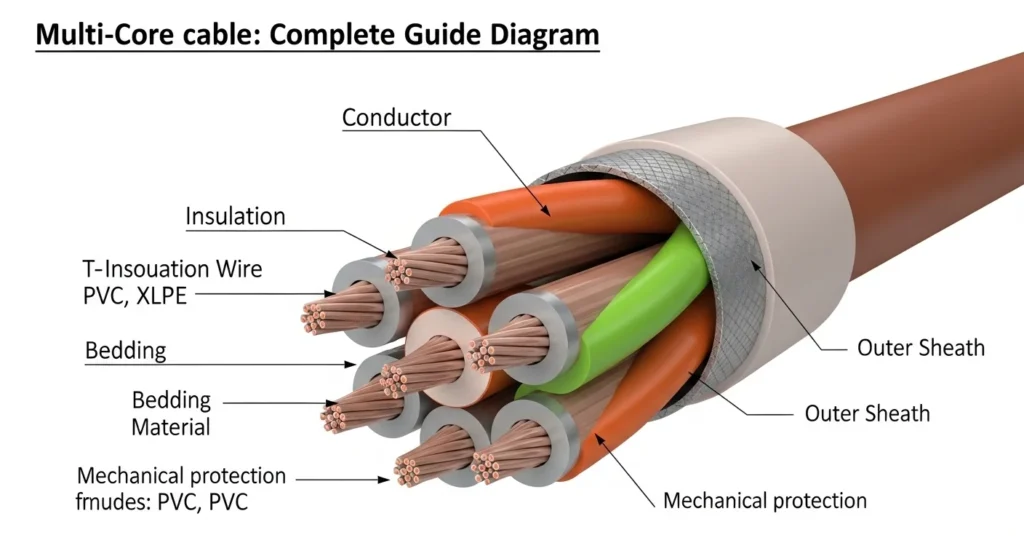
5. Main Components of Multi Core Cable
Multi core cables consist of several important parts that ensure safe and reliable electrical transmission.
Conductor
The conductor carries electrical current.
Common materials:
- Copper (high conductivity)
- Aluminum (lightweight and economical)
Insulation
Insulation surrounds each conductor and prevents electrical leakage or short circuits.
Common insulation materials include:
- PVC (Polyvinyl Chloride)
- XLPE (Cross-linked Polyethylene)
- Rubber insulation
Inner Sheath
The inner sheath holds all insulated conductors together and provides additional protection.
Armoring (Optional)
Some cables include steel wire or aluminum armor for mechanical protection.
Armored cables are used in underground or industrial installations.
Outer Sheath
The outer sheath protects the cable from:
- Moisture
- Chemicals
- Mechanical damage
- Environmental conditions
It is usually made of PVC or polyethylene.
6. Multi Core Cable Advantages
There are many benefits of using multi core cables in electrical systems.
- Simplified Wiring Installation
Multiple conductors are combined in one cable. - Improved Safety
Proper insulation reduces the risk of short circuits. - Space Saving
One cable replaces several individual wires. - Better Mechanical Protection
Outer sheath protects all conductors. - Neat Electrical Layout
Wiring systems become organized and easier to manage. - Reduced Installation Time
Electricians install fewer cables. - Versatility
Suitable for power, control, and signal transmission.
These benefits explain the popularity of multi core cables in modern electrical installations.
7. Multi Core Cable Disadvantages / Limitations
Despite many advantages, there are also some limitations.
- Higher Initial Cost compared to single core cables
- Heat Dissipation Limitations when many conductors carry heavy current
- Difficult Repairs if one conductor inside the cable is damaged
- Less Flexible in large size cables
However, proper design and installation usually minimize these issues.
8. Multi Core Cable Applications
Multi core cables are widely used in residential, commercial, and industrial systems.
Residential Applications
- House wiring systems
- Air conditioner connections
- Water pump motors
- Lighting circuits
Industrial Applications
- Power distribution systems
- Electric motors
- Machine control wiring
- Manufacturing equipment
Control Systems
Multi core cables are used in:
- Control panels
- Automation systems
- PLC wiring
Communication Systems
Special multi core cables transmit:
- Signals
- Data
- Control commands
Underground Power Distribution
Armored multi core cables are commonly used for underground electrical networks.
These multi core cable applications make them essential in modern electrical engineering.
9. Comparison Section
Difference Between Single Core Cable and Multi Core Cable
| Feature | Single Core Cable | Multi Core Cable |
|---|---|---|
| Number of Conductors | One | Two or more |
| Installation | Requires multiple cables | Single cable installation |
| Space Requirement | More space | Compact wiring |
| Flexibility | Higher flexibility | Slightly less flexible |
| Applications | Simple circuits | Complex power and control circuits |
Understanding the difference between single core cable and multi core cable helps engineers select the correct cable for electrical projects.
10. Selection Guide
Choosing the right multi core cable requires careful consideration of several factors.
Current Rating
Ensure the cable can safely carry the required electrical current.
Voltage Rating
Choose cables suitable for the system voltage (low voltage, medium voltage, etc.).
Number of Cores
Select based on circuit requirements.
Examples:
- 2 core for simple circuits
- 3 core for single-phase systems
- 4 or 5 core for three-phase systems
Insulation Type
Different environments require different insulation materials.
Examples:
- PVC for general wiring
- XLPE for higher temperature resistance
Environmental Conditions
Consider factors like:
- Moisture
- Heat
- Chemicals
- Mechanical stress
Installation Method
Cables may be installed:
- Underground
- In cable trays
- Inside conduits
Proper selection improves system safety and durability.
11. Common Problems & Solutions
Why does a multi core cable overheat?
Possible reasons include:
- Overloading
- Poor ventilation
- Incorrect cable size
Solution: Use proper cable sizing and ensure adequate cooling.
What causes insulation damage?
Common causes include:
- Mechanical stress
- High temperature
- Chemical exposure
Solution: Use armored cables or protective conduits.
Why does voltage drop occur?
Voltage drop may occur due to:
- Long cable distance
- Small conductor size
Solution: Use thicker cables with higher current capacity.
Can one damaged core affect the entire cable?
Yes. If one conductor fails, the entire cable may need replacement.
Regular inspection helps prevent failures.
12. Future Trends
Electrical cable technology continues to evolve to meet modern power demands.
High-Efficiency Insulation Materials
New insulation materials improve heat resistance and energy efficiency.
Smart Monitoring Cables
Future cables may include embedded sensors to monitor temperature and electrical performance.
Fire-Resistant Cables
Advanced cables can continue operating during fires, improving safety in buildings.
Environmentally Friendly Materials
Manufacturers are developing eco-friendly cable materials that reduce environmental impact.
Compact High-Power Cables
New designs allow higher current capacity in smaller cable sizes.
These innovations will improve the reliability and safety of electrical systems.
13. Conclusion
Multi core cables play a vital role in modern electrical systems because they allow multiple conductors to operate safely within a single cable structure. This design simplifies electrical installations and improves protection for conductors.
Understanding the multi core cable working principle, types, components, and applications is essential for electrical students, engineers, and technicians. These cables are widely used in homes, industries, control panels, and power distribution systems.
Although multi core cables may have some limitations, such as higher initial cost and heat management challenges, their benefits greatly outweigh the disadvantages. Proper cable selection, installation, and maintenance ensure safe and efficient operation.
As electrical technology continues to evolve, advanced multi core cables with better insulation, monitoring systems, and improved safety features will become even more important in modern power networks.