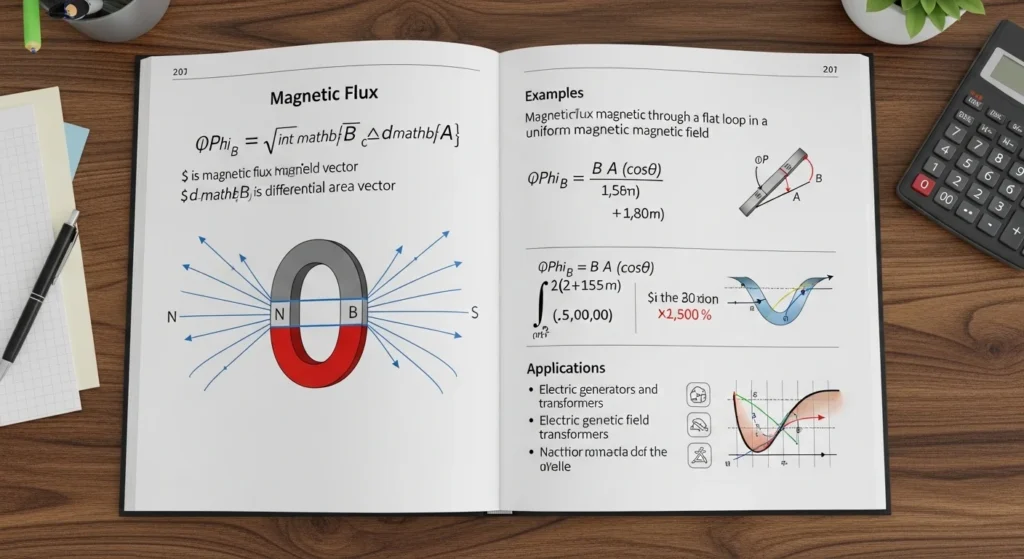

Magnetic flux is a fundamental concept in physics and electrical engineering that helps us understand how magnetic fields interact with surfaces. The magnetic flux formula is widely used in real-world applications such as electric generators, transformers, and motors.
For beginners, magnetic flux may seem like a complex topic, but it becomes easy to understand when explained step by step. In simple terms, magnetic flux measures the amount of magnetic field passing through a surface.
This guide will explain the magnetic flux formula in a simple and clear way, along with its meaning, units, examples, and practical applications.
What Is Magnetic Flux?
Magnetic flux is the total number of magnetic field lines passing through a given surface area.
Simple Explanation
- More magnetic field lines = higher magnetic flux
- Fewer magnetic field lines = lower magnetic flux
It depends on three main factors:
- Strength of the magnetic field
- Area of the surface
- Angle between the field and the surface
Magnetic Flux Formula
The standard magnetic flux formula is:
\Phi = B A \cos\theta
Meaning of Symbols
- Φ (Phi) = Magnetic flux
- B = Magnetic field strength (Tesla)
- A = Area (square meters)
- θ (theta) = Angle between magnetic field and surface
Understanding the Magnetic Flux Formula
When θ = 0°
- Cos(0°) = 1
- Maximum magnetic flux
This means the magnetic field is directly perpendicular to the surface.
When θ = 90°
- Cos(90°) = 0
- Magnetic flux becomes zero
This means the magnetic field is parallel to the surface.
Key Concept
The angle plays a very important role in determining how much magnetic field actually passes through the surface.
Unit of Magnetic Flux
The SI unit of magnetic flux is:
- Weber (Wb)
Definition of Weber
1 Weber is the magnetic flux when a magnetic field of 1 Tesla passes through an area of 1 square meter at a perpendicular angle.
Types of Magnetic Flux
Uniform Magnetic Flux
- Magnetic field is constant
- Same amount of flux across the surface
Non-Uniform Magnetic Flux
- Magnetic field varies across the surface
- Flux is different at different points
History of Magnetic Flux
Magnetic flux is closely related to the development of electromagnetism.
Early Discoveries
Scientists discovered that magnetic fields can influence electric currents.
Faraday’s Contribution
Michael Faraday discovered that changing magnetic flux can produce electricity. This led to the invention of generators.
Modern Developments
Today, magnetic flux is used in:
- Power generation
- Electrical machines
- Electronics
Magnetic Flux in Electromagnetic Induction
Magnetic flux plays a key role in electromagnetic induction.
Faraday’s Law
- Changing magnetic flux produces electric current
- This principle is used in generators
Factors Affecting Magnetic Flux
Magnetic Field Strength (B)
- Stronger field → more flux
- Weaker field → less flux
Area (A)
- Larger area → more flux
- Smaller area → less flux
Angle (θ)
- Smaller angle → higher flux
- Larger angle → lower flux
Applications of Magnetic Flux Formula
Electric Generators
- Convert mechanical energy into electrical energy
- Use changing magnetic flux
Transformers
- Transfer electrical energy between circuits
- Work based on magnetic flux
Electric Motors
- Convert electrical energy into mechanical motion
- Depend on magnetic fields and flux
Inductors and Coils
- Store energy in magnetic fields
- Used in electronic circuits
Magnetic Flux in Daily Life
Magnetic flux is used in many everyday devices:
- Fans
- Washing machines
- Mobile chargers
- Power stations
Techniques to Understand Magnetic Flux Easily
Visualizing Field Lines
Imagine magnetic field lines passing through a surface like threads through a net.
Using Diagrams
Drawing simple diagrams helps in understanding angle and area effects.
Practical Experiments
Using magnets and coils can demonstrate magnetic flux concepts.
Common Mistakes in Magnetic Flux
- Ignoring the angle (θ)
- Confusing magnetic flux with magnetic field
- Using incorrect units
Solved Example
Example Problem
Find magnetic flux when:
- B = 2 Tesla
- A = 3 m²
- θ = 0°
Solution
Φ = B × A × cos(0°)
Φ = 2 × 3 × 1
Φ = 6 Weber
Advantages of Understanding Magnetic Flux
For Students
- Helps in physics exams
- Builds strong concepts
For Engineers
- Useful in electrical system design
- Helps in machine analysis
For Beginners
- Easy to learn basic electromagnetism
- Improves technical knowledge
Interesting Facts About Magnetic Flux
- Magnetic flux cannot be seen directly
- It is represented using field lines
- It plays a key role in electricity generation
- It is essential in modern technology
How Magnetic Flux Impacts Technology
- Enables power generation
- Improves efficiency of machines
- Supports renewable energy systems
Tips for Beginners
- Start with basic formulas
- Practice numerical problems
- Understand concepts visually
- Focus on units and angles
Conclusion
The magnetic flux formula is a simple yet powerful concept in physics that helps us understand how magnetic fields interact with surfaces. By learning the formula and its factors, students and beginners can easily grasp the fundamentals of electromagnetism.
Magnetic flux is not just a theoretical idea—it plays a major role in real-life applications such as generators, motors, and transformers. Understanding this concept opens the door to advanced topics in science and engineering.
With practice and clear understanding, anyone can master the magnetic flux formula and apply it in practical situations.